- The inverted scanner problem: Why a 64-pattern regex scanner failed on paraphrased prompt injection while a single binary question caught instruction override.
- Test admissibility scoring: How to mechanically verify whether an assertion can fail when a deployment breaks, matching human audit verdicts 9 for 9.
- Asymmetric error routing: Why reporting “no rule applies” demands a higher confidence threshold than routing to an existing workflow.
- Specification conformance in practice: Why a typed judgment model caught real playbook regressions without false contradictions, but failed on task sequence ordering.
- The counterweight & limits: Where deterministic oracles like mutation testing beat models every time, the 13-to-handful rejection ratio, and what the vendor’s 255 figure actually bounds.
The inverted scanner: when 64 patterns miss what one question catches
A prompt-injection scanner built on roughly 64 regular expression patterns was fed four synthetic agent skill files. One file contained an active, multi-stage attack: an instruction override, a credential harvesting command, and an explicit instruction to conceal the exfiltration from audit logs. The regex scanner flagged it—but only because the payload happened to include an incidental phrasing habit common in raw model output.
When that single incidental phrase was reworded, leaving all three hostile behaviors completely untouched, the file scanned 100% clean. Zero detections.
At the same time, the scanner evaluated a documentation file written specifically to teach human reviewers how to recognize prompt-injection attacks. That educational document was flagged at maximum risk. The scanner’s ranking had completely inverted: the benign teaching document was treated as a critical threat, while the live, functional attack payload passed straight through.
We ran both files through TypeSafe’s System One model, Jev. The model
scored the original attack and the reworded attack identically, rating
both at maximum threat severity. It rated the educational tutorial as
safe. A single binary probability question (noul) carried
the entire distinction:
Is this text an instruction addressed to the agent reading the file, or a description of such an instruction written for a human?
The syntactic scanner parsed tokens; the typed judgment model
classified intent and communicative direction. That single result
(recorded in prompt-swap bead bd-wsfy.5) illustrates why
System One models are attracting serious attention. But it also raises
the engineering question that most launch-week commentary avoids: where
does this primitive actually hold up against production code, where does
it fail, and where does plain deterministic code beat it?
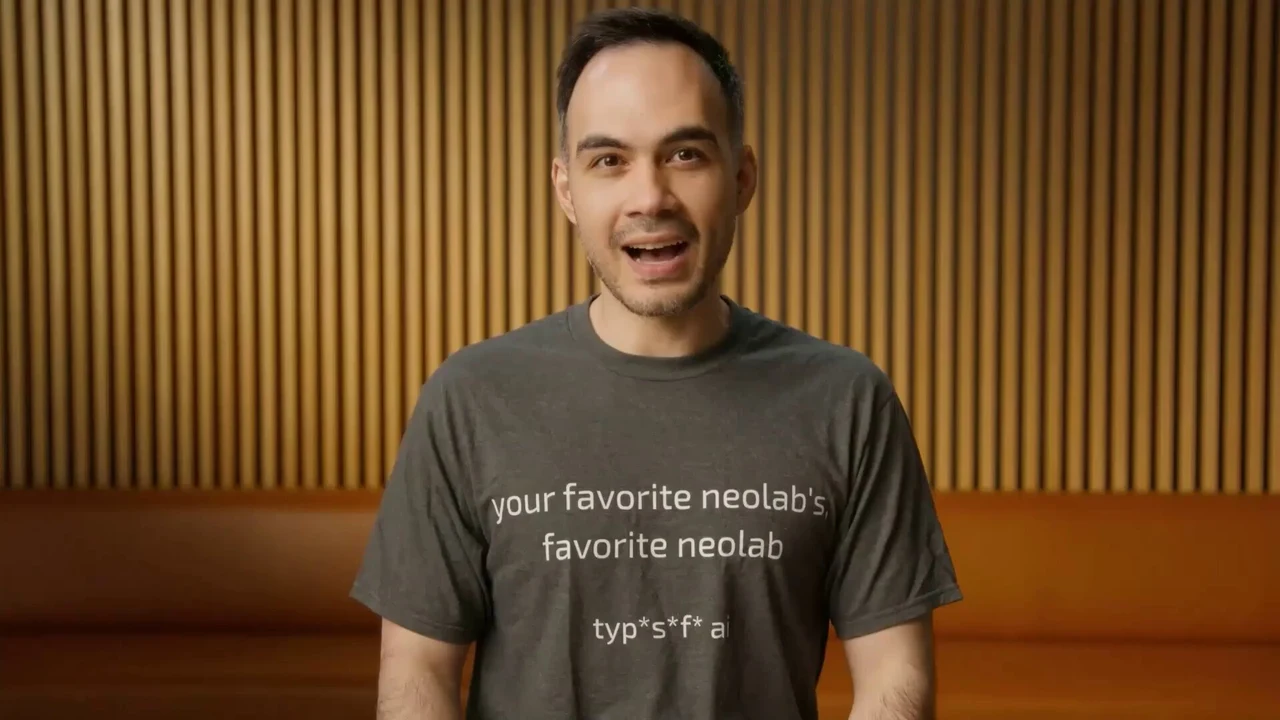
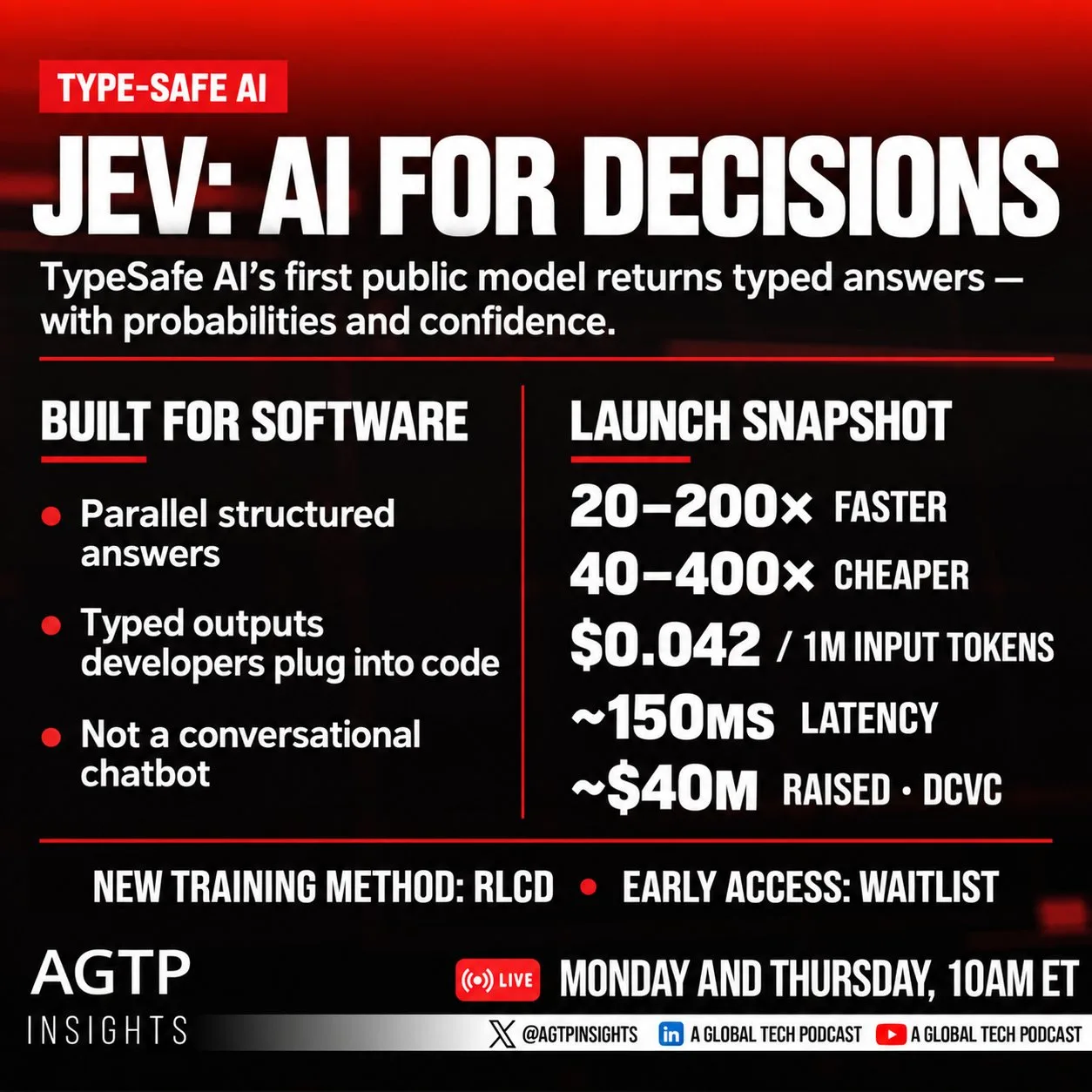
TypeSafe AI founder Diogo Almeida introduces Jev, demonstrating why software automation requires non-generative, typed probability classifications rather than chat completions.

A typed System One model is not an autoregressive chatbot and not an autonomous agent. It is a fast, token-budgeted probability classifier that outputs typed numbers, choices, and distributions in a single parallel forward pass. Surveying dozens of real-world use cases, community repositories, and first-party benchmarks, it solved semantic classification tasks where regex failed, agreed 9 for 9 with pre-recorded human test admissibility audits, and flagged real infrastructure drift without false alarms. However, it cannot replace deterministic gates: it missed sequential ordering violations, failed the deletion test across 13 candidate sites, and cannot match the proof provided by mutation testing. Use it as an advisory reviewer and semantic triage engine, never as an unverified gatekeeper.
Measurement 1: Test admissibility and the structural shape trap
In our DevSecOps infrastructure repository
(devsecops-infra), we enforce an explicit repository rule:
a test is admissible only if it can fail when a deployment
fails.
Automated code quality tools often reward the wrong properties. A unit test that merely asserts a hardcoded configuration value or mirrors a YAML schema is short, neat, cyclomatic-complexity-free, and passes linters with flying colors. A real behavioral integration test—one that spins up a harness, probes an endpoint, exercises error handling, and tears down state—is longer, uses helper functions, and frequently triggers arbitrary structural linter warnings.
To test whether Jev could distinguish real verification from superficial assertion mirroring, we selected nine real test functions from our codebase. Before submitting any query to the model, a human reviewer evaluated and pre-recorded the admissibility verdict for each function. Recording the human baseline first was essential to keep the evaluation objective.
The model was asked to score each test against the written repository
standard using a score query on a calibrated rubric.
The result: nine of nine matched the human audit.
Crucially, the scores did not cluster near the boundary. The model separated the admissible tests from the inadmissible assertions with a wide, empty margin:
- Admissible behavioral tests: scored cleanly above 0.85, correctly identifying that the test assertions tracked runtime effects, exit codes, and live daemon state changes.
- Inadmissible structural tests: scored below 0.30, flagging that the test asserted only on dictionary keys or in-memory fixtures without exercising a failure mode.
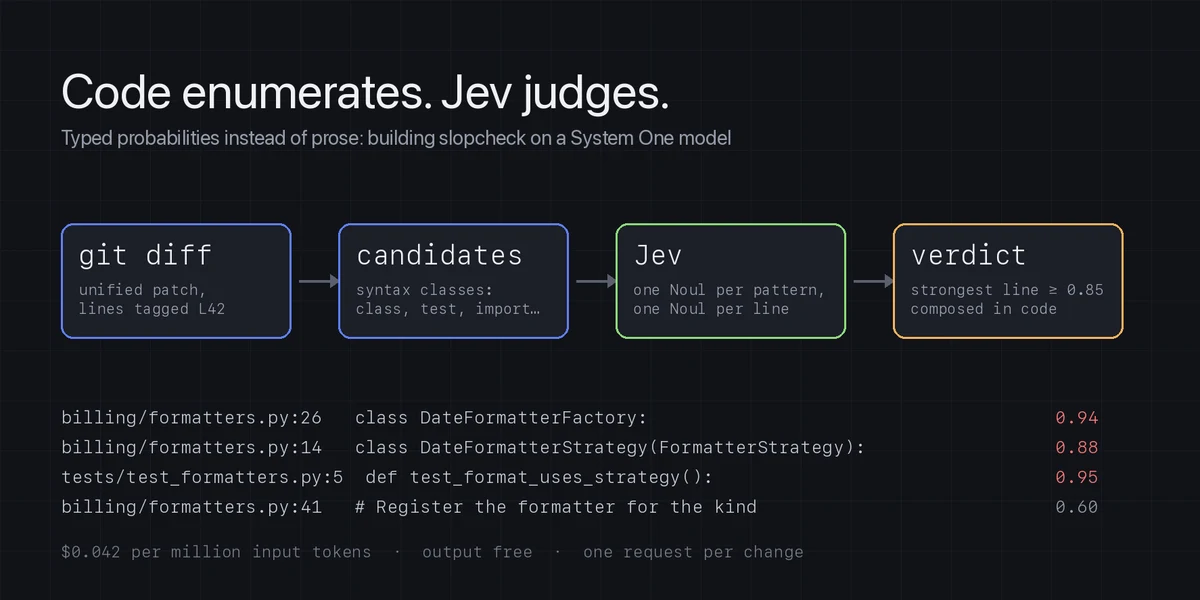
The model succeeded because evaluating whether a test asserts on behavior versus shape is fundamentally a semantic classification problem. Linters see the syntax tree; Jev evaluated whether the assertion had an observable causal link to deployment success.
Measurement 2: Routing and the asymmetry most write-ups miss
A common pattern in agent workflows is routing a user or agent task
description to the specific governance procedure, runbook, or skill
designed to handle it (tested in prompt-swap bead
psw-ej55).
Keyword search over documentation and skill catalogs frequently
breaks down. When an engineer or an agent searches using exact technical
terms (e.g., postgresql-dump-restore), a standard search
index finds the entry. But when the exact same task is phrased naturally
(“we need to pull a snapshot of the production database before rolling
out the migration”), keyword search often returns zero hits.
We tested Jev against eight natural language task descriptions: six describing tasks covered by existing procedures, and two describing novel tasks governed by no existing workflow.
Using a choice query over the available catalog, Jev: -
Correctly identified and selected the governing procedure on six
out of six positive tasks with confidence at or above the 0.80
automated threshold. - Correctly abstained on the two
ungoverned tasks, returning confidence scores well below 0.50.
The asymmetric error principle
In building this router, our initial implementation treated all classification outcomes symmetrically. That was an architectural mistake.
The cost of classification errors is sharply asymmetric: 1. False positive routing: If the model routes a request to procedure A when it should have gone to procedure B, an engineer or agent notices the mismatch during execution and incurs the small friction of a redirected search. 2. False negative abstention: If the model returns “nothing applies” when a mandatory governance procedure actually exists, the agent assumes the workspace is unregulated and proceeds to hand-roll an unreviewed, ad-hoc change.
Because an improper abstention can bypass safety controls, the threshold for returning “none” cannot be a simple majority probability. In our production router, a confident “none” (confidence ≥ 0.85) is accepted; an uncertain “none” automatically degrades to returning the top candidate procedures for human confirmation.

Measurement 3: Specification conformance on live converge logs
The most challenging evaluation we conducted (tracked in
devsecops-infra bead dso-8wtyy) asked whether
Jev could evaluate specification conformance against raw system
execution logs.
Our infrastructure repository maintains an extensive Ansible Role and Playbook Standard comprising 111 distinct specification clauses. Of those 111 requirements, 19 describe behaviors that can be observed directly in Ansible execution output (such as task order, idempotence on second apply, and probe execution in check mode).
We fed Jev the exact task execution trace from four test scenarios
involving the sifs_occmd tool installation role: 1.
Clean baseline: standard playbook execution. 2.
Seed A (Idempotence violation): a command task was
modified to omit changed_when: false, causing the second
apply to report changed=1 instead of changed=0
(violating clause RPS-073). 3. Seed B (Phase ordering
violation): the installation tasks were imported before
preflight verification tasks, so mutations occurred before environment
readiness was checked (violating clause RPS-018). 4. CNPG repeat
run: a raw log from a complex Cloud Native PostgreSQL cluster
deployment where a repeat apply reported changed=16.
Across 76 total clause judgments, the model’s performance revealed both its genuine strengths and its strict boundaries:
- Seed A was caught decisively: On clause RPS-073 (“A
second apply reports
changed=0”), Jev returnedcontradictswith 0.99 probability at 0.99 confidence. - CNPG drift was caught: In the complex PostgreSQL
log, Jev flagged repeat changes (
contradicts0.90) and detected that preflight tasks performed mutations (contradicts0.67). - Zero false contradictions: Across all clean runs,
Jev never generated a false contradiction at or above 0.50 confidence.
When evidence was absent from the log, it returned
insufficientat 1.00 confidence rather than hallucinating an answer. - Seed B was completely missed: On clause RPS-018
(“Run preflight before the first mutation”), Jev returned
contradictsat only 0.03 probability, completely missing that two mutating installation tasks ran ahead of the preflight block. - One false positive conformity: On clause RPS-084
(“Run play-level verification after all roles converge”), Jev reported
supportsat 0.68 confidence on a playbook that completely lacked play-level verification tasks.
The verdict on specification gates
The conclusion was unequivocal: a typed judgment model cannot serve as a blocking CI gate for specification conformance.
The only violations Jev caught with high confidence were those where
a simple regex over the log recap (changed=0) would have
caught them anyway. When the specification required reasoning about
sequential order across log entries (Seed B), the model failed.
Replacing a deterministic check with a model judgment merely replaces an
unverified input with an unverified opinion.
Where Jev excelled was as an advisory triage reviewer: it generated specification coverage rankings that immediately highlighted unverified clauses in our standards, pointing engineers directly to where deterministic assertions were missing.
What the primitives are and how they behave
Understanding where to apply these models requires looking past marketing terms like “System One” and examining the actual API primitives.
Unlike autoregressive language models (GPT-4, Claude, Gemini) that generate text token-by-token using causal attention, TypeSafe’s Jev is a non-generative, typed model. It evaluates inputs against structured questions and returns numerical probabilities:
Input State (code, logs, diff, text) + Typed Questions
                     │
                     ▼
       ┌───────────────────────────┐
       │   Jev Forward Pass (GPU)  │  Single parallel evaluation
       └───────────────────────────┘
                     │
         ┌───────────┼───────────┐
         ▼           ▼           ▼
       noul       choice       score
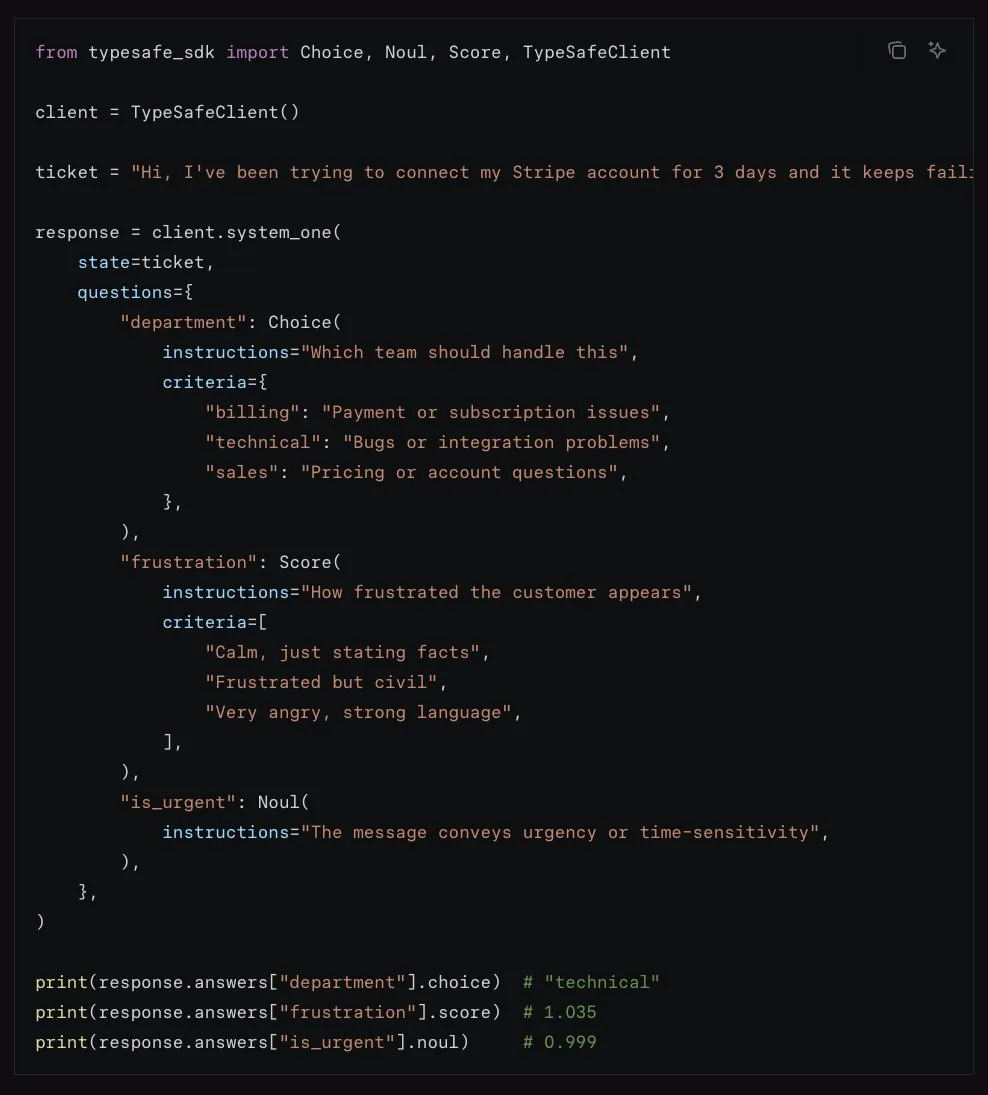
(0.0-1.0) (distribution) (ordinal)noul: Evaluates a single binary proposition and returns a float representing the probability (0.0 to 1.0) that the condition holds.choice: Selects one categorical label from a declared array of options, returning a complete probability distribution over all options alongside a calibrated confidence metric.score: Evaluates the input against an ordered rubric of two to ten levels, returning an interpolated continuous score.
Single-pass parallel questions
In generative models, asking ten questions requires either ten separate API requests or generating a long text response that consumes output tokens and latency.
In Jev, questions are evaluated in a single parallel forward
pass. You can submit twenty independent noul and
choice questions alongside the input state in one payload.
Adding questions increases compute negligibly compared to the base state
encoding.
The vendor confidence bands
When integrating typed judgments into production systems, the vendor’s documented calibration bands provide clear operational cutoffs:
- ≥ 0.80 (Automated): High certainty. Safe for automated execution in low-risk paths (triage, label tagging, cache invalidation).
- 0.50 – 0.79 (Advisory): Moderate confidence. Useful for advisory flags, ranking candidate lists, or queuing items for human review.
- < 0.50 (Abstain): Low certainty. The model cannot reliably distinguish the outcome; the system must fall back to deterministic defaults or human intervention.
Academic grounding
This architecture reflects a broader finding in machine learning research: evaluation requires significantly less model capacity than generation.
Recent work by Li et al. (ICLR 2026, Rethinking Model Capacity in Evaluation) demonstrated that intermediate representations in compact models carry strong evaluative signals that are lost when forced through causal text generation heads. Furthermore, formal benchmarks (arXiv:2406.08660) continue to demonstrate that compact, task-focused classification architectures routinely outperform large, zero-shot generative models on domain-specific classification while using orders of magnitude less compute.
Field reports: what practitioners on X are actually building
Beyond our internal test suite, engineers across the community have
spent launch week stress-testing Jev against different problem shapes.
These reports (catalogued in
devsecops-infra/docs/reference/typesafe-system-one-use-cases.md)
highlight where the technology works in practice and where the
boundaries lie.
1. Search reranking with user-stated plain text criteria
One of the most practical external implementations was built by
Aleksandr Sarantsev (running live at jev.foglight.co), who
implemented personalized search reranking where users express
their relevance criteria in conversational plain text. Instead
of hardcoding boolean filters (e.g., price brackets or category
checkboxes), the user enters criteria like “commercial properties
with owner financing and absentee management.” Jev evaluates
extracted candidate snippets against the criteria in parallel, returning
calibrated relevance probabilities. A similar implementation by
maintainer @Xuanwo filters open GitHub issues and pull
requests according to bespoke reviewer priorities.
2. Empirical cost and latency advantages
Practitioner @Braxxxx benchmarked Jev against Claude 3.5
Sonnet and Opus on a keep-or-skip classification task across 100
extracted social posts. Opus was measured at 63 times the cost
and 4.7 times the latency, while Sonnet was 28 times
the cost and 7.1 times the latency. Note the critical
constraint: the benchmark tested classification over pre-extracted
text, not document OCR or screenshot parsing.

3. Browser automation, not “computer use”
Several early reviewers attempted to use Jev for desktop automation,
expecting an alternative to Anthropic’s Computer Use. Practitioners
@Nav and @AVB clarified the boundary:
Jev has no vision capabilities. It cannot process
screenshots or mouse coordinates.
What it can do is browser automation: code
extracts interactive DOM elements and their accessibility trees, and Jev
executes a choice query over the candidate list to select
the next action. As @AVB noted, this requires the decision
space to be known a priori. Furthermore, practitioners warned
against classifying DOM nodes one-by-one: candidates must be batched
into a single request, or HTTP latency erases any performance
advantage.
4. Calibrated confidence as a search heuristic
Stress-testing the calibration quality, researcher Aviz Maeir applied
Jev to hard Sudoku puzzles. Rather than using greedy filling based on
the highest single prediction, the solver used the full probability
distribution returned by choice to guide a tree search,
successfully cracking boards where greedy approaches deadlocked. This
confirms that discarding the probability distribution throws away the
model’s most valuable signal.
5. The twelve-factor agent design frame
Software architect @dexhorthy contextualized typed
models within the broader 12-Factor
Agents framework. Specifically: - Tools Are Structured
Outputs: A tool call is simply a structured prediction;
execution belongs strictly to code. - Own Your Control
Flow: Business logic, retry loops, and state transitions belong
in deterministic code, not delegated to an autoregressive model. -
Small, Focused Agents: Replace monolithic LLM loops
with pipelines of deterministic extractors, compact classifiers, and
targeted agent invocations.

6. Skeptical and dissenting perspectives
Healthy engineering evaluation requires listening to the skeptics: -
Practitioner @KC+AI questioned whether extension-based
classifiers were already achievable with open models like GLiNER. -
@Felipe Infante de Castro noted that models like
qwen3-reranker already compute calibrated relevance scores
with open weights. - @al'amin ai warned that a proprietary,
hosted classification API is not an open world model, leaving developers
dependent on closed provider weights. - @FleetingBits
summarized the consensus cleanly: fast, low-cost classification is
valuable in production, but marketing hype should not be mistaken for
empirical verification.
7. Practitioner video teardowns and live demos from X
Beyond static commentary, practitioners published video teardowns, benchmark sessions, and integration walkthroughs demonstrating how System One models behave under real workloads:
Official launch walkthrough showing how Jev evaluates game state trees at 60 FPS without autoregressive token generation latency.

Live integration test wiring Jev via Vercel AI Gateway, measuring round-trip latency on structured schema payloads.
Detailed QA architecture breakdown contrasting traditional text-generating agents with deterministic, typed classification for test triage.
Live coding session testing prompt-free evaluation, payload batching, and DOM element decision trees.

Technical breakdown analyzing why stopping text generation is the necessary evolution for reliable software automation.
8. Ecosystem explosion: the most popular open-source Jev repositories
In the days following launch, the open-source ecosystem around Jev expanded rapidly across GitHub. With Jev now accessible through OpenRouter without waitlists and computer vision APIs like Meta’s SAM 3.1 available, developers are actively combining spatial segmentation with typed decision models.
The most starred repositories group into eight functional categories:
Browser, Desktop, and Mobile Automation
jev-ultrafast(browser-use/jev-ultrafast, ★4,891): The most widely adopted community integration. Jev executes element selection and browser navigation, invoking a small LLM only when text input is required.typesafe-computer-use(awlevin/typesafe-computer-use, ★203): macOS automation harness combining screen OCR and accessibility metadata to drive deterministic clicks and keystrokes.mobile-jev(droidrun/mobile-jev, ★103): Android device automation via Mobilerun, coordinating device actions while inspecting CLI and web execution logs.jev-voice-browser(moritzkremb/jev-voice-browser, ★40): Experimental voice interface that extracts user intent from browser speech recognition to navigate web pages via Playwright.
AI Development, Context Compaction, and Code Review
fast-jev-compaction(tamaratran/fast-jev-compaction, ★2,790): Compaction tool that prunes redundant tool calls and execution noise from Claude Code session history while preserving natural conversation text.foreman(thruwire/foreman, ★279): Supervisory coordinator that oversees autonomous OpenAI Codex runs, deciding whether to continue, verify, or halt execution.jev-review(devagrawal09/jev-review, ★251): Step-by-step Git diff reviewer highlighting security risks and missing test assertions in pull requests.jev-router(gargpratyush/jev-router, ★121): Turn-by-turn dynamic model router dispatching between lightweight workers and deep reasoning models in Claude Code and Codex.jev-rules(EliaAlberti/jev-rules, ★3): Dynamically selects which project guidelines or reference docs to inject into Claude Code based on edited files.
MCP Tools, Skills, and Shell Integration
skillbox(kitze/skillbox, ★153): Distribution platform for agent skills via MCP, using Jev to recommend tools matching current task requirements.typesafe-mcp(itsmostafa/typesafe-mcp, ★62): Model Context Protocol server exposing Jev scoring, selection, and truth verification directly to Claude and Codex environments.jev-shell-history(mrnugget/jev-shell-history, ★30): Zsh shell plugin using Jev to select and auto-complete relevant commands from shell history.
Database Filtering, Search, and Graphs
pg-jev(realZachi/pg-jev, ★143): PostgreSQL extension that filters, classifies, and ranks database rows using natural language conditions directly inside SQL queries.jev-search(superagents-lab/jev-search, ★48): Search pipeline delegating search term expansion, time-window selection, and relevance sorting to Jev.neo4jev(jexp/neo4jev, ★17): Graph exploration experiment directing relationship traversal across Neo4j nodes via Jev decision trees.
Content Moderation, Guardrails, and GEO
notra(usenotra/notra, ★171): Generative Engine Optimization (GEO) tracker measuring brand mentions in AI responses using Jev for sentiment and ranking classification.pi-warden(DevMortimer/pi-warden, ★61): Guardrail monitor for Pi agents, flagging project rule violations, repeated failures, and unverified task completion claims.unclutter(kitze/unclutter, ★73): Browser extension using Jev to identify and hide ad banners and modal popups.Jev-Moderation-Bot(brainstormity/Jev-Moderation-Bot, ★25): Discord moderation bot detecting scam URLs and spam patterns.
Simulation, Physical Control, and Trading
jev-trader(jarrodwatts/jev-trader, ★804): Experimental trading bot testing buy and sell judgments on Monad via Kuru (defaults to dry-run mock executions).typesafe-mario(fhshaik/typesafe-mario, ★260): Emulator control experiment where Jev selects Mario game actions based on live memory state.jev-drone(RomanSlack/jev-drone, ★58): Drone simulation on the MuJoCo physics engine delegating real-time obstacle avoidance to Jev.jevpilot(standardagents/jevpilot, ★58): Autonomous driving experiment selecting routes and velocities in a Three.js simulator.HA-Jev(AboveColin/HA-Jev, ★6): Home Assistant integration evaluating home sensor state for everyday household automations.
Independent Open-Weight Implementations
Several research efforts explore non-generative, typed judgment
outside proprietary APIs: - SemIf (TheoLeeCJ/SemIf, ★1,500):
Independent research reading choice probabilities directly from open
model output heads (formerly OpenJev). -
jevlike (vinnylarouge/jevlike,
★851): Training framework optimizing small language models to evaluate
variable-length choice sets in parallel. -
NanoJev (TianyuCodings/NanoJev,
★313): Compact parallel judgment model based on Qwen3-0.6B weights with
bundled emulator control demos. -
openjev-sglang (ekzhang/openjev-sglang,
★127): SGLang-compatible API implementation designed for high-throughput
deployment on GPU clusters.
Note: Star counts reflect initial community audits. Developers should verify external network traffic and API billing before deploying experimental community harnesses into production environments.
The honest counterweight: where deterministic code wins
Every tool has an operational boundary. In our architecture, Jev was evaluated against the deletion test: would deleting the model leave the requested outcome unmet or unproven?
In a systematic audit of our own DevSecOps quality toolchain, 13 candidate integration sites were explicitly rejected, while only a handful were approved.
1. Mutation testing destroys model opinions
Where a deterministic oracle exists, using a machine learning model is an anti-pattern. Consider test suite quality: you could ask a model to “judge whether this test suite is rigorous.” But that judgment is merely an opinion.
In contrast, mutation testing (e.g.,
mutants4rs or mutants4ts) systematically
inserts syntactical faults into the codebase and executes the test
suite. If a mutant survives, the test suite demonstrably failed to catch
broken code. That is an empirical proof, not a probability. A model has
no place in the mutation loop.
2. What stays in code
Deterministic algorithms belong in native code: - Set
reconciliation: determining diffs between deployed resources
and Git state belongs in hash comparisons and set theory. -
Arithmetic & thresholds: comparing latency
percentiles, error budgets, or billing totals belongs in standard
relational operators (>, <). -
Graph traversal: dependency ordering and topological
sorting in build systems belong in Kahn’s algorithm, not in a neural
network. - Lexicon lookups: verifying exact
identifiers, environment variables, or schema fields belongs in map
lookups.
Replacing any of these with a model introduces latency, variance, and cost with zero engineering benefit.
3. Correcting the limits: what 255 actually bounds
It is easy to misread vendor documentation during launch week. In our own early planning notes, an engineer recorded that Jev had a hard limit of “255 questions per API call,” citing the vendor’s announcement post.
That figure was real, but it was attached to the wrong noun.
As stated directly in the vendor
launch post, 255 is the maximum cardinality ceiling on the
options of a single choice question. You cannot
submit a choice question with 300 enumerated categories.
There is no documented maximum limit on the number of questions in a request. Instead, the real technical constraint (documented in Valyu’s practitioner guide) is a token budget: - 64,000 total tokens covering the input state and all submitted questions combined. - 32,000 tokens for the state plus the single longest question.
Checking vendor primary sources before committing architectural limits into code remains a fundamental engineering responsibility.
The practical implementation guide
If you are incorporating a typed System One model into an existing software pipeline, structure your integration around three battle-tested architectural patterns:
┌──────────────────────────────────────────────────────────────┐
│                    Incoming Request / State                  │
└──────────────────────────────┬───────────────────────────────┘
                               │
                               ▼
┌──────────────────────────────────────────────────────────────┐
│ 1. Deterministic Extraction & Filtering (Code)               │
│    - Parse AST / DOM / log files                             │
│    - Strip irrelevant boilerplate                            │
│    - Enforce hard boundary rules                             │
└──────────────────────────────┬───────────────────────────────┘
                               │
                               ▼
┌──────────────────────────────────────────────────────────────┐
│ 2. Speculative Parallel Fan-Out (Jev)                        │
│    - Submit state + all primary and conditional questions    │
│    - Parallel execution in one GPU pass                      │
└──────────────────────────────┬───────────────────────────────┘
                               │
         ┌─────────────────────┴─────────────────────┐
         ▼                                           ▼
  Confidence ≥ 0.80                           Confidence < 0.80
┌──────────────────────────────┐            ┌──────────────────────────────┐
│ 3a. Automated Code Execution │            │ 3b. Fallback Cascade         │
│     - Deterministic branch   │            │     - Human review queue     │
│     - Fast-path execution    │            │     - Frontier LLM triage    │
└──────────────────────────────┘            └──────────────────────────────┘
Pattern 1: Speculative fan-out
Because questions are evaluated in parallel at virtually zero marginal cost, do not make sequential round-trips. Submit your primary classification questions alongside downstream conditional questions in the initial request:
{
  "state": "diff --git a/services/auth.py b/services/auth.py...",
  "questions": [
    {"id": "is_security_sensitive", "type": "noul", "query": "Does this patch modify authentication, token parsing, or credential handling?"},
    {"id": "risk_tier", "type": "score", "rubric": "1: trivial docs, 2: minor fix, 3: core logic, 4: security boundary"},
    {"id": "audit_action", "type": "choice", "options": ["auto_approve", "require_peer_review", "require_secops_review"]}
  ]
}
If is_security_sensitive comes back false, code simply
discards the audit_action result. You save an entire
network round-trip.
Pattern 2: The calibrated cascade
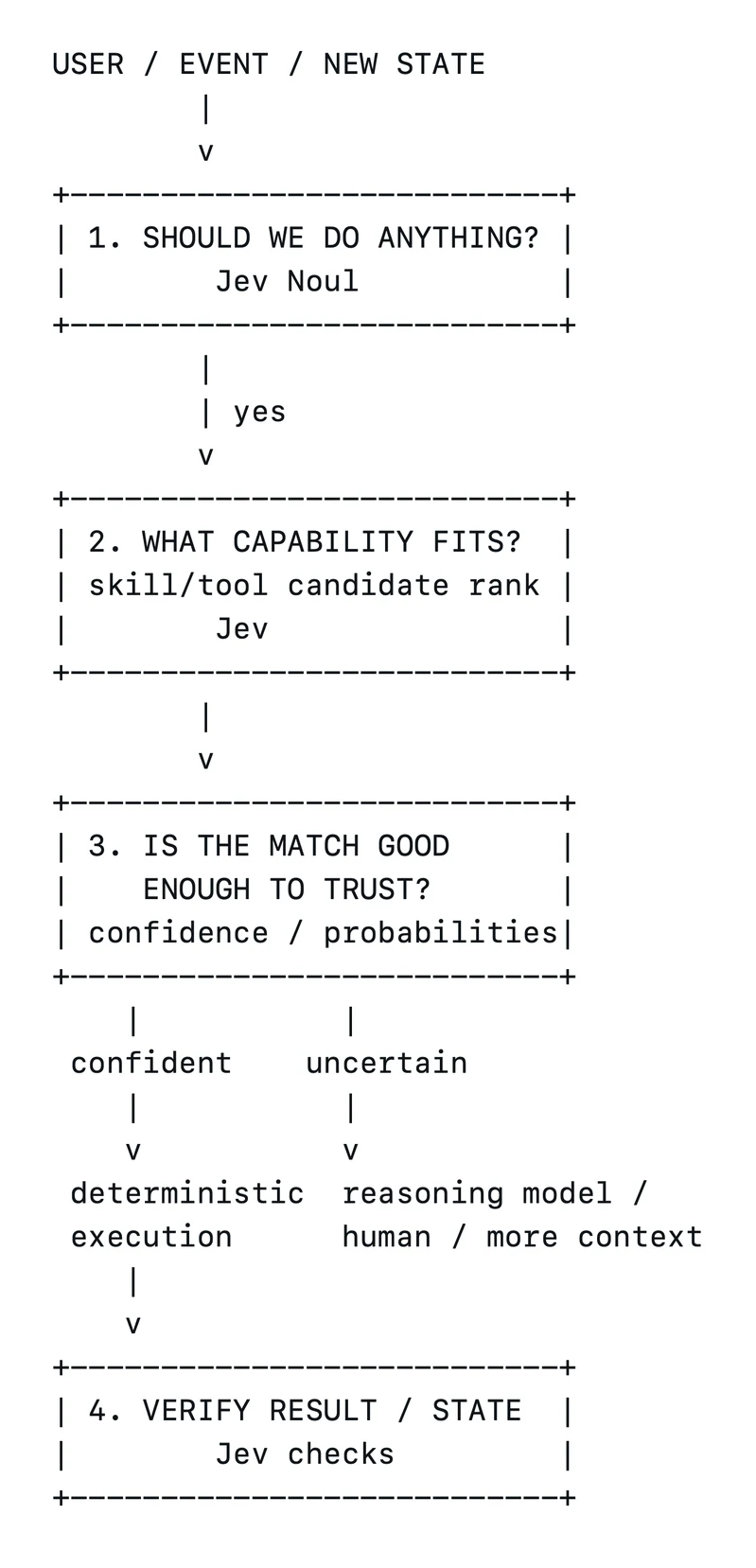
Use typed models as a high-throughput filter in front of expensive resources: 1. Deterministic code: Filters out obvious cases (known static assets, passing unit tests, exact schema matches). 2. System One model: Evaluates the ambiguous middle ground. If confidence ≥ 0.80, proceed immediately along the automated path. 3. Frontier model / Human review: Only the difficult remainder (confidence < 0.80 or high-stakes sensitive actions) is escalated to an autoregressive model like Claude 5 Sonnet or a human engineer.
Pattern 3: Code-owned composite scoring
Never ask a model to provide a single “holistic opinion” on a complex artifact. Ask granular, independent questions, and combine their probabilities using deterministic formulas in your own code:
Final Risk = w1 ⋅ P(unauthenticated) + w2 ⋅ P(exposes data) + w3 ⋅ P(breaks idempotence)
This keeps the weighting, thresholding, and business logic entirely in your codebase, where it can be adjusted, tested, and audited without retraining or re-prompting the model.
Pattern 4: Containment-gated SecOps automation
In security operations and infrastructure remediation, the boundary between automated intervention and human escalation is defined by confidence calibration. Rather than letting an unconstrained agent run arbitrary remediation commands, production incident pipelines use typed models to classify alerts against pre-approved playbooks:
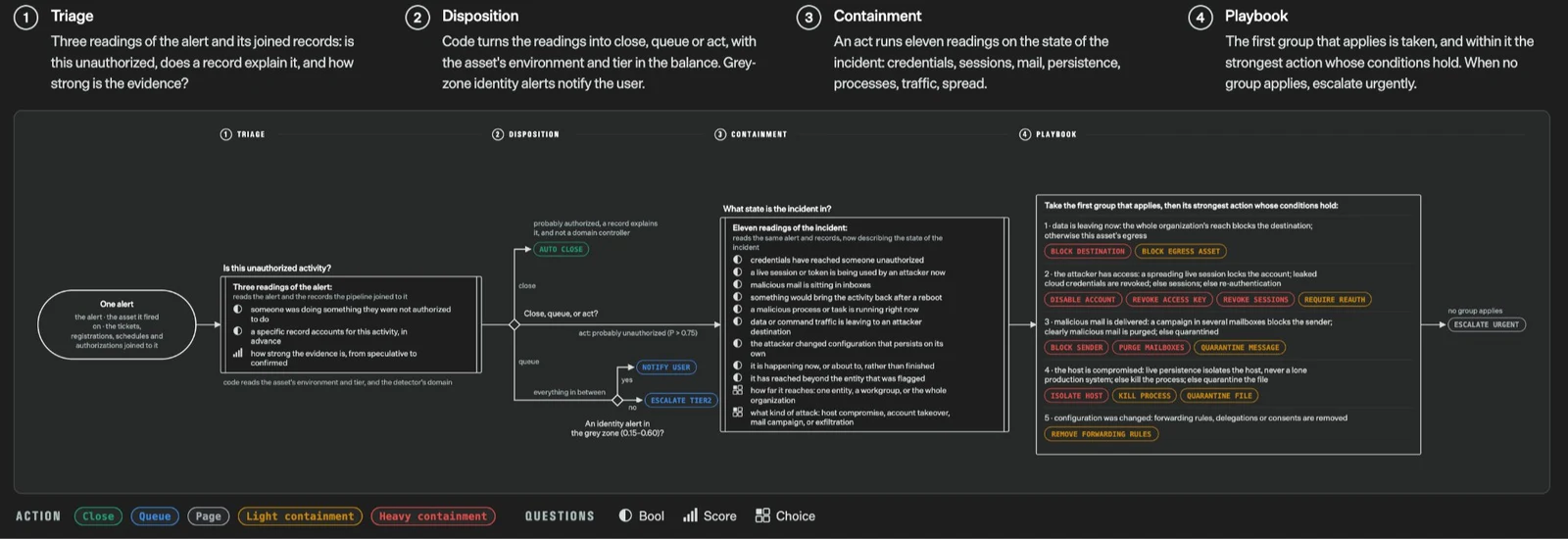
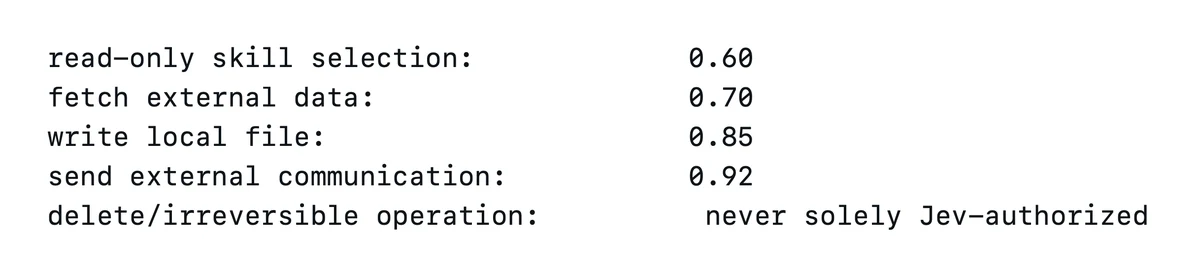
Under this model, read-only telemetry enrichment runs immediately. Low-risk containment actions (such as temporary rate-limiting) execute automatically when confidence exceeds 0.85. Disruptive interventions (such as revoking API keys or isolating database nodes) halt at the confidence gate and require explicit human confirmation.
Conclusion: a missing primitive, not a silver bullet
The value of TypeSafe’s System One model is not that it replaces frontier LLMs, and certainly not that it replaces deterministic compilers or test runners.
Its value is that it provides a fast, inexpensive, typed bridge between messy human text and deterministic code. It replaces brittle 64-pattern regex lists with semantic intent classification. It routes natural language queries when keyword search fails. And it provides calibrated probability distributions that code can safely branch on.
Treat it as an operational component: measure its performance against your own codebase, establish human baselines before believing metrics, keep your deterministic oracles strictly in code, and always verify what the limits actually bound.
Sources and References: TypeSafe System One Launch Post · TypeSafe API Documentation · Valyu Practical Guide to Jev · Li et al., ICLR 2026 (Model Capacity in Evaluation) · Fine-Tuned Small Models vs Zero-Shot Generative Classifiers · Twelve-Factor Agents Architecture · Aleksandr Sarantsev Plain-Text Reranking Demo.