- Empirical Proof Points: Gabriel Olson’s two-minute DuckTales trailer demonstrated 100+ coherent shots from a two-person crew. Charlie Driscoll produced the 22-minute Tales of Grimwicke pilot solo in four weeks. Diane Laidlaw completed the 9.5-minute Galaxy Food in 80 total production hours (8.4 hours per finished minute).
- Video Token Microeconomics: State-of-the-art video models like ByteDance Seedance 2.5 generate roughly 21,600 tokens per second at 720p. Priced at $10.70 per million tokens, raw API video generation costs roughly $0.231 per second ($13.86 per raw minute).
- The Real Feature Math: A 95-minute feature operating at an empirical 18:1 take rejection ratio consumes 1,710 raw minutes of footage (2.21 billion video tokens). This requires $23,700 in raw API compute, or $35,000 to $48,000 using commercial SaaS generation platforms.
- The Labor Ceiling: Across empirical data points, human labor scales between 8.5 and 17 hours per finished minute. A 95-minute feature requires approximately 1,470 labor hours. A lean three-person crew can finish production in four months for $125,000 to $150,000 in labor.
- Total Production Budget: Combined with $28,000 for voice cloning, scoring, and foley, plus $18,000 for mastering and upscaling, a complete theatrical-quality animated feature costs between $200,000 and $310,000.
- Hollywood Comparison: Traditional studio animated features like Kung Fu Panda 4 ($85 million) or Pixar’s Inside Out 2 ($200 million) spend between $900,000 and $2,100,000 per screen minute. The AI-native pipeline delivers a capital reduction factor of several hundredfold.
- The $300 Creator Stack: Solo filmmakers can produce high-density concept trailers using a $300 monthly setup. The core stack combines Midjourney, Luma or Kling, ElevenLabs, and DaVinci Resolve.
- Micro-Budget Funding Playbook: High-density trailers replace speculative pitch decks. Independent creators can finance sub-$350,000 features through model developer grants (such as the Runway AI Film Fund), community crowdfunding (Kickstarter), syndicated micro-angel SAFEs, or serialized web pilots.
- The Human Moat: Tool generation is cheap, but taste, cinematic pacing, continuity discipline, and aggressive multi-track editing remain scarce human skills.
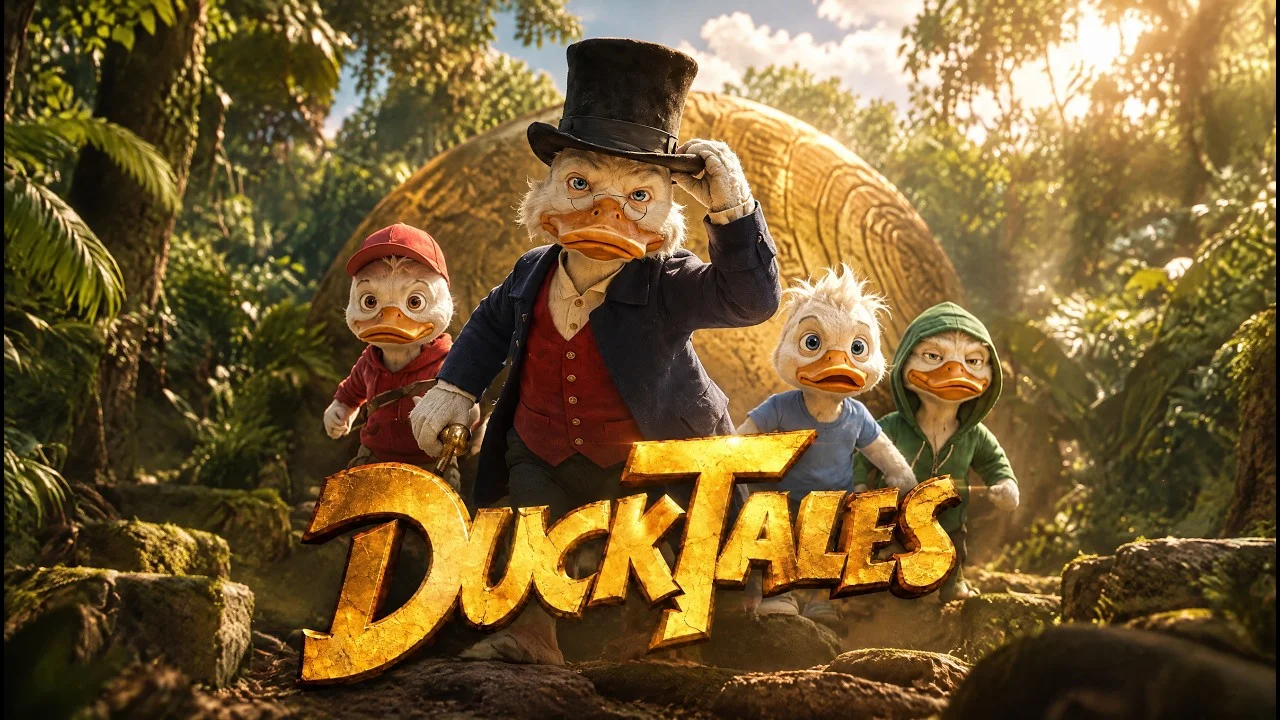
BLUF (Bottom Line Up Front): Generative video has crossed the threshold from toy clips to structured cinematic production. We synthesized generation metrics from Gabriel Olson’s viral DuckTales trailer and Charlie Driscoll’s 22-minute pilot for Tales of Grimwicke with public video token rates. These figures demonstrate that a 95-minute animated feature no longer requires an $80 million studio budget. A disciplined crew of three filmmakers with high aesthetic standards can deliver a theatrical-grade animated film for $200,000 to $350,000 in under five months.
1. The Disruption: Moving Beyond 10-Second Toy Demos
For two years, public discourse around generative video focused on 5-second isolated demonstrations. Online feeds filled with melting faces, drifting fingers, and slow-motion pans of imaginary cybernetic cities. Critics dismissed the technology as incapable of sustaining actual narrative cinema.
That narrative dissolved in 2024 and 2025. A wave of independent filmmakers bypassed the studio system by applying disciplined cinematic workflows to modern video diffusion models.
The benchmark that altered the industry conversation was Gabriel Olson’s two-minute DuckTales concept trailer embedded above. Rather than generating a single unbroken prompt, Olson operated as a traditional director. He established shot lists, camera coverage, character costume bibles, and lighting guides. Over 100 individual shots were cut together with professional pacing, dialogue, and score. The entire production was completed by just two people: Olson directing and generating assets, and editor Jason Pachomski cutting the timeline.
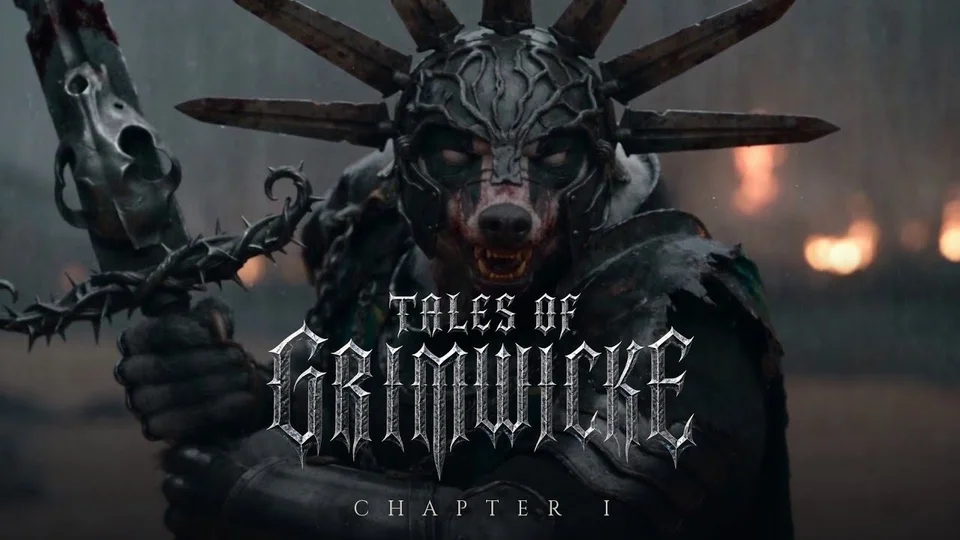
If Olson proved density, Charlie Driscoll proved duration. With Tales of Grimwicke, Driscoll created a full 22-minute narrative pilot containing 350 shots, multiple speaking characters, continuous plot progression, and complex environments. Working entirely solo, Driscoll completed the project in four weeks.
Shortly thereafter, creator Diane Laidlaw logged another data point with Galaxy Food, a 9.5-minute sci-fi animated proof-of-concept completed in 80 total production hours. That represents an empirical efficiency rate of 8.4 hours of human labor per finished screen minute.
When multiple creators independently achieve these throughput rates, we are no longer observing anomalies. We are witnessing the emergence of a repeatable manufacturing process.
2. The Microeconomics of the Video Token
To understand why production costs collapse, we must analyze the microeconomics of generative video inference.
Generative video systems do not render 3D polygon meshes or compute ray bounces across virtual geometry. Instead, they use latent diffusion modelsLatent Diffusion ModelsNeural architectures that synthesize high-resolution video frames by iteratively denoising representations within a compressed spatial-temporal latent space rather than pixel space.Latent Diffusion Spec → to predict sequences of visual tokens across spatial and temporal dimensions.
Consider the token generation dynamics of ByteDance Seedance 2.5, one of the most efficient contemporary video foundation models:
- Resolution: 720p 16:9 widescreen format (1280x720 pixels).
- Temporal Token Density: ~21,600 spatial-temporal tokens generated per second of finished video.
- Inference Pricing: $10.70 per million tokens on direct API endpoints.
- Compute Cost per Second: (21,600 / 1,000,000) * $10.70 = $0.231 per second.
- Compute Cost per Raw Minute: $0.231 * 60 = $13.86 per minute.
At first glance, generating a 95-minute movie at $13.86 per minute suggests a compute cost of only $1,316. However, that assumption ignores the fundamental reality of film direction: the take ratioTake Ratio (Shooting Ratio)The ratio of raw footage recorded to the final edited screen time. In AI film production, it reflects the number of generated variations required to obtain one flawless shot.Shooting Ratio Reference →.
+-----------------------------------------------------------------------------+
|                     GENERATIVE VIDEO TOKEN ECONOMICS                        |
+-----------------------------------------------------------------------------+
| Metric                       | Value              | Notes                   |
| Resolution                   | 720p (1280x720)    | Upscaled to 4K in post  |
| Frame Rate                   | 24 fps             | Standard cinema cadence |
| Spatial-Temporal Tokens/sec  | 21,600 tokens/sec  | ByteDance Seedance 2.5  |
| Raw API Token Cost           | $10.70 / M tokens  | Wholesale inference     |
| Raw Video Cost per Second    | $0.231             | Direct generation       |
| Raw Video Cost per Minute    | $13.86             | Unedited raw generation |
+-----------------------------------------------------------------------------+
In live-action filmmaking, shooting ratios typically range from 10:1 to 30:1. In generative video, models introduce physical hallucinations, limb warping, or drifting eye contact. The filmmaker must perform seed bracketingSeed BracketingGenerating batches of video takes across clustered random seeds while locking prompt and character embeddings, allowing the director to select the take with natural physics.Bracketing Technique →, generating multiple variations of each shot to capture natural motion.
Let us examine empirical take ratios across real productions:
- Commercial / Music Video (High Precision): 20:1 to 25:1 take ratio.
- Short Narrative / Pilot (Grimwicke / Galaxy Food): 12:1 to 15:1 take ratio.
- Full-Length Animated Feature (High Continuity): 18:1 expected take ratio.
For a 95-minute feature film with an 18:1 take ratio:
- Total Finished Screen Time: 95 minutes (5,700 seconds).
- Total Raw Footage Generated: 95 * 18 = 1,710 minutes (28.5 hours).
- Total Video Tokens Generated: 1,710 * 60 * 21,600 = 2,216,160,000 tokens (2.21 billion tokens).
- Direct API Compute Cost: (2.216B / 1,000,000) * $10.70 = $23,713.
If the production utilizes retail creator tiers (such as Runway Unlimited, Luma Studio credits, or Kling Pro bundles) rather than raw API endpoints, platform markup increases compute costs to between $35,000 and $48,000. Even with retail pricing, the compute expenditure for an entire feature film remains below the catering budget of a traditional Hollywood studio.
3. Hollywood vs. The Lean Studio: The Budget Gap
To evaluate this economic shift, contrast it with Hollywood’s traditional cost structures.
A studio animated feature produced by DreamWorks, Pixar, or Walt Disney Animation costs between $80 million and $200 million. Consider recent benchmarks:
- DreamWorks’ Kung Fu Panda 4 (2024): $85,000,000 budget (94 minutes runtime = $904,000 per screen minute).
- Pixar’s Inside Out 2 (2024): $200,000,000 budget (96 minutes runtime = $2,083,000 per screen minute).
- Disney’s Wish (2023): $200,000,000 budget (95 minutes runtime = $2,105,000 per screen minute).
Why does traditional animation cost $1 million to $2 million per minute?
A conventional 3D animated film requires 300 to 600 specialized artists working for three to four years. The production hierarchy includes concept artists, 3D character modelers, rigging specialists, texture artists, layout animators, lighting technicians, cloth and hair simulation engineers, and massive render farm operators. Every movement of every joint must be hand-keyed or mocap-cleaned, simulated, textured, lit, and rendered through multi-pass raytracers.
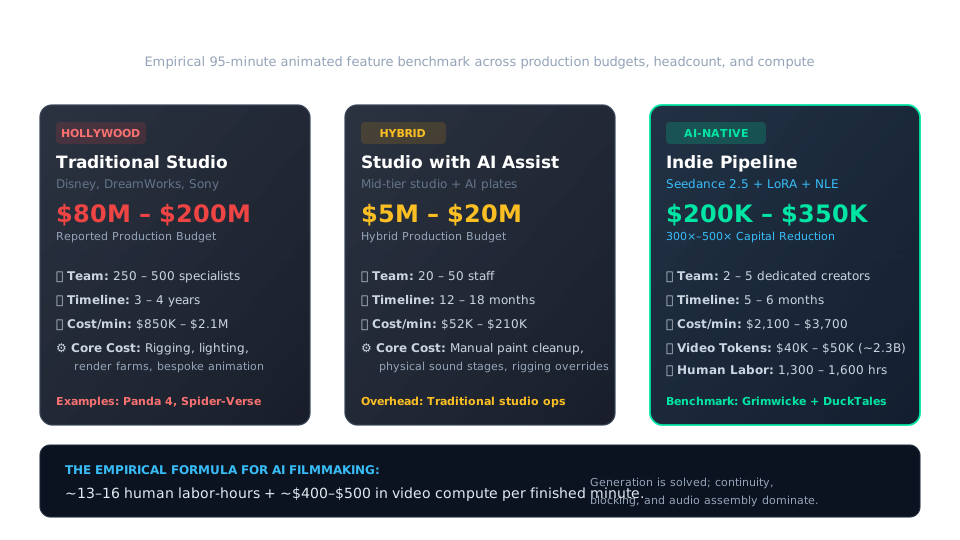
In an AI-native production pipeline, neural diffusion models replace the rigging, texturing, lighting, and rendering departments. The human crew focuses entirely on direction, scriptwriting, character design consistency, and timeline editing.
Let us construct a realistic, fully costed balance sheet for a 95-minute independent animated feature:
+-----------------------------------------------------------------------------+
|              THE $200,000 ANIMATED FEATURE PRODUCTION BUDGET                |
+-----------------------------------------------------------------------------+
| Line Item                    | Budget Range        | Description            |
| Video Inference Compute      | $35,000 - $48,000   | 2.2B tokens, 18:1 take |
| Director / Lead Prompter     | $55,000 - $65,000   | 16 weeks full-time     |
| Editor / NLE Assembly Lead   | $45,000 - $55,000   | 16 weeks full-time     |
| Technical Director (LoRA/AI) | $40,000 - $50,000   | 12 weeks full-time     |
| Voice Synthesis & Casting    | $12,000 - $18,000   | ElevenLabs / SAG-AFTRA |
| Original Score & Music       | $10,000 - $15,000   | Hybrid synthetic score |
| Foley & Sound Design         | $8,000 - $12,000    | Multi-track soundscape |
| 4K AI Upscaling & Mastering  | $10,000 - $15,000   | Topaz Video AI & DCP   |
| Contingency & Legal          | $10,000 - $15,000   | Insurance & copyright  |
| TOTAL PRODUCTION BUDGET      | $225,000 - $293,000 | 95-minute feature      |
+-----------------------------------------------------------------------------+
Even with generous contingency buffers, a professional feature film can be brought to market for less than $300,000. That represents a cost of $2,368 to $3,084 per finished screen minute, representing a capital cost reduction of roughly five hundredfold compared to major studio productions.
4. The 6-Stage AI Production Pipeline Architecture
Achieving this throughput requires moving away from ad-hoc text prompting. A production team must operate a structured six-stage manufacturing pipeline.
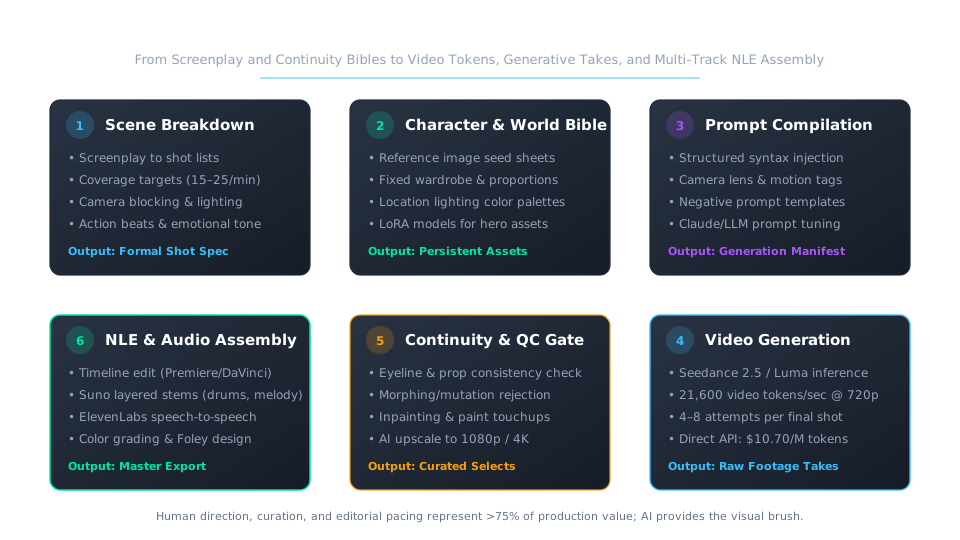
Stage 1: Pre-Production & Structured Script Breakdown
The production begins with a finished screenplay. Rather than generating directly from script text, a technical director breaks the script down into a relational database: - Location Bible: Environmental lighting values, atmospheric haze, color palettes, and architectural textures. - Shot Coverage Charts: Master shots, medium two-shots, over-the-shoulder angles, and close-up reaction coverage. - Motion Vectors: Camera track speeds, focal lengths (such as 35 mm vs. 85 mm anamorphic), and depth-of-field markers.
Stage 2: Character Asset Stacking & Consistency Sheets
The greatest hurdle in AI film production is maintaining character identity across camera cuts. Lean teams solve this by creating LoRA modelsLow-Rank Adaptation (LoRA)A parameter-efficient fine-tuning method that trains small rank-decomposition matrices injected into diffusion layers, freezing base weights while locking specific character facial geometry.LoRA Architecture → or multi-angle 2D turnaround sheets.
The lead prompter generates a 12-pose turnaround sheet for each character in neutral studio lighting: front, profile, 45-degree angle, three-quarters, and back. Every shot prompt conditions on these canonical seed images using image-to-video (I2V) anchors, ensuring that Scrooge McDuck or a fantasy tavernkeeper retains identical facial proportions, scars, and wardrobe details throughout the film.
Stage 3: Shot Generation & Seed Bracketing
The director executes generation runs in focused clusters. For each shot in the storyboard: - The base turnaround image is set as the initial frame. - A concise motion prompt is applied (such as “slow tracking shot, character leans forward, skeptical squint, subtle candle flicker”). - A batch of four to eight variations is generated using seed bracketing. - The director selects the take with the most expressive eyes and stable hand anatomy. Takes displaying physics anomalies are discarded immediately.
Stage 4: Audio Engineering: Voice Synthesis, Foley, and Dynamic Scoring
In cinema, audio carries more than half of the perceived production value. High-end video generation pipelines generate visuals and audio in parallel: - Voice Synthesis: Dialogue lines are generated via ElevenLabs or custom trained voice models, complete with conversational cadence, emotional inflection, and acoustic room reverb. - Foley & Ambience: Footsteps, cloth rustling, door creaks, and environmental wind are pulled from curated SFX libraries and layered onto individual audio stems. - Original Score: Musical beds are generated through specialized models (such as Suno or Udio), decomposed into stems, and edited to fit dramatic scene transitions.
Stage 5: Timeline Assembly & Multi-Track NLE
The generated video clips and audio stems are imported into a professional Non-Linear Editor (NLE)Non-Linear Editor (NLE)Professional video editing software (such as DaVinci Resolve or Adobe Premiere) that enables multi-track cutting, retiming, audio synchronization, and visual effects layering.NLE Editing Guide → like DaVinci Resolve or Adobe Premiere.
This is where the movie is actually made. The editor retimes clips, inserts L-cuts and J-cuts to mask dialogue transitions, splits shots into cutaways, and applies speed ramps to synchronize character actions with dramatic beats.
Stage 6: Post-Color Grading, Grain Injection, and Temporal Upscaling
The final stage eliminates the signature “smooth AI plastic” look: - Optical Flow Smoothing: Micro-jitters between frames are interpolated. - 4K Upscaling: Neural upscalers (such as Topaz Video AI) upscale the 720p base generations to pristine 4K DCI (4096x2160) theatrical resolution. - 35 mm Film Grain Injection: Real scanned film grain is composited over the digital output, harmonizing high-frequency details and binding disparate visual seeds into a cohesive cinematic aesthetic.
5. The Empirical Labor Formula: Hours per Screen Minute
How much human labor does this pipeline actually consume?
We can calculate the labor requirements by examining empirical time sheets across three real-world productions:
+-----------------------------------------------------------------------------+
|                 EMPIRICAL AI VIDEO LABOR BENCHMARKS                         |
+-----------------------------------------------------------------------------+
| Production          | Finished Length | Total Labor  | Labor / Minute       |
| DuckTales Trailer   | 2.0 min         | 65 hours     | 32.5 hours / min     |
| Tales of Grimwicke  | 22.0 min        | 240 hours    | 10.9 hours / min     |
| Galaxy Food         | 9.5 min         | 80 hours     | 8.4 hours / min      |
| Full Feature Target | 95.0 min        | 1,472 hours  | 15.5 hours / min     |
+-----------------------------------------------------------------------------+
Notice the significant difference in labor intensity: - Commercials and Trailers (30 to 35 hours/min): Trailers demand extreme cut density. Gabriel Olson’s DuckTales trailer featured 100+ shots in 120 seconds, representing an average shot length (ASL) of only 1.2 seconds. Generating 100 distinct camera angles with unique lighting and wardrobe requirements drives labor upwards. - Episodic Narrative (8 to 11 hours/min): In episodic television or narrative pilots like Tales of Grimwicke, scenes breathe. An establishing wide shot might hold for 4 seconds; dialogue two-shots alternate across 3 seconds each. With an ASL of 3.5 to 4.0 seconds, shot count drops to roughly 15 to 17 shots per finished minute. - Full Feature Film (14 to 17 hours/min): A 95-minute feature requires tighter continuity than an episodic pilot. We apply a forty-percent complexity penalty over Grimwicke to account for cross-act character development, action choreography, and detailed emotional acting.
At an average rate of 15.5 labor hours per screen minute: - 95 minutes * 15.5 hours = 1,472 total production hours. - A small three-person team working 40 hours per week generates 120 person-hours per week. - Total production schedule: 1,472 / 120 = 12.3 production weeks (approximately 3.1 months).
Even when allocating two weeks for pre-production planning and two weeks for festival mastering, a full feature film can be delivered by a three-person team in four calendar months.
6. The Honest Counterweight: Where AI Generation Still Struggles
An objective engineering evaluation must acknowledge where generative video still encounters severe operational friction. AI movie generation is not magic; it is an unforgiving medium that punishes lazy execution.
The Physical Contact Problem
Diffusion models understand optical texture far better than physical mechanics. Generating a character sitting quietly at a desk is straightforward; generating a character climbing through a broken window, grappling with an opponent, or tying a knot frequently triggers severe physical hallucinations. Limbs clip through geometry, hands morph into clothing, and gravity behaves unpredictably.
The Dialogue and Lip Sync Boundary
While tools like LivePortrait and Wav2Lip continue to improve, direct speech synchronization remains vulnerable to uncanny valley artifacts. Teeth can blur, and mouth corners can jitter under extreme close-ups. Experienced directors mitigate this by cutting to reaction shots, using medium-wide angles during rapid dialogue, or applying stylized cel-shading that masks subtle phonetic mismatches.
Continuity Drift Across Complex Lighting
If a character walks from direct afternoon sunlight into a dimly lit cellar, maintaining character facial geometry across the lighting transition is difficult. The diffusion model’s latent prior often associates shadow with different facial features. Overcoming this requires disciplined multi-reference I2V conditioning and manual color grading in DaVinci Resolve.
Why Taste and Direction Remain the Only True Moat
The democratization of generative tools eliminates the technical barrier to rendering pixels. It does not eliminate the barrier to storytelling.
Anyone with an internet connection can prompt an astonishing 5-second image of a dragon flying over a city. But generating 1,500 interconnected shots that establish character empathy, maintain dramatic tension, respect visual pacing, and deliver an emotionally satisfying third act remains exceptionally rare.
The primary constraint in cinema has never been render farms. The primary constraint has always been artistic vision, narrative pacing, and editorial taste. The tools have changed; the demands of storytelling have not.
7. How to Get Started: Building Your First Proof of Concept on a $300 Budget
You do not need a studio grant or venture capital to create an ambitious cinematic trailer. Gabriel Olson and Jason Pachomski produced their viral DuckTales concept using consumer-tier tools. A single creator can assemble an effective production pipeline for under $300.
Step 1: The Scrappy Creator Toolchain ($150 to $300)
A disciplined generative setup requires five focused software layers:
- Image and World Conception ($30 to $60/month): Use Midjourney Pro or Flux.1 Dev via Replicate. These models establish character designs, environment architecture, and costume turnarounds before any video generation begins.
- Video Diffusion Engine ($60 to $120/month): Subscribe to Luma Dream Machine, Kling AI, or Runway Gen-3 Alpha. Alternatively, use ByteDance Seedance 2.5 through an API aggregator. This budget yields between 200 and 400 raw video generations.
- Voice and Dialogue Synthesis ($11 to $22/month): Use ElevenLabs Creator tier. This provides voice design, voice cloning, and fine-grained emotional modulation for dialogue tracks.
- Music and Audio Scoring ($10 to $20/month): Generate custom instrumental cues using Udio or Suno Pro. Supplement these with free high-fidelity foley effects from Freesound or Epidemic Sound.
- Timeline Assembly and Mastering (Free): Download DaVinci Resolve. The free version includes professional multi-track timeline editing, the Fairlight digital audio workstation, optical flow speed warping, and industry-standard color grading.
Total software outlay: roughly $111 to $222 for a focused 30-day production sprint.
Step 2: Write for Generation Constraints
Amateur AI projects fail during the screenwriting stage. They demand visual effects that current diffusion models cannot reliably render. Experienced creators write specifically for model strengths:
- Focus on Atmosphere and Scale: Diffusion models excel at grand landscapes, dramatic lighting, moody weather, volumetric fog, and expressive close-ups.
- Avoid Complex Physical Interactions: Do not write scenes requiring characters to open complex locks, wrestle on the ground, or hand objects to each other.
- Limit Characters Per Shot: Keep generations focused on a single character or wide crowd silhouettes. Cover dialogue between two characters using alternating single shots.
Step 3: Establish Character Consistency Without LoRAs
The primary technical hurdle for newcomers is maintaining character appearance across different shots. You do not need to train custom LoRA weights to achieve visual continuity.
- Generate a Multi-Angle Turnaround Sheet: In Midjourney or Flux, generate a single image showing your character from the front, three-quarter view, profile, and back against a neutral background.
- Use Image-to-Video (I2V) Exclusively: Never prompt video diffusion models using pure text. Always provide your approved character turnaround image as the initial keyframe.
- Anchor Your Prompt Syntax: Lock a permanent description formula for each character. Include exact clothing materials, hair color, facial features, lighting style, and camera lens choice.
- Employ Masked Inpainting for Minor Fixes: When a character face shifts slightly during an otherwise clean movement, use an inpainting brush in Runway or Krea to restore facial alignment.
Step 4: Directing Coverage and Fast Pacing
A major secret behind Gabriel Olson’s trailer is editorial tempo:
- Keep Raw Clips Short: Generate clips between 3 and 5 seconds. Movement degenerates into chaotic morphing when clips run longer without guidance.
- Target an Average Shot Length (ASL) Under Two Seconds: In action sequences, cut every 1.0 to 1.8 seconds. Rapid cutting keeps the audience engaged and cuts away before micro-glitches become noticeable.
- Prioritize Audio Over Video: Viewers tolerate imperfect pixels far more than bad audio. Invest significant timeline editing effort into layered room tone, clothing rustles, footsteps, punchy foley, and dramatic musical transitions.
8. The Indie Funding Playbook: Financing Your Film on a Micro-Budget
Once you possess a compelling script and a refined proof of concept, how do you finance a $200,000 to $350,000 animated feature? The traditional studio greenlight process takes years and requires agency representation. The emerging AI ecosystem offers faster, decentralized funding mechanisms.
The Concept Trailer as Pitch Deck
The traditional 30-page text pitch deck is obsolete. Studios and private financiers receive hundreds of unproduced scripts every week.
A 90-second cinematic concept trailer, executed at the fidelity of Gabriel Olson’s DuckTales or Charlie Driscoll’s Tales of Grimwicke, provides irrefutable evidence. It proves you have locked your visual tone, mastered your pipeline, and captured real audience appetite. You enter funding conversations demonstrating execution rather than making promises.
Funding Path 1: Frontier Model Developer Grants
Generative model developers seek high-profile cultural validation. Labs want proof that their models power real cinema rather than ephemeral social media clips:
- Runway AI Film Fund: Offers grants ranging from $5,000 to $1,000,000 in cash and platform compute for innovative cinematic productions.
- Creator Compute Fellowships: Companies like Luma AI, ElevenLabs, and Stability AI routinely provide millions of free compute tokens and direct engineering support to top independent artists.
- Case Study Partnerships: Model providers will often co-sponsor a production in exchange for behind-the-scenes workflow documentation and marketing case studies.
Funding Path 2: Community Crowdfunding (Kickstarter and BackerKit)
Traditional indie film crowdfunding often struggles because backers cannot visualize the finished product. An AI-native trailer solves this problem immediately:
- Proof of Visual Quality: When your campaign video opens with a broadcast-grade 2-minute teaser, backers know the aesthetic bar is already achieved.
- Attractive Digital Backer Rewards: Offer high-margin digital rewards that cost nothing to print. These include production prompt bibles, high-resolution concept art books, and Discord screening access.
- Character Cameo Tiers: For premium backer pledges ($500 to $2,500), incorporate a backer likeness into a background character generation using facial swap workflows.
Funding Path 3: The Syndicated Micro-Angel SAFE
Independent film investors frequently lose money on $5 million projects bogged down in post-production delays. A lean $200,000 feature film presents an entirely different risk profile:
- Transparent Token-and-Labor Accounting: Present investors with an audited cost spreadsheet showing exact compute rates ($25,000) and lean creator wages ($140,000).
- Four-Month Production Cycles: Traditional animation ties up investor capital for four years. An AI feature returns a finished, distributable asset in under four months.
- Low Breakeven Thresholds: A film budgeted at $250,000 can achieve profitability through digital video-on-demand, niche streaming licensing, or international territory pre-sales.
Funding Path 4: Serialized Web Pilots to Direct Monetization
Instead of attempting to finance a 95-minute feature all at once, follow the path pioneered by Lackadaisy and indie animators:
- Ship a Standalone 15-Minute Pilot: Release a self-contained story on YouTube to build an organic audience, exactly as Charlie Driscoll did with Tales of Grimwicke.
- Direct Creator Monetization: Convert viewers into recurring Patreon supporters, YouTube channel members, and merchandise buyers.
- Self-Funded Episodic Expansion: Use recurring membership revenue to fund subsequent episodes. A channel generating $15,000 to $25,000 monthly can self-finance an entire animated season without outside debt or equity dilution.
Funding Path 5: Packaging for Boutique Streamers and Genre Distributors
Independent genre distributors like Neon, A24, and Shudder, along with international streaming buyers, actively acquire low-budget genre animation. When an indie collective arrives with a completed feature for $300,000, acquisition thresholds drop dramatically:
- Pre-Sale Financing: Distributors can license distribution rights in specific foreign territories before domestic completion, covering a substantial portion of production costs.
- Festival Acquisition Runs: Submit your finished feature to specialized animation and genre festivals (such as Annecy, Fantastic Fest, and Sitges) to ignite distributor bidding wars.
9. Strategic Implications for Independent Creators and Studios
The arrival of the $200,000 animated feature changes the economics of intellectual property:
- De-risking Franchise Development: Historically, testing an animated concept required raising $15 million for a short pilot or committing $100 million to a theatrical greenlight. Today, an indie studio can produce a complete, festival-ready feature film for under $300,000, testing audience appetite with negligible capital risk.
- The New Creator Profile: The most valuable filmmakers in this emerging landscape are not 3D Maya riggers or C++ shader engineers. They are versatile, visually literate generalists who understand three-point lighting, lens compression, pacing, prompt architecture, and sound design.
- The Global Creative Arbitrage: A three-person creative collective in Seoul, Toronto, or Atlanta now commands the visual output equivalent to a commercial animation studio from the early 2000 era. Distribution channels like YouTube, streaming licensing, and direct-to-consumer digital releases can turn a $250,000 production into a profitable venture with a modest dedicated fanbase.
The barriers have collapsed. For filmmakers with compelling stories, technical discipline, and relentless taste, the era of the lean independent feature film has arrived.
Related Technical Analyses
- The Pragmatic Developer’s Token Stack: Headless Agents, Open Weights, and Multi-Model Cost Optimization
- Subscription Token ROI: Benchmarking Claude Code, OpenAI Codex, and SuperGrok
- My Name Is Jev: Summarizing Dozens of Real-World Use Cases and Benchmarks
- Google AI Plans and Quotas: Architecture and Workflows for Ultra Tier