As explored across our analyses of Google AI plans and Jules, OpenAI subscription quotas, Anthropic’s 5-hour usage windows, and empirical subscription token ROI benchmarks, relying on a single vendor’s chat interface creates severe operational friction.
A browser chat window cannot execute your test suites, inspect compile errors, or manage git branching. Even more critically, most developers operate under flat-rate token subscriptions (such as ChatGPT Pro, Claude Max, or Team plans) rather than raw metered API billing. In a subscription model, there is no direct marginal cent billed per turn; instead, your primary constraint is a strict weekly or rolling plan capacity budget. Burning scarce reasoning quotas (such as GPT-5.6 Sol or Astra) on routine syntax conversions, mock fixtures, or docstring scaffolding rapidly drains your weekly high-compute allowance, triggering crippling rate-limit lockouts in the middle of a sprint.
Cost-conscious engineering teams avoid this trap by adopting a headless, multi-model developer token stack. They run local terminal agent harnesses that execute directly inside local git working trees, paired with intelligent tiered routing that allocates tasks across plan quotas to maximize delivered value.

1. The Subscription Quota & Task Allocation Hierarchy
Instead of dumping every developer prompt into a single flagship model and triggering mid-week lockouts, modern agentic workflows categorize work into distinct capability tiers aligned with subscription quota allowances:
+---------------------------------------------------------------------------------+
|             SUBSCRIPTION PLAN QUOTA & TASK ALLOCATION ARCHITECTURE              |
+--------+--------------------------+-----------------------+---------------------+
| TIER   | WORKLOAD TYPE (VOLUME)   | RECOMMENDED MODELS    | PLAN QUOTA IMPACT   |
+--------+--------------------------+-----------------------+---------------------+
| Tier 1 | Intermediate Tasking     | Codex sub Luna,       | Negligible Quota    |
|        | (~80% of turns: mocks,   | DeepSeek V4 Flash,    | Drain; 240B+ tokens |
|        | boilerplate, unit tests) | Gemini 3 Flash        | delivered headroom  |
+--------+--------------------------+-----------------------+---------------------+
| Tier 2 | Planning & Architecture  | Claude 5 Sonnet,      | Moderate Quota;     |
|        | (~15% of turns: ADRs,    | Gemini 3 Pro          | 90% prompt cache    |
|        | refactors, API contracts)|                       | preserves 5-hr cap  |
+--------+--------------------------+-----------------------+---------------------+
| Tier 3 | Deep Reasoning Escalate  | GPT-5.6 Sol, Astra,   | Highest Quota Drain;|
|        | (<5% of turns: race      | Claude 5 Opus         | Hidden thinking     |
|        | conditions, proofs)      |                       | burns weekly cap    |
+--------+--------------------------+-----------------------+---------------------+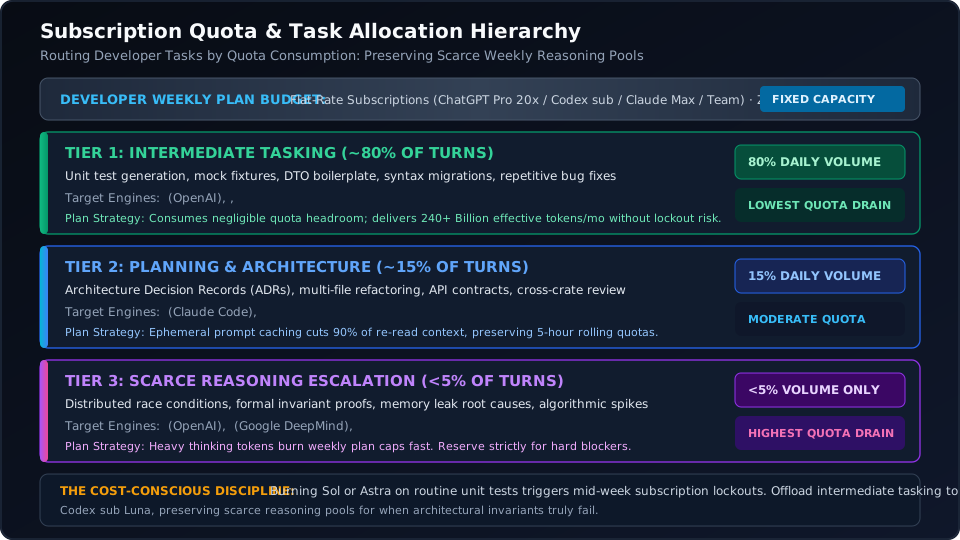
Tier 1: High-Volume Intermediate Tasking
Accounts for approximately 80% of total developer turns benchmarked across coding agent evaluations. These tasks require clean syntax following established repository conventions, but no novel mathematical invention: - Unit test mocking and fixture generation. - Data transfer object (DTO) schemas and serialization mapping. - Adding error handling, logging instrumentation, and docstrings. - Translating endpoints between framework conventions and fixing linter errors.
For cost-conscious developers on subscription plans, Codex sub Luna (OpenAI), DeepSeek V4 Flash, and Gemini 3 Flash are the primary workhorses. On plans like ChatGPT Pro or Team, Luna delivers massive token velocity. It yields over 240 Billion effective tokens per month on 20x tier multipliers measured in empirical subscription benchmarks with virtually zero risk of exhausting your weekly plan quota. Offloading all intermediate execution to this tier ensures your daily agentic loop never halts.
Tier 2: Precision Planning & System Architecture
Accounts for approximately 15% of developer tasks benchmarked across multi-file agent evaluations. These require deep structural understanding across multiple files and package boundaries: - Architecture Decision Records (ADRs) and interface contracts. - Multi-file refactoring across package and crate boundaries. - Resolving subtle compiler type-inference mismatches. - Designing state management architectures and lifecycle hooks.
Claude 5 Sonnet (via Claude Code) and Gemini 3 Pro excel in this tier. When paired with ephemeral prompt caching (as detailed in our Anthropic Claude guide), input tokens receive a 90% discount per Anthropic API pricing. This prevents the dreaded “compounding context trap,” allowing terminal agents to re-read extensive repository maps without triggering the 5-hour rolling session lockout.
Tier 3: Scarce Reasoning Escalation
Accounts for less than 5% of developer tasks documented in SWE-bench agent telemetry. These represent hard computational or logical puzzles where standard autoregressive models loop or produce subtle bugs: - Distributed race conditions and concurrent database deadlock analysis. - Formal protocol verification, invariant checks, and state machine reachability proofs. - Complex algorithm optimization and zero-shot architectural debugging.
Flagship reasoning models like GPT-5.6 Sol, Astra (Google DeepMind), and Claude 5 Opus allocate thousands of internal hidden thinking tokens before generating code. In flat-rate subscriptions, these models draw from strictly capped weekly or rolling compute pools. Squandering this scarce quota on routine unit tests or docstrings is a planning failure that leaves you locked out when critical production bugs arise. Cost-conscious developers treat Sol and Astra as targeted consulting specialists, reserved exclusively for thorny architectural deadlocks.
2. Subscription Pareto Economics: Which Plans Deliver Maximum Model Tier Value?
Choosing the right models is only half the equation; developers must also select the right subscription plans to fund them. As detailed in our empirical study of LLM subscription token value and ROI multipliers, evaluating an AI plan requires measuring effective delivered unit cost rather than monthly sticker prices.
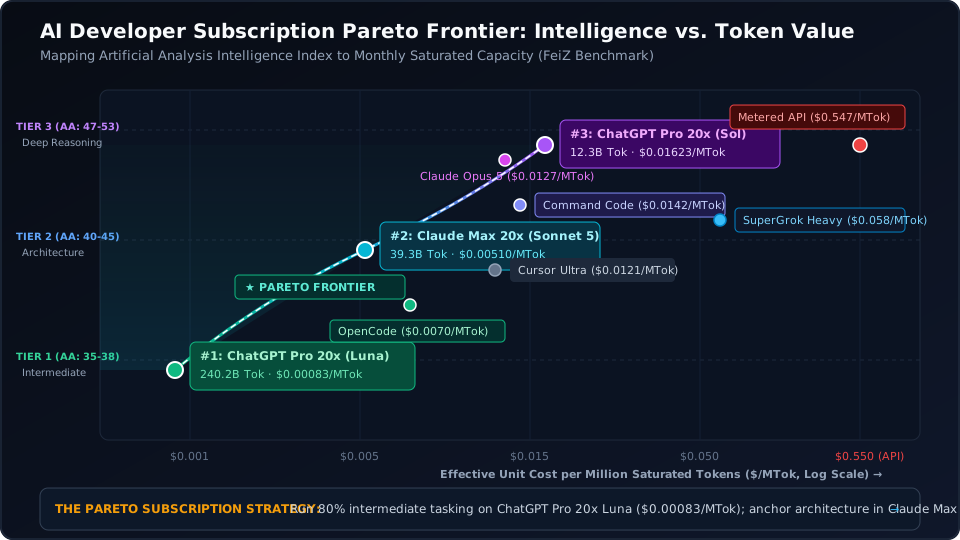
Empirical pricing researcher FeiZ (@Fei2411) benchmarked 81 model and subscription configurations to map the real Pareto Frontier of AI developer tooling:
+---------------------------------------------------------------------------------+
|              AI DEVELOPER SUBSCRIPTION PARETO FRONTIER RANKING                  |
+-----------------------------+-----------------------+-------------------+-------+
| SUBSCRIPTION & MODEL TIER   | SATURATED TOKENS / MO | EFFECTIVE $/MTOK  | TIER  |
+-----------------------------+-----------------------+-------------------+-------+
| ChatGPT Pro 20x (Luna)      | 240.2 Billion Tokens  | $0.00083 / MTok   | T1    |
| Claude Max 20x (Sonnet 5)   | 39.25 Billion Tokens  | $0.00510 / MTok   | T2    |
| OpenCode Subscription       | 28.40 Billion Tokens  | $0.00704 / MTok   | T1/T2 |
| Cursor Ultra (Composer 2.5) | 16.51 Billion Tokens  | $0.01211 / MTok   | T1/T2 |
| Claude Max 20x (Opus 5)     | 15.70 Billion Tokens  | $0.01274 / MTok   | T3    |
| Command Code Pro            | 14.10 Billion Tokens  | $0.01418 / MTok   | T2/T3 |
| ChatGPT Pro 20x (Sol)       | 12.32 Billion Tokens  | $0.01623 / MTok   | T3    |
| SuperGrok Heavy (Grok 4.6)  | 5.09 Billion Tokens   | $0.05894 / MTok   | T2/T3 |
| Standalone Metered API (Sol)| Metered Consumption   | $0.54723 / MTok   | T3    |
+-----------------------------+-----------------------+-------------------+-------+
The Optimal Plan-to-Task Mapping
Several plans define the Pareto efficiency curve across their respective model tiers:
Tier 1 Volume Leader (ChatGPT Pro 20x / Codex sub Luna): Ranks #1 overall across all audited configurations benchmarked by FeiZ. At $0.00083 per Million Tokens, it delivers unmatched volume. Developers routing routine intermediate execution (tests, fixtures, lint fixes) through Codex sub Luna gain 240+ Billion tokens of monthly headroom with virtually zero risk of exhaustion.
Tier 2 Architectural Leader (Claude Max 20x / Claude 5 Sonnet): Ranks #2 for architectural reasoning at $0.00510 per Million Tokens. When combined with 90% prompt caching discounts per Anthropic API pricing, Claude 5 Sonnet provides surgical repository refactoring without exceeding Anthropic’s strict 5-hour rolling usage window.
Tier 3 Frontier Reasoning (ChatGPT Pro 20x Sol & Claude Max 20x Opus 5): Delivers deep reasoning at $0.01274 to $0.01623 per Million Tokens. This represents a 34x to 43x cost advantage over standalone metered reasoning APIs ($0.547/MTok) documented in public pricing datasets. Reserving these quotas exclusively for non-deterministic race conditions and formal proofs preserves full reasoning availability when urgent blockers strike.
Open-Protocol High-Volume (OpenCode Subscription): Delivers 28.40 Billion saturated tokens per month at $0.00704 per Million Tokens benchmarked in empirical token subscription models. OpenCode sits right on the Tier 1/Tier 2 efficiency boundary. Unlike closed vendor gardens, OpenCode exposes open endpoint protocols that connect directly to independent terminal harnesses without secondary API metering.
Agentic Tool-Use Reasoning (Command Code Pro): Delivers 14.10 Billion tokens per month at $0.01418 per Million Tokens tracked across developer subscription benchmarks. Command Code is engineered for multi-step terminal tool dispatch and complex refactoring workflows. It provides enterprise-grade tool orchestration at a fraction of the wrapper markup seen in IDE extensions.
The Wrapper Penalty (Cursor Ultra & SuperGrok Heavy): Third-party wrappers and single-window models sit interior to the Pareto curve. Cursor Ultra incurs an intermediary margin penalty ($0.01211/MTok for 16.51 Billion tokens), while SuperGrok Heavy ($0.05894/MTok) provides massive raw burst capacity on 7-day windows but lower overall token density per dollar.
Triangulating Quality and Price with Artificial Analysis
Evaluating model routing requires pairing subscription throughput with verified intelligence benchmarks. Independent evaluation laboratory Artificial Analysis (@ArtificialAnlys, artificialanalysis.ai) continuously maps the frontier of model capability against metered API pricing and inference speed.
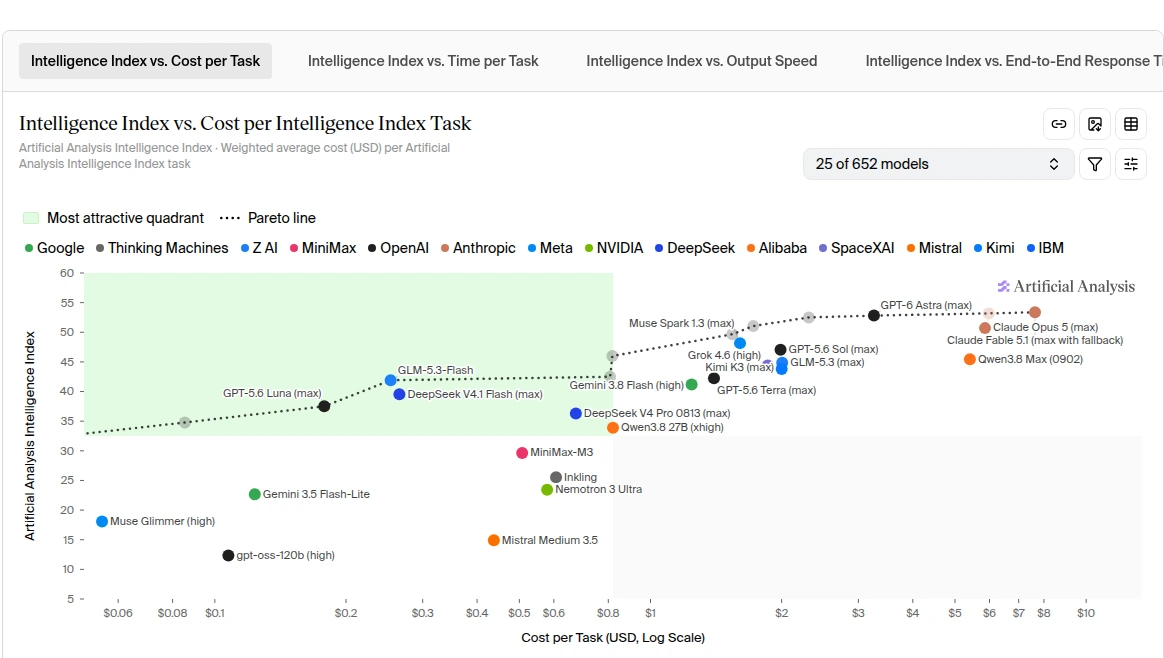
Their benchmark methodology establishes the foundational quality criteria that justify model routing: - Intelligence Index & Coding Performance: Artificial Analysis evaluates reasoning and agentic problem-solving via SWE-bench Verified and Terminal-Bench evaluations. This identifies the intelligence threshold required for each task tier, preventing subtle regressions. - Speed & Latency Metrics: By tracking Time to First Token and throughput, Artificial Analysis proves Tier 1 models like Codex sub Luna excel for interactive loops tracked on independent leaderboards. - The Dual-Frontier Strategy: While Artificial Analysis maps the Quality vs. Metered API Price Frontier, FeiZ measures Subscription Delivery Economics. Combining both datasets proves that subscription plans flatten the cost curve. Developers accessing Claude 5 Sonnet or GPT-5.6 Sol through flat-rate subscriptions receive frontier intelligence at up to 97% savings compared to metered API rates documented across independent benchmark indexes.
3. Choosing a Headless Agent Harness
A terminal agent harness connects model endpoints to your local filesystem, compiler, and version control. Five primary modern harnesses dominate developer workflows:
pi & oh my pi
(omp)
Minimalist, high-throughput terminal harnesses designed for zero-overhead shell execution: - Ultra-Low Latency Streaming: Eliminates heavy electron or web-view wrappers, streaming tokens directly into standard Unix terminals. - Open Endpoint Routing: Connects to OpenAI, OpenCode, or local reverse-proxy endpoints without vendor lock-in. - Git-Native Diff Reviews: Renders interactive diffs in the terminal with immediate keyboard approvals before disk writes. - Command Chaining: Integrates directly into Unix pipes, allowing scripted terminal execution across headless development environments.
Claude Code (claude)
Anthropic’s official agentic terminal harness built for direct shell
pair programming: - Native Shell Execution: Runs
terminal commands and file edits directly in your working directory with
automatic error remediation. - Prompt Cache Alignment:
Structures context automatically to leverage Anthropic’s 90% prompt
caching discounts per
Anthropic API pricing. - Repository Policy
Enforcement: Ingests instructions from CLAUDE.md
and project skill directories to enforce strict coding rules. -
Subagent Delegation: Spawns background worker agents
for deep research without cluttering the main interactive session.
OpenAI Codex CLI
(codex)
OpenAI’s dedicated terminal agent harness engineered for high-velocity software engineering: - Tiered Routing Integration: Shifts between Codex sub Luna for fast execution and GPT-5.6 Sol for complex logical proofs. - Sandboxed Safety: Isolates command execution to prevent accidental file deletion or unauthorized network traffic. - Non-Interactive Batch Mode: Executes scripted tasks and automated pull request reviews without human intervention.
Google Antigravity & Jules
Google DeepMind’s orchestrator and asynchronous cloud agent: - High-Throughput Quotas: Leverages rolling 5-hour compute pools on Google AI Studio Ultra plans. - Multi-Workspace Synthesis: Coordinates local file edits across multiple linked repositories simultaneously. - Cloud Sandboxes (Jules): Compiles and tests code inside ephemeral cloud VMs without tying up local machine compute.
Autonomous Multi-Agent Orchestrators
Multi-agent coordination rigs (such as SIFS and Agent Mail harnesses) for parallel developer teams: - File-Reservation Locks: Prevents concurrent editing collisions across parallel terminal workers via structured messaging. - Adversarial Review Separation: Enforces governance rules where author agents cannot approve their own merge requests. - Headless Background Execution: Orchestrates continuous autonomous task execution using event-driven wakeups.
Harness Portability vs. Subscription Lock-In
When selecting a developer subscription, the ability to choose your terminal harness is as critical as raw model intelligence. Subscription providers diverge sharply on harness portability:
- Anthropic Claude (Strict Lock-In): Anthropic
restricts Claude Pro, Team, and Max subscription quotas strictly to its
first-party interfaces: the Claude web client, desktop app, and official
claudeCLI. Third-party terminal harnesses (pi,oh my pi, Neovim plugins) cannot consume subscription quotas. Accessing Claude models through external tools requires provisioning separate metered API keys with full per-token billing per Anthropic platform terms. - Google AI (Ecosystem Lock-In): Google’s AI Studio Ultra and Gemini compute pools are bound directly to Google’s first-party ecosystem (Antigravity CLI, Jules cloud sandboxes, and AI Studio web interface). While Google provides generous 5-hour rolling request allowances, developers cannot redirect these subscription quotas into arbitrary external harnesses without switching to standard Google Cloud Vertex AI metered billing.
- OpenAI ChatGPT & Codex (Open Portability):
OpenAI permits greater harness portability. Developers on ChatGPT Plus,
Pro, or Team plans can authenticate third-party harnesses like
pioroh my piusing session credentials. This allows routing flat-rate subscription token allowances into independent headless workflows without incurring secondary metered API expenses. - OpenCode (Universal Portability): Built on open
protocols, OpenCode decouples token subscription billing from the client
harness. Subscribers receive universal endpoint credentials compatible
with any OpenAI-standard terminal agent (
pi,oh my pi, custom headless bash wrappers), providing maximum harness portability without vendor lock-in.
Metered Usage Trends: The OpenRouter Harness Leaderboard
Beyond theoretical capabilities, empirical telemetry provides clear visibility into which terminal agent harnesses developers run in production.
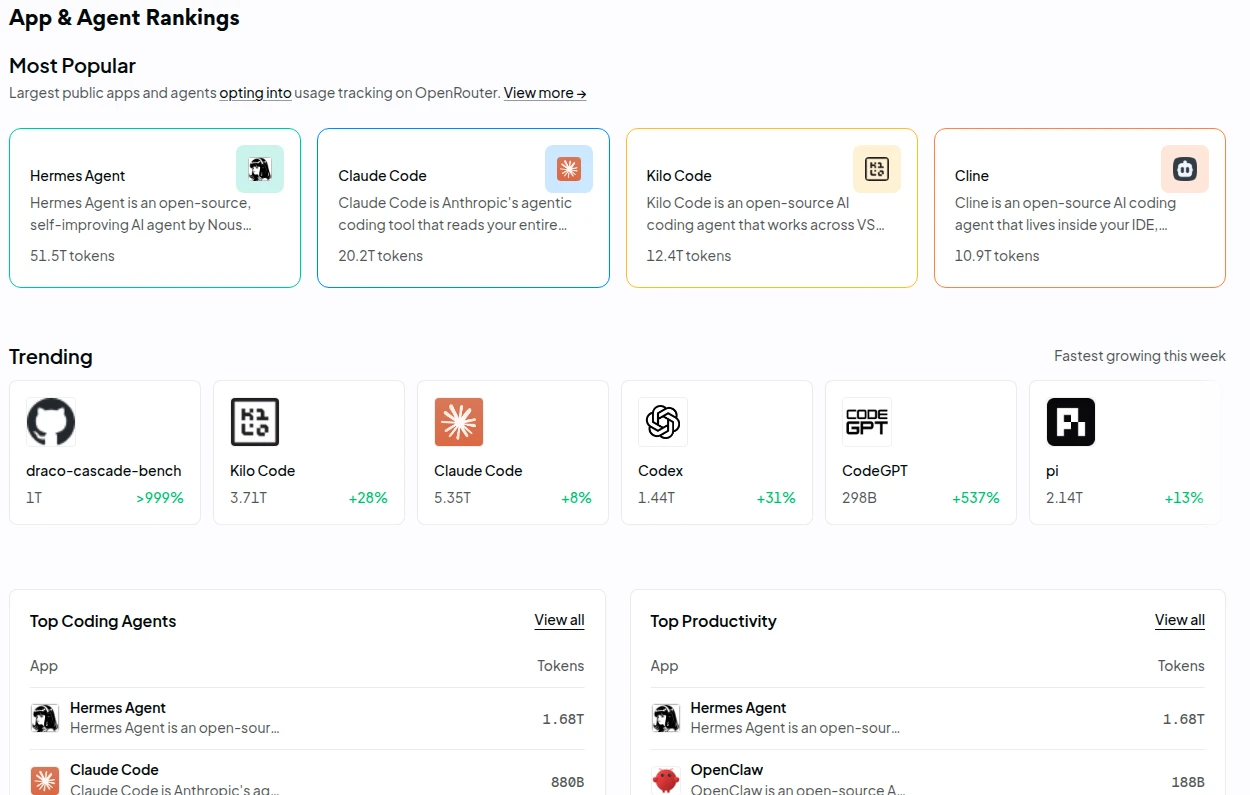
Aggregated API gateway OpenRouter publishes real-world token consumption telemetry across registered client applications. Their weekly activity metrics reveal massive production adoption across modern agentic harnesses:
- Claude Code: Leads coding agent consumption with over 20.2 Trillion cumulative tokens, processing 5.35 Trillion tokens this week alone tracked on OpenRouter app rankings.
- Kilo Code: Fast-growing multi-environment coding harness processing 3.71 Trillion tokens this week with 12.4 Trillion cumulative tokens per OpenRouter telemetry.
pi: The minimalist terminal-native harness processed 2.14 Trillion tokens this week benchmarked on OpenRouter, demonstrating surging demand for zero-overhead shell agents.- OpenAI Codex: Processed 1.44 Trillion tokens this week recorded on OpenRouter via headless API integration.
- Cline: IDE-integrated autonomous coding agent processing 2.88 Trillion tokens this week documented on OpenRouter rankings across active environments.
The Subscription Visibility Gap
When interpreting OpenRouter token leaderboards, an important operational rule applies: flat-rate subscription tokens are not counted.
OpenRouter metrics capture only requests routed through their metered API gateway where developers pay per-token prices. Developers using flat-rate token subscriptions (such as ChatGPT Pro, Claude Max, or Google AI Studio Ultra) route traffic directly to provider endpoints or session credentials. Those hundreds of billions of monthly subscription tokens never touch third-party gateways.
As a result, actual developer harness adoption is substantially
higher than public API telemetry suggests. OpenRouter proves that
developers spend heavily on metered API tokens for harnesses like
claude, pi, and codex. However,
cost-conscious teams route their highest-volume turns through flat-rate
subscription quotas to eliminate per-token marginal expense.
4. The 90% Cost Optimization Playbook
To keep monthly agentic developer costs under control while maintaining maximum velocity, apply four operational rules to achieve up to a 90% reduction in token expense:
Rule 1: Enforce Ephemeral Prompt Caching
Always place static repository context (system prompts, coding guidelines, repository maps) at the very beginning of the prompt sequence. In providers that support prompt caching (Anthropic, Google), consecutive turns within the cache window receive up to a 90% discount per Anthropic API pricing. Placing dynamic content (like file diffs or current test outputs) ahead of static context breaks cache alignment and forces expensive full recomputation.
Rule 2: Keep Context Windows Compact
The common assumption that “bigger context windows mean better code” is false. Pumping 200,000 tokens of raw source code into an LLM degrades attention focus (the “lost-in-the-middle” effect) and introduces hallucinated syntax. Use tools that generate concise symbol graphs and compact repository indexes to feed only the symbols, function signatures, and interface declarations relevant to the task.
Rule 3: Use Autonomous Cloud Sandboxes for Asynchronous Bursts
When facing a large backlog of repetitive tasks (such as migrating 40 API endpoints to a new error handler or updating breaking package imports), do not sit in a terminal waiting for each one. Offload the work to asynchronous cloud agent sandboxes like Jules, which compile and test code in ephemeral cloud VMs without tying up local machine compute or burning personal API credits.
Rule 4: Decouple Team Collaboration from Terminal Compute
Do not buy $200 individual web subscriptions for every developer on your team. Provide developers with shared Team workspaces ($25–$30/seat on ChatGPT Team or Claude Team) to ensure corporate data privacy and facilitate architectural discussions. Then fund headless terminal agents through centralized, metered API pools with spend alerts.
This hybrid model ensures that engineering teams maintain enterprise data security, eliminate rate-limit roadblocks, and scale developer velocity at a fraction of standard vendor subscription costs.