Software developers and engineering teams subscribe to frontier AI plans with a common expectation: that paying $20, $200, or $300 each month purchases reliable, high-volume compute for coding tasks.
Yet the reality of commercial AI subscriptions is defined by opaque constraints. Hidden reasoning tokens burn through allowances behind the scenes. Rigid rolling timers lock developers out mid-flow. Complex product tiers obscure what you are actually buying.
A fundamental financial question emerges: If you push your subscription to its limits on real-world coding agent tasks, how many dollars worth of metered API tokens do you actually receive?
To answer this, we analyze recent empirical benchmark measurements across flagship subscriptions, dissect the confusing multi-tier Grok ecosystem, and compare the quota pacing architectures that govern your daily workflow.

1. The Empirical Benchmark: Metered Token Return per Dollar
In September 2026, benchmark researcher Kun Chen (@kunchenguid on X) published empirical measurements evaluating the true token value delivered by top-tier coding subscriptions.
The Methodology
The evaluation ran in an isolated test harness. Each provider was exercised through repeated real-world software engineering tasks drawn from open-source repositories. By measuring token consumption across 5 percentage points of each account’s quota, the tests calculated total delivered token value based on standard developer API pricing.
The benchmark focused strictly on coding agent execution, which represents the vast majority of developer token consumption, excluding standard conversational web chat.
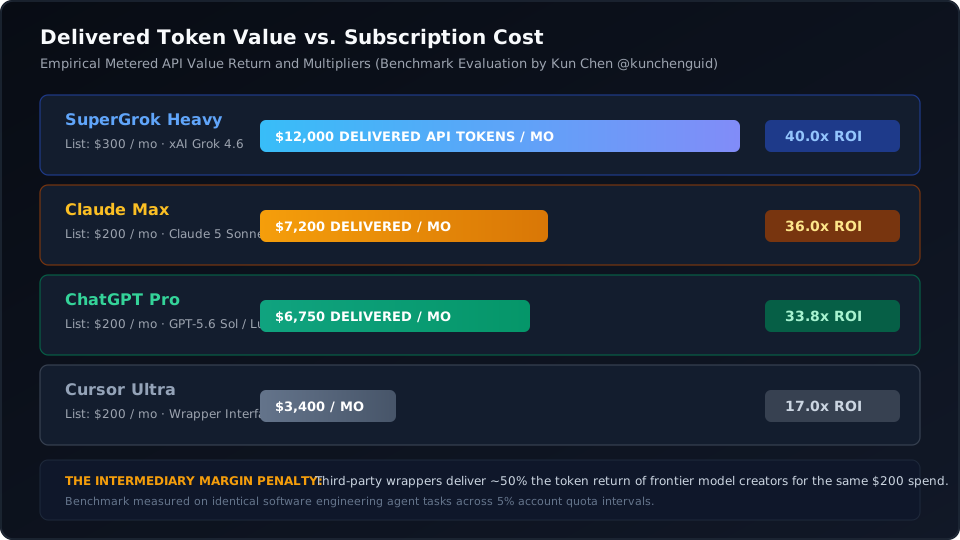
The Results: Delivered Token Value vs. List Price
+-------------------------------------------------------------------------------+
| PLAN               | LIST PRICE / MO | DELIVERED VALUE / MO | VALUE MULTIPLIER|
+--------------------+-----------------+----------------------+-----------------+
| SuperGrok Heavy    | $300            | $12,000              | 40.0x ROI       |
| Claude Max         | $200            | $7,200               | 36.0x ROI       |
| ChatGPT Pro        | $200            | $6,750               | 33.8x ROI       |
| Cursor Ultra       | $200            | $3,400               | 17.0x ROI       |
+--------------------+-----------------+----------------------+-----------------+
Analysis of the Value Spread
Four immediate insights stand out from this empirical subscription audit:
The Frontier Labs Deliver Consistent 34x–36x Multipliers: Both Anthropic (Claude Max) and OpenAI (ChatGPT Pro) deliver between $6,750 and $7,200 in metered API token value for a $200 monthly subscription per benchmarked agent runs. When pushed to capacity, these subscriptions return over thirty times their cost in compute.
SuperGrok Heavy Takes the Raw Volume Crown: At $300 per month, xAI’s SuperGrok Heavy delivered an astounding $12,000 in monthly token equivalent, achieving a 40x ROI multiplier documented in empirical testing. Following quota adjustments coordinated directly with xAI engineering, the tier provides the highest raw compute ceiling of any self-service consumer plan.
The Intermediary Margin Penalty (Cursor Ultra at 17x): While Cursor Ultra costs the same $200 per month as ChatGPT Pro and Claude Max, its delivered token value ($3,400) is roughly half that of the model creators evaluated under identical repository tasks. This reflects the reality of third-party wrappers: Cursor must pay underlying model providers wholesale token rates while maintaining server infrastructure and profit margins. For individual developers prioritizing raw token volume, third-party wrappers carry a steep cost penalty.
The Theoretical Ceiling Caveat: These multipliers reflect full subscription exhaustion. If you use your account intermittently for an hour or two each day, your effective ROI drops substantially. Value realization requires sustained, automated development workflows.
2. Real API Pricing: The Pareto Frontier and Effective Unit Cost
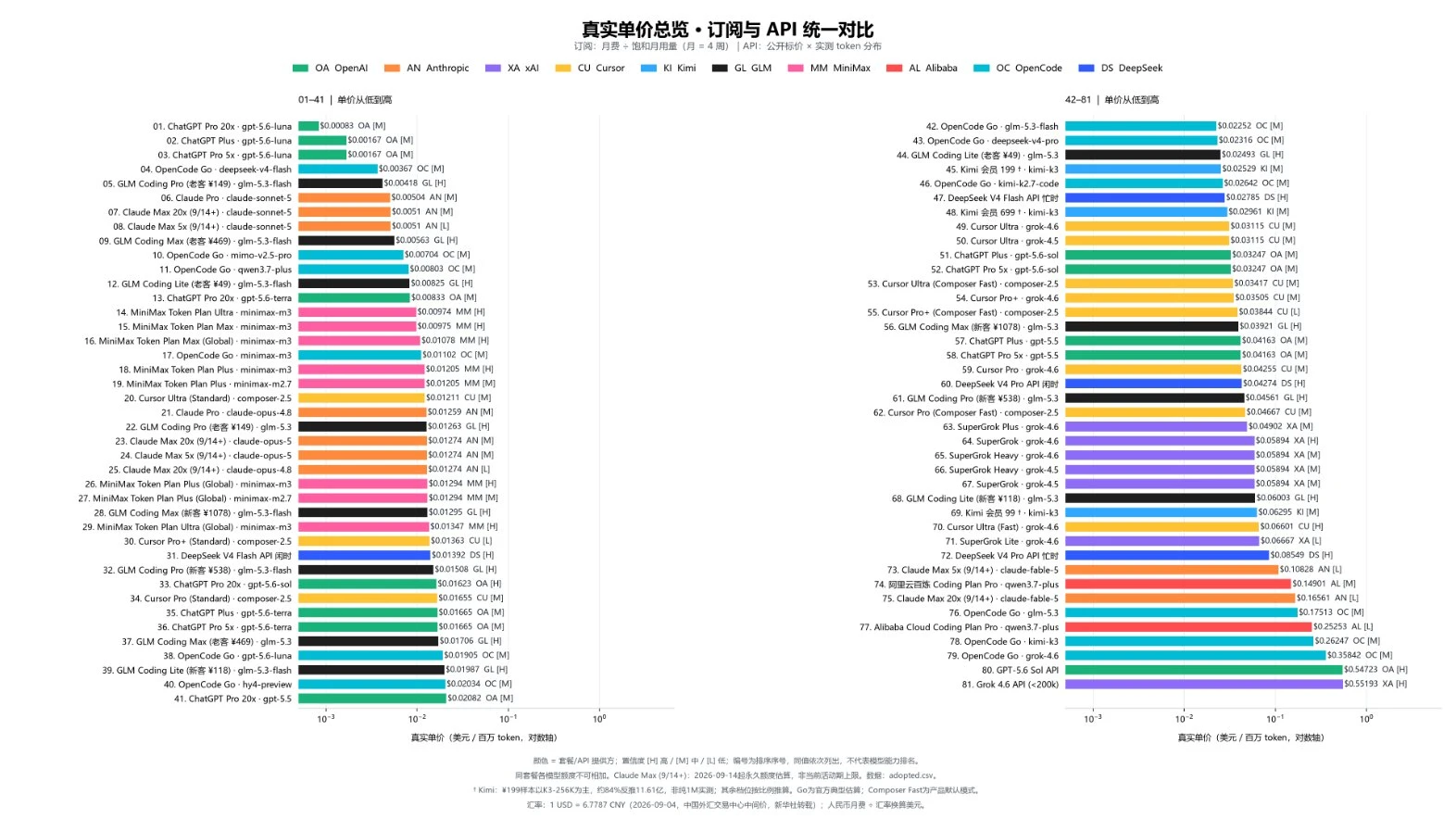
Beyond top-line ROI multipliers, empirical pricing researcher FeiZ (@Fei2411 on X, repository real-api-pricing) formulated the Real API Pricing Method across 81 model and subscription configurations.
The Pricing Inversion Formula
The framework calculates effective unit cost by dividing monthly subscription cost by empirical saturated token capacity over four weeks benchmarked across 81 plan configurations:
$$\text{Effective Unit Price (\$/MTok)} = \frac{\text{Monthly Subscription Price}}{\text{Saturated Monthly Delivered Tokens}}$$
Under this lens, conventional assumptions regarding cheap and expensive models invert completely:
- The Subscription Subsidy on Frontier Models:
Flagship models considered expensive on metered APIs become cheap when
consumed inside flat-rate subscriptions:
- GPT-5.6 Luna on ChatGPT Pro 20x: Ranked #1 overall, delivering saturated monthly compute at an astonishing $0.00083 per Million Tokens ($0.00083/MTok) documented in empirical Pareto frontier benchmarks.
- Claude Sonnet 5 on Claude Pro / Max: Ranks #6 to #8, delivering effective pricing of $0.00504 to $0.00510/MTok verified in saturation tests.
- Claude Opus 5 on Claude Max 20x: Ranks #23 at $0.01274/MTok, delivering 15.7 billion monthly tokens evaluated under saturated workloads.
- GPT-5.6 Sol on ChatGPT Pro 20x: Ranks #33 at $0.01623/MTok, delivering 12.32 billion monthly tokens.
- The Metered API Surcharge: Conversely, models
traditionally celebrated for low token prices lose their economic
advantage when compared against saturated flat-rate subscriptions:
- DeepSeek V4 Flash API: Ranks #31 during off-peak hours ($0.01392/MTok) and drops to #47 during peak hours ($0.02785/MTok) documented in public pricing datasets.
- SuperGrok Plus: Ranks #63 at $0.04902/MTok.
- Standalone Grok 4.6 API: Ranks #81 at $0.55193/MTok for queries under 200k tokens.
- Standalone GPT-5.6 Sol API: Ranks #80 at $0.54723/MTok.
Saturated Monthly Token Volumes
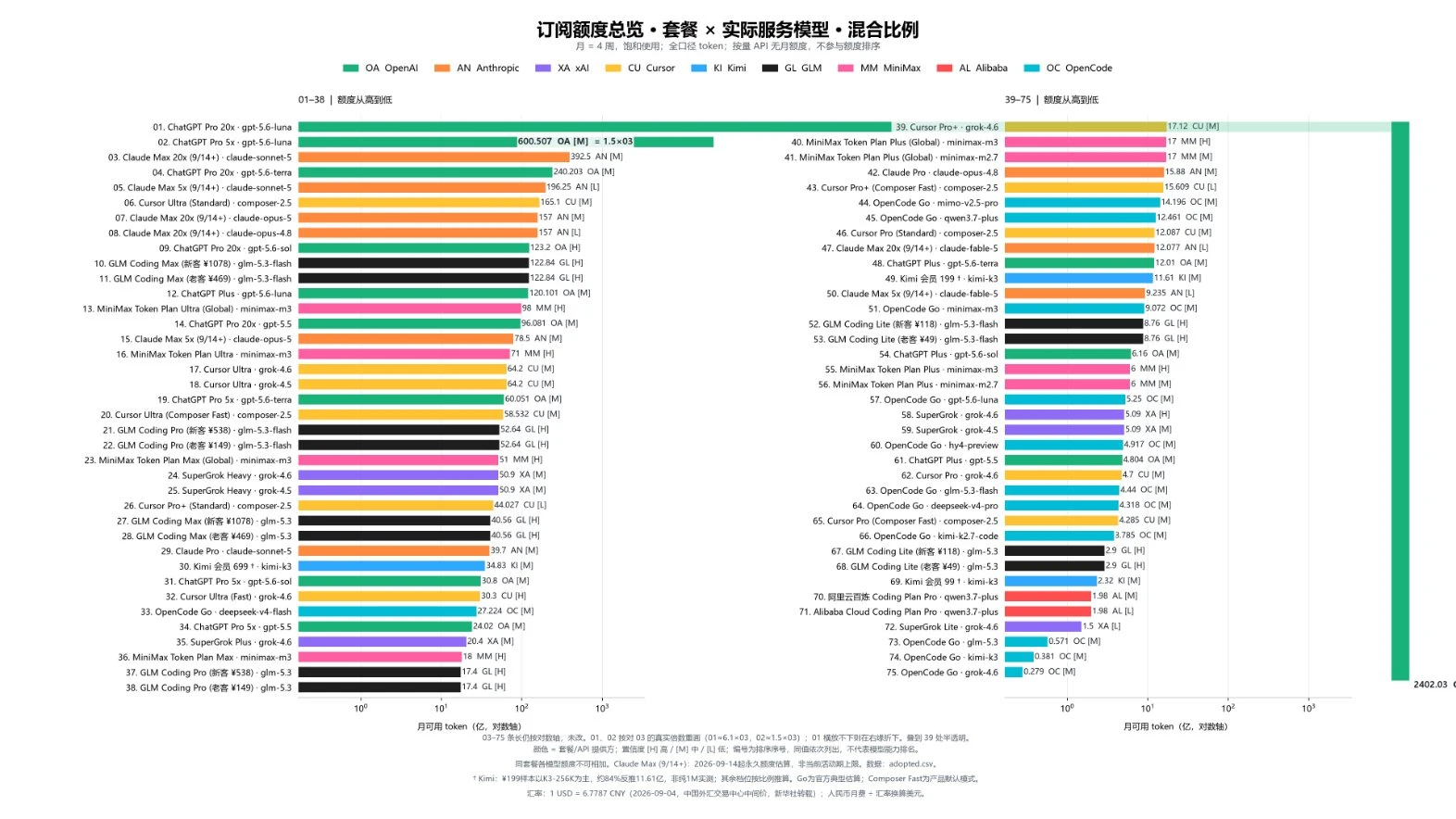
When measuring absolute token throughput for developers running continuous automated coding loops, delivered volumes diverge by orders of magnitude documented in benchmark reports:
+-------------------------------------------------------------------------------+
| PLAN & MODEL                   | SATURATED TOKENS / MO | EFFECTIVE UNIT COST  |
+--------------------------------+-----------------------+----------------------+
| ChatGPT Pro 20x (Luna)         | 240.2 Billion Tokens  | $0.00083 / MTok      |
| Claude Max 20x (Sonnet 5)      | 39.25 Billion Tokens  | $0.00510 / MTok      |
| Cursor Ultra (Composer 2.5)    | 16.51 Billion Tokens  | $0.01211 / MTok      |
| Claude Max 20x (Opus 5)        | 15.70 Billion Tokens  | $0.01274 / MTok      |
| ChatGPT Pro 20x (Sol)          | 12.32 Billion Tokens  | $0.01623 / MTok      |
| SuperGrok Heavy (Grok 4.6)     | 5.09 Billion Tokens   | $0.05894 / MTok      |
| SuperGrok Plus (Grok 4.6)      | 2.04 Billion Tokens   | $0.04902 / MTok      |
| SuperGrok Lite (Grok 4.6)      | 0.15 Billion Tokens   | $0.06667 / MTok      |
+--------------------------------+-----------------------+----------------------+
3. The Grok Subscription Maze: Demystifying X vs. xAI Tiers
While SuperGrok Heavy provides immense nominal token capacity, xAI’s subscription lineup has caused widespread confusion across the developer community. Because xAI is tightly coupled with the X social platform, users routinely purchase the wrong tier expecting developer tool access.
Here is the exact breakdown of how xAI separates social media perks, dedicated AI apps, and developer API keys.
+-------------------------------------------------------------------------------+
|                       THE GROK ACCESS TAXONOMY                                |
+-----------------------+---------------------+---------------------------------+
| SUBSCRIPTION          | MONTHLY COST        | PRIMARY WORKLOAD / ACCESS       |
+-----------------------+---------------------+---------------------------------+
| X Basic               | $3 / mo             | Platform features; minimal AI   |
| X Premium             | $8 / mo             | Blue checkmark; basic Grok chat |
| X Premium+            | $16 / mo            | Ad-free feed; higher Grok caps  |
| SuperGrok             | $30 / mo            | grok.com app; standalone AI     |
| SuperGrok Plus        | $100 / mo           | High concurrency; video models  |
| SuperGrok Heavy       | $300 / mo           | Multi-agent coding; 40x ROI     |
| xAI Developer API     | Pay-as-you-go       | api.x.ai; headless agents only  |
+-----------------------+---------------------+---------------------------------+
The Social Bundle: X Basic, Premium, and Premium+
These subscriptions are managed entirely through the X social network (x.com): - X Basic ($3/mo): Focuses on social platform features (edit post, longer video uploads) with little to no Grok allowance. - X Premium ($8/mo): Grants the verified checkmark and unlocks standard Grok chat inside the X web and mobile interface. Message limits are restrictive, and reasoning model access is severely throttled. - X Premium+ ($16/mo): Removes ads from the For You timeline and roughly doubles Grok chat allowances compared to Premium.
The Developer Trap: Subscribing to X Premium+ does not grant SuperGrok status on grok.com, nor does it provide developer API keys for local IDE agents. It is fundamentally a social media subscription that bundles basic chatbot queries.
The Standalone AI Tiers: SuperGrok on grok.com
In late 2024 and early 2025, xAI separated its AI power users into
dedicated standalone plans hosted at grok.com: -
SuperGrok ($30/mo or $300/yr): The standard
professional tier. Provides direct access to frontier models (such as
Grok 3 and Grok 4), multi-modal analysis, and deep web research without
social media overhead. - SuperGrok Plus ($100/mo):
Introduces expanded concurrency, higher context windows, and
high-definition video generation. - SuperGrok Heavy
($300/mo): The flagship powerhouse evaluated in Kun Chen’s
benchmark. Engineered for continuous coding agent sessions, massive
prompt context, and heavy multi-turn reasoning loops.
The Weekly Shared Pool Gotcha
Unlike OpenAI and Anthropic, which meter text reasoning separately from multi-modal generation, paid SuperGrok plans typically draw from a single shared weekly compute pool.
This pool covers Chat, Imagine (image generation), Voice, and Build (coding agents). If a team member consumes substantial compute generating synthetic video or high-resolution images, that usage depletes the weekly allocation available for coding agents. For software engineering teams, maintaining strict discipline over multi-modal features is mandatory to avoid premature quota lockouts.
The xAI Developer Platform
(api.x.ai)
Just as with OpenAI and Google, xAI maintains an absolute wall
between its consumer subscriptions and its developer API: - Monthly fees
paid for X Premium+ or SuperGrok Heavy do not subsidize API calls to
api.x.ai. - Terminal agents (like Aider or Cline) require
separate prepaid credits deposited into the xAI Developer Console.
4. Quota Architecture Shootout: How Providers Enforce Limits
Quota pacing dictates developer velocity far more than nominal token volume. A large quota is useless if an arbitrary timer blocks you during a production deployment.
Anthropic: The Strict 5-Hour Rolling Cliff
As detailed in our Anthropic Claude subscription guide, Anthropic enforces a rigid 5-hour rolling usage window: - The Mechanic: Every prompt sent within a rolling 5-hour block consumes from your allowance. On Pro, sending roughly 45 Claude 5 Sonnet prompts exhausts the quota. - The Lockout Cliff: At limit exhaustion, Claude rejects subsequent prompts until the rolling window advances. If you burn your allowance in 45 minutes of intense debugging, you are locked out for over 4 hours. - The Impact: Requires disciplined pacing. Developers must avoid triggering heavy agent loops without prompt caching.
OpenAI: Dynamic Compute Pools and Capacity Resets
As explored in our OpenAI developer plans deep dive, OpenAI structures quota enforcement around dynamic compute pools rather than rigid rolling hour clocks: - No 5-Hour Lockout Cliff on Pro ($200/month): ChatGPT Pro removes fixed hourly message counters for standard models and reasoning workflows. Developers can work continuously across a standard engineering shift without hitting an arbitrary mid-day shutdown. Everyday conversational chat is unlimited, while compute-heavy reasoning checkpoints draw from shared dynamic allocations. - The Operational Trade-Off: Freedom from Anthropic’s 5-hour cliff delivers uninterrupted developer flow. However, when throttles do trigger (via anti-abuse velocity ceilings or weekly reasoning limits), recovery timing is less deterministic than a clock countdown. - Cluster Capacity Generosity: OpenAI’s enforcement thresholds adjust dynamically with data center GPU load. During off-peak hours, weekends, or following compute cluster expansions, OpenAI frequently grants unannounced usage resets and expands silent prompt ceilings well beyond baseline floors.
xAI: The Weekly Consumption Budget
xAI structures SuperGrok around a weekly allowance rather than short rolling hours: - The Benefit: Unmatched burst capacity. You can execute massive 12-hour automated refactoring sessions on a Monday without triggering an hourly lockout. - The Risk: If your test harness runs runaway loops or burns tokens on multi-modal assets, you can exhaust your entire weekly allocation by Tuesday, leaving you stranded for days.
+-------------------------------------------------------------------------------+
|                       QUOTA PACING COMPARISON                                 |
+--------------------+-------------------+--------------------+-----------------+
| PROVIDER           | TIMING MECHANISM  | RECOVERY DURATION  | PREDICTABILITY  |
+--------------------+-------------------+--------------------+-----------------+
| Anthropic (Claude) | 5-Hour Rolling    | Strict 5 Hours     | Very High       |
| OpenAI (Plus/Team) | Dynamic / Periodic| Rolling / Dynamic  | Moderate        |
| OpenAI (Pro $200)  | Dynamic / Weekly  | Uncapped / Rolling | Dynamic         |
| xAI (SuperGrok)    | Shared Weekly     | 7 Days             | Consumption-Led |
+--------------------+-------------------+--------------------+-----------------+
5. Synthesis: How to Allocate Your Engineering Budget
Based on empirical token returns and quota architectures, here is how technical leaders and individual developers should allocate their tooling budget:
Scenario A: The Single-Model Deep Thinker ($200/month)
If your primary need is deep architectural reasoning and interactive refactoring directly with frontier models, Claude Max ($7,200 token value) and ChatGPT Pro ($6,750 token value) offer the cleanest developer ergonomics. - Choose ChatGPT Pro if you require unbroken all-day coding without a 5-hour lockout cliff and leverage Codex sub Luna allocations. - Choose Claude Max if your codebase benefits from Claude 5 Sonnet’s superior architectural refactoring and you adhere to strict 5-hour pacing discipline.
Scenario B: The High-Volume Agent Power User ($300/month)
If you run high-throughput automated coding loops and want maximum raw compute per dollar, SuperGrok Heavy ($12,000 token value, 40x ROI measured in empirical benchmarks) is the clear price-to-performance winner. - Requirement: Isolate your account strictly to text and coding agent tasks. Do not allow video generation or media creation to drain the shared weekly compute pool.
Scenario C: The Headless Multi-Model Team (Under $150/month)
If you want to avoid subscription lock-in and hourly cliff timers entirely, the optimal engineering decision is to bypass consumer subscriptions altogether.
As demonstrated in our headless terminal agent routing guide, combining open terminal harnesses (such as Aider or Cline) with metered API endpoints delivers superior economics: 1. Route 80% of routine syntax, unit testing, and boilerplate to high-speed models (such as Codex sub Luna, DeepSeek V4 Flash, or Gemini 3 Flash). 2. Route 15% of complex multi-file refactoring to Claude 5 Sonnet with prompt caching, slashing input expenses by 90%. 3. Reserve high-compute reasoning models (GPT-5.6 Sol, Astra, Opus 5) strictly for verifiable architectural edge cases.
By decoupling execution from proprietary web subscription lockouts, engineering teams eliminate artificial hourly cliffs while ensuring complete privacy and code sovereignty.