Among developer-focused AI providers, Anthropic occupies a unique position. For pure coding and architectural synthesis, Claude 5 Sonnet is widely regarded as the industry benchmark. Yet many developers discover that their subscriptions behave unpredictably when deployed against real production codebases.
You start an interactive debugging session with Claude Pro, attach
three source files and an API schema, and after just eight messages, the
interface warns you that your quota will reset in four hours. Or you
install the new claude-code CLI terminal agent, connect
your personal account, and find your daily quota consumed before
lunch.
Anthropic manages compute through a fundamentally different mechanism than Google’s daily 24-hour task allocations or OpenAI’s weekly Sol reasoning caps. Understanding the 5-hour rolling window, the thinking token burn rate, and the economics of API prompt caching is necessary to build a sustainable agentic development workflow.

1. The 5-Hour Rolling Usage Window: How It Actually Works
Anthropic does not measure consumption in fixed daily message limits (such as “100 messages per day”). Instead, both free and paid accounts operate on a continuous 5-hour rolling capacity window:
- Dynamic Token Weighting: Every message you send is weighted based on total conversation length, system prompt size, attached documents, and the computational complexity of the model response.
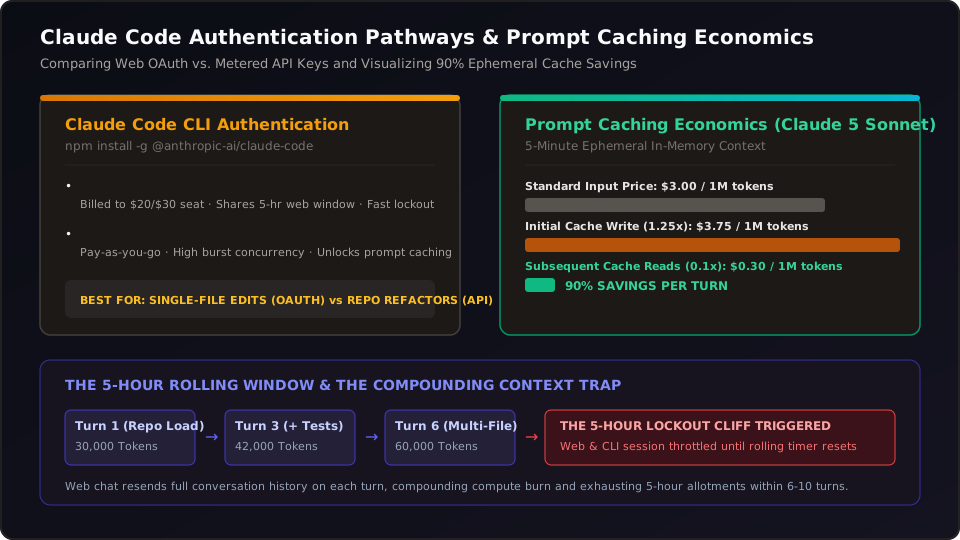
- The Compounding Context Trap: In web and mobile chat interfaces, every new turn resends the entire conversation history back to the model. If your session starts with a 30,000-token codebase dump, your first question consumes 30,000 input tokens. Your second question resends the first question plus the response, consuming 35,000 tokens. By turn six, a single message might consume 60,000 tokens of input compute.
- The Result: A user asking short general questions might get 45–60 messages per 5-hour window on Claude Pro. In contrast, a developer working on large files can exhaust that capacity in 6–10 turns.
Hybrid Reasoning & Thinking Token Burn (Claude 5 Sonnet)
With the introduction of hybrid reasoning in Claude 5 Sonnet, developers can toggle between standard output and “extended thinking.”
When extended thinking is enabled: 1. Thinking Tokens Count as Output Compute: Even though thinking tokens are displayed in a collapsible interface or hidden behind execution logs, they are billed and quota-metered as output tokens. 2. Capacity Acceleration: Setting a thinking budget of 16,000 tokens means a single complex prompt can burn through the equivalent of 20 standard conversation turns in one execution cycle. 3. Best Practice: Reserve extended thinking strictly for difficult architectural problems (e.g., verifying concurrent state machine transitions or auditing security protocol handshakes). For straightforward boilerplate, test drafting, and syntax translations, disable thinking mode to preserve your rolling window.
2. Subscription Comparison: Free vs. Pro vs. Team vs. Enterprise
When structuring seats for an engineering organization, Anthropic provides three primary commercial options:
Claude Pro ($20/month)
- Target: Individual engineers and technical power users.
- Capacity: Approximately 5-fold the usage allowance of the free tier per 5-hour window documented in Anthropic Claude pricing specs.
- Features: Priority access during high-traffic periods, early access to new models, and the ability to create personal Projects.
- Projects Feature: Allows uploading up to 200,000 tokens of reference material (documentation, styling guides, code snippets) that ground all conversations within that workspace.
- Limitation: Individual seat only. Cannot share projects with team members, lacks administrative controls, and inputs may be sampled for model improvement unless opt-out preferences are explicitly configured in privacy settings.
Claude Team ($25/seat/month billed annually, or $30/seat/month billed monthly; 5-seat minimum)
- Target: Engineering squads, startups, and product teams.
- Capacity: Higher usage allocations per user compared to Pro (typically providing higher burst tolerance before throttling).
- Team Workspaces: Shared Projects allow all team members to access common codebase documentation, architecture decision records, and API contracts.
- Data Protection Guarantee: Unlike consumer accounts, Anthropic explicitly commits that Team workspace inputs and outputs are never used to train foundation models.
- Admin Management: Centralized billing, user provisioning, and role-based workspace management.
Claude Enterprise (Custom Annual Contract)
- Target: Regulated enterprise organizations requiring formal compliance.
- Context Ceiling: Expands supported context windows up to 500k tokens for massive codebase analysis.
- Integrations: Native GitHub workspace integration allowing Claude to pull directly from repositories.
- Compliance & Security: Single Sign-On (SAML/SCIM), SOC 2 Type II compliance, audit logging, and custom data retention schedules.
3.
Claude Code (@anthropic-ai/claude-code): Terminal Agent
Architecture
Anthropic’s official terminal agent, Claude Code, brings agentic development directly to the Linux command line. Unlike browser chat interfaces, Claude Code operates as a true agent: it reads local repository files, edits code in place, executes bash test commands, and handles git commits.
The Critical Choice: Pro/Team Subscription vs. Console API Key
When you run claude in your terminal for the first time,
you are presented with two authentication pathways:
+-------------------------------------------------------------------------+
|                         CLAUDE CODE AUTHENTICATION                      |
+------------------------------------+------------------------------------+
|       WEB OAUTH (PRO / TEAM)       |        CONSOLE API KEY             |
+------------------------------------+------------------------------------+
| - Authenticates via claude.ai      | - Authenticates via ANTHROPIC_KEY  |
| - Billed to $20/$30 monthly seat   | - Metered pay-as-you-go billing    |
| - Shares your 5-hour web window    | - Independent API rate limits      |
| - Zero per-token micro-invoicing   | - Unlocks Prompt Caching (90% off) |
| - Hard throttling on heavy repos   | - High burst capacity for CI loops |
+------------------------------------+------------------------------------+
Pathway A: Web OAuth (Pro / Team Subscription)
- How It Works: Claude Code opens a browser window and authenticates with your existing Pro or Team subscription.
- Pros: Zero marginal cost. All terminal operations are covered by your flat $20/month subscription.
- Cons: Full repository analysis consumes massive token context. Running Claude Code over a medium repository can exhaust your 5-hour subscription quota in 20 minutes, locking you out of both the terminal and web interface.
Pathway
B: Anthropic Console API Key (ANTHROPIC_API_KEY)
- How It Works: You provide a prepaid API key from
console.anthropic.com. - Pros: No 5-hour lockout. The agent runs at full API throughput, making it ideal for deep refactoring sessions, test suite generation, and long-running autonomous tasks.
- Cons: You pay metered rates per token. Without proper caching and scoping, a runaway agent loop can rapidly consume $15–$30 in an afternoon.
4. Prompt Caching: Slashing Terminal & API Costs by 90%
For developers choosing the API route, Anthropic Prompt Caching is the single most important architectural feature in the platform, delivering up to a 90% cost reduction on cached prompts.
How It Works
Traditional LLM APIs recompute the entire input context on every request. If an agent loops 10 times to fix a bug, and your repository context is 40,000 tokens, you are charged for 400,000 input tokens.
Anthropic’s prompt caching stores static context (repository maps, documentation, and system prompts) in server memory for up to 5 minutes, refreshed on every cache hit documented in Anthropic API pricing specs:
- Cache Write Cost: Charged at 1.25x the standard input token rate on the initial write.
- Cache Read Cost: Charged at only 0.1x (10%) of the standard input token rate on all subsequent requests within the cache window.
- The Savings: On Claude 5 Sonnet, reading cached context drops the price from $3.00 per 1 M tokens down to $0.30 per 1 M tokens – a 90% discount.
Request 1 (Initial Cache Write):
[ System Prompt + Full Repo Context (40k tokens) ]  -->  $3.75 / 1M tokens

Requests 2 through 15 (Subsequent Agent Steps within 5 min):
[ System Prompt + Full Repo Context (Cached) ]      -->  $0.30 / 1M tokens (90% savings)
[ Incremental User Edits & Test Output (1k tokens) ] -->  $3.00 / 1M tokens
When using Claude Code or building custom developer agents, ensure
that system prompts and codebase context blocks are placed at the
beginning of the prompt array and marked with cache control breakpoints
(cache_control: {"type": "ephemeral"}). This ensures that
multi-turn debugging sessions cost pennies instead of dollars.
5. Structuring the Engineering Toolchain
To maximize engineering productivity across the Anthropic ecosystem without triggering constant rate-limit throttling:
- Use Claude Team for Team Knowledge & Review: Deploy Claude Team ($25–$30/seat) to all developers. Use shared Projects to store architectural guidelines, OpenAPI contracts, and design systems. This guarantees audited SOC 2 Type II data privacy while providing ample capacity for day-to-day code review and design work.
- Use OAuth Claude Code for Targeted Single-File Tasks: For quick terminal tasks (generating a single utility function, explaining a compiler error, or staging a git commit), use Claude Code authenticated against your subscription seat.
- Switch to API Keys with Prompt Caching for Full-Repo
Refactors: When launching autonomous multi-file refactoring
runs or large test-generation tasks, switch your terminal harness to
ANTHROPIC_API_KEY. Prompt caching will keep compute costs minimal while ensuring your session never hits a mid-task 5-hour lockout. - Link into a Multi-Model Stack: As explored in our Google AI plans and Jules breakdown and our OpenAI developer tiers guide, high-performing teams avoid relying on a single provider. Pairing Claude 5 Sonnet for precision coding with high-volume subscription allocations (like Codex sub Luna) or Jules cloud sandboxes creates a resilient, cost-effective development engine.