Every engineering team that adopts OpenAI tooling eventually
experiences the same friction: you sign up for a $20/month ChatGPT Plus
subscription, build an automated terminal agent or CI evaluation script,
and suddenly hit a wall. Your terminal throws
401 Unauthorized or 429 Rate Limit Exceeded,
your prompt history stops synchronizing, and your team leads start
asking whether corporate source code is being used to train the next
foundation model.
OpenAI does not run a single developer product. It operates three completely separate commercial pipelines that share the same underlying models but enforce different authentication, quotas, rate limits, and data privacy contracts:
- Consumer Web/App Subscriptions: ChatGPT Plus ($20/mo) and ChatGPT Pro ($200/mo).
- Multi-User Business Workspaces: ChatGPT Team ($25–$30/user/mo) and ChatGPT Enterprise.
- The OpenAI Developer Platform: Pay-as-you-go API
access (
api.openai.com) governed by usage tiers (Tier 1 through Tier 5).
Understanding how these three pipelines interact – and where they fail to cross over – is essential for preventing surprise bills, rate-limit outages, and compliance violations.

1. Plan Breakdown: Plus vs. Pro vs. Team vs. Enterprise
When selecting a subscription for engineering work, the choice is governed by three factors: reasoning model allowances, workspace data isolation, and budget efficiency.
ChatGPT Plus ($20/month)
The standard consumer tier designed for single-user conversational prototyping: - Model Access: GPT-5.6 Luna, Canvas interactive code editor, and standard reasoning models (GPT-5.6 Sol with dynamic caps). - Reasoning Quotas: Everyday conversational text chat is unlimited, while compute-heavy reasoning models draw from shared dynamic pools with weekly velocity limits on high-compute checkpoints like Sol. - Privacy & Training: Opt-in to training by default. If you disable “Improve the model for everyone” in Data Controls to prevent your source code from training future models, OpenAI disables your chat history and web search memory. - Developer Utility: Great for solo debugging, ad-hoc regex generation, and conversational code review. Unusable as a shared team environment or automated CI runner.
ChatGPT Pro ($200/month)
The top-tier individual subscription aimed at heavy software engineers, quantitative researchers, and technical power users: - Model Access: High-volume access to GPT-5.6 Luna, Sol, and Sol pro mode (extended compute reasoning). - Unlimited Reasoning: Unlike Plus, which throttles Sol after a burst of complex queries, Pro substantially elevates message caps under normal usage (subject to automated platform abuse throttles). - Compute-Heavy Modes: Unlocks Deep Research (autonomous web crawl synthesis) and high-compute Sol modes that allocate thousands of internal hidden reasoning tokens before outputting code. - The Core Gotcha: It is strictly an individual seat. You cannot share the account, invite teammates, or provision shared custom GPTs with role-based access control. Most importantly, it provides zero API tokens.
ChatGPT Team ($25/user/month billed annually, or $30/user/month billed monthly, 2-seat minimum)
The entry point for commercial engineering organizations: - Workspace Isolation: A dedicated admin console separating corporate projects from personal chat history. - Zero Training on Corporate Data by Default: Unlike Plus, all inputs and outputs within a Team workspace are excluded from model training automatically, without disabling chat history. - Higher Message Caps: Substantially expanded reasoning allowances and concurrency compared to Plus documented in OpenAI Team plan specs, with expanded Luna and Sol reasoning ceilings. - Shared Artifacts: Team members can create and share internal Custom GPTs connected to company documentation, OpenAPI specs, and internal coding style guides. - The Limitation: Team does not provide the unlimited Sol compute of the $200 Pro tier; heavy reasoning queries still consume from shared periodic quotas.
ChatGPT Enterprise (Custom Annual Contract, typically 150+ seats)
For regulated enterprise engineering organizations: - Enterprise Controls: SOC 2 Type II compliance, SAML SSO/SCIM provisioning, domain verification, and custom data retention windows. - Expanded Context: 128k context windows on flagship models with dedicated high-speed inference pools. - Admin Analytics: Complete audit logs of all model interactions, API usage tracking, and compliance exports.
The Quota Window Architecture: Dynamic Compute vs. Anthropic’s 5-Hour Lockout Cliff
A major operational contrast between OpenAI and Anthropic lies in how their quota clocks tick.
As detailed in our Anthropic Claude subscription analysis, Anthropic enforces a strict, unyielding 5-hour rolling usage window across Pro and Team tiers. If an engineer burns through their allowance within 45 minutes during an intense debugging sprint, Claude locks them out until the 5-hour mark elapses.
OpenAI approaches quota pacing differently, particularly for developer and Codex workflows:
Absence of 5-Hour Limits on Key Plans: Unlike Anthropic, OpenAI does not impose a rigid 5-hour rolling lockout window on Codex and reasoning tasks across plans like ChatGPT Pro ($200/month). Everyday conversational chat is unlimited, and advanced reasoning compute runs without an arbitrary 5-hour shutdown. Engineers can prompt continuously throughout an eight-hour workday without hitting a mid-day lockout cliff.
The Operational Trade-Off: Unbroken Flow vs. Opaque Throttling:
- The Benefit: Freedom from the 5-hour lockout cliff allows unbroken developer flow. You are never stranded mid-refactor waiting for an arbitrary hourly timer to reset.
- The Drawback: When OpenAI does throttle an account (due to anti-abuse rate limits, concurrency ceilings, or weekly reasoning caps), the recovery timeline is less deterministic. Rather than displaying a predictable countdown, OpenAI may downgrade queries to lighter models, apply silent velocity delays, or require waiting for weekly pool refreshes.
Cluster Capacity Generosity: OpenAI’s throttling thresholds fluctuate dynamically with real-time data center load. When GPU clusters experience low contention (such as off-peak overnight hours, weekends, or following new infrastructure expansions), OpenAI is remarkably generous with granting early usage resets and expanding silent prompt allowances well beyond baseline floors. Conversely, during major service spikes, limits contract dynamically without advance warning.
2. The Great Wall: ChatGPT UI Subscriptions vs. OpenAI Platform API
The single most common misunderstanding among software developers is assuming that subscribing to ChatGPT Plus ($20) or Pro ($200) funds their development API scripts.
They are completely separate billing systems.
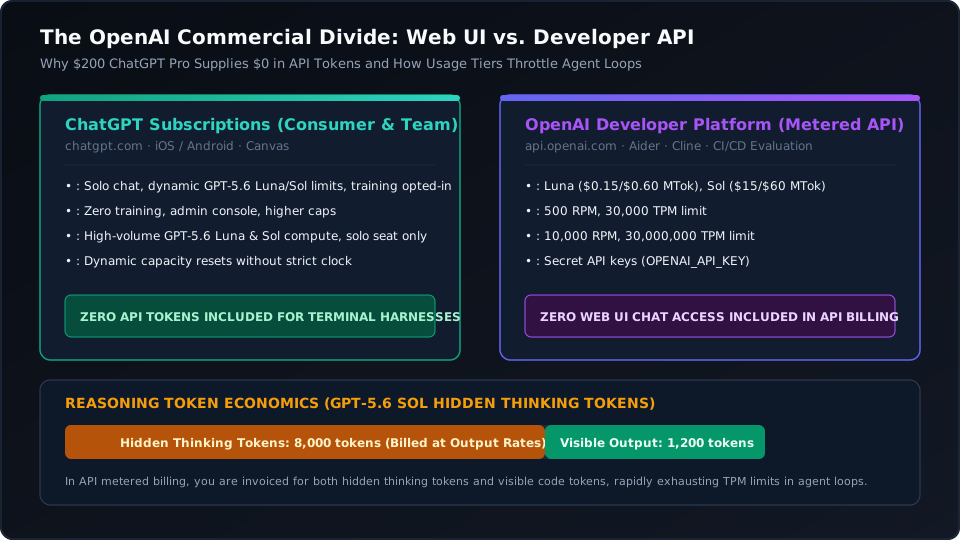
+-------------------------------------------------------------------------+
|                           OPENAI ECOSYSTEM                              |
+------------------------------------+------------------------------------+
|         CHATGPT SUBSCRIPTIONS      |       OPENAI DEVELOPER PLATFORM    |
|       (chatgpt.com / mobile)       |         (api.openai.com)           |
+------------------------------------+------------------------------------+
| - Plus ($20) / Pro ($200) / Team   | - Pay-As-You-Go API Tokens         |
| - Fixed monthly credit card bill   | - Metered billing per 1 M tokens   |
| - Authenticates via OAuth / Web    | - Authenticates via API Secret Key |
| - Output: Rendered web UI / Canvas | - Output: Raw JSON token streams   |
| - Quota: Messages per rolling hrs  | - Quota: RPM / TPM / RPD Tiers     |
| - Runs inside browser or app       | - Runs in terminal agents, CI/CD   |
| - ZERO API CREDITS INCLUDED        | - ZERO WEB UI ACCESS INCLUDED      |
+------------------------------------+------------------------------------+
If you configure a terminal agent (such as Aider, Cline, OpenHands,
or custom Python orchestration scripts) with
OPENAI_API_KEY, your monthly ChatGPT subscription does not
subsidize a single token. Every input prompt, cached context block, and
generated completion is billed against your prepaid credit balance at
standard rates. For example, GPT-5.6 Luna costs $0.15 per 1 M input
tokens and $0.60 per 1 M output tokens, while GPT-5.6 Sol costs $15.00
per 1 M input tokens and $60.00 per 1 M output tokens.
Comparison with Google’s Ecosystem
This is where OpenAI diverges sharply from Google: - On Google’s $200/mo Ultra plan, subscribers receive $100/month in Google Cloud developer credits, which can be directly routed to Gemini API token billing in Google AI Studio or Vertex AI. - On OpenAI’s $200/mo Pro plan, you receive $0 in API credits. The entire $200 is consumed by web and mobile client compute.
If your primary workload involves automated agent loops running inside terminal environments, paying $200 for ChatGPT Pro is an operational mismatch unless you are leveraging native Codex sub allocations. Otherwise, that $200 is far more effectively deployed as prepaid API credits driving headless agents over raw endpoints.
3. Reasoning Models: GPT-5.6 Sol and Thinking Model Quota Economics
OpenAI’s flagship reasoning models (such as GPT-5.6 Sol) introduce an invisible cost vector: hidden reasoning tokens.
How Reasoning Tokens Work
When you submit a complex debugging prompt to Sol, the model produces two distinct sets of tokens: 1. Thinking Tokens: Internal chain-of-thought tokens where the model explores hypotheses, backtracks, and plans code structure. You never see these tokens in the UI output, but they count against your quota and API token bill. 2. Completion Tokens: The visible markdown response, code snippets, and explanations returned to you.
On complex refactoring tasks, a Sol model might generate 8,000 thinking tokens to produce 400 lines of Python code (approximately 1,200 visible tokens). In API billing, you are invoiced for all 9,200 tokens.
Quota Behavior Across Tiers
- On ChatGPT Plus: Sol has strict weekly and daily velocity caps. Submitting two 1,000-line file audits can lock your account out of Sol for the remainder of the day, forcing fallback to standard GPT-5.6 Luna.
- On ChatGPT Pro ($200/mo): Sol runs without visible message counters under standard conditions. However, OpenAI enforces background concurrency rate limits to prevent automated scraping scripts from monopolizing compute clusters.
- On the Developer API: There are no message count caps, but you are subject to TPM (Tokens Per Minute) limits. Because a Sol query consumes thousands of reasoning tokens in seconds, a parallel batch of 5 developer requests can instantly trigger an HTTP 429 rate limit error on lower platform tiers.
4. The API Rate Limit Trap: Tiers 1 Through 5
When an engineering team builds an internal tool or CI test runner using OpenAI’s API, depositing money does not immediately grant high throughput. OpenAI enforces an automated reputation and spend ramp known as Usage Tiers:
- Tier 1 ($5 prepaid deposit):
- Strict limits: 500 RPM (Requests Per Minute) and 30,000 TPM (Tokens Per Minute) on flagship models.
- Failure Mode: A single repository agent analyzing 20 source files with prompt caching can easily exceed 30,000 tokens in a single request, resulting in immediate HTTP 429 failures.
- Tier 2 ($50 paid + 7 days since first payment):
- 5,000 RPM and 450,000 TPM on Luna; 1,000 RPM and 100,000 TPM on Sol.
- Suitable for small internal team scripts and lightweight PR review bots.
- Tier 3 ($100 paid + 7 days since Tier 2):
- 5,000 RPM and 800,000 TPM on Luna; 200,000 TPM on Sol.
- Capable of running continuous integration test suites and multi-agent code analysis.
- Tier 4 ($250 paid + 14 days since Tier 3):
- 10,000 RPM and 2,000,000 TPM on flagship models.
- Tier 5 ($1,000 paid + 30 days since Tier 4):
- Maximum standard self-service throughput (10,000+ RPM and 4,000,000+ TPM).
The Ramp-Up Trap
If your engineering organization launches a new product feature powered by OpenAI on Day 1, you cannot bypass this progression simply by depositing $2,000 into a fresh account. OpenAI enforces the time-gated waiting period between tiers to mitigate fraudulent chargebacks and cluster abuse.
Mitigation Strategy: Provision your organization’s API account weeks in advance of planned launch dates and execute scheduled automated synthetic test runs to graduate through Tiers 2, 3, and 4 before production traffic arrives.
5. Canvas vs. Full-Repository Coding Agents
OpenAI’s coding interface, Canvas, represents an intermediate paradigm between conversational chat and autonomous terminal agents:
- What Canvas Does Well:
- Side-by-side editable document surface.
- Targeted surgical refactoring: you highlight lines 42–68 and prompt “Add bounds checking and extract error return types.”
- Inline code review comments with quick-accept buttons.
- Where Canvas Fails:
- No Repository Context: Canvas has no awareness of
files outside the active editor window. It cannot read your
package.json, follow imports into neighboring modules, or verify type signatures across packages. - No Verification Execution: Canvas cannot run your unit tests, execute linters, or check compiler outputs. You must manually copy code back into your local IDE to test it.
- Manual Synchronization Overhead: Keeping a multi-file refactor synchronized between Canvas and your git working tree creates friction and error-prone copy-paste drift.
- No Repository Context: Canvas has no awareness of
files outside the active editor window. It cannot read your
For multi-file refactoring, dependency updates, and automated test-driven development, developers achieve far higher leverage by combining headless terminal harnesses (such as Aider, Cline, or Antigravity) directly with local git trees and API keys.
6. Data Governance: How to Protect Corporate Code
Engineering teams handling proprietary algorithms or customer data must enforce strict privacy controls:
Consumer Accounts (Plus / Pro)
- By default, all interactions are eligible to be included in future foundation model training datasets.
- To opt out, navigate to Settings > Data Controls > Improve the model for everyone and toggle it off.
- The Penalty: Disabling training in consumer accounts disables your saved chat history and cross-session memory. If you want history retention without model training, you must move to a business tier.
Team and Enterprise Accounts
- Zero Training Contract: Commercial workspaces are covered by OpenAI’s Business Data Privacy policy. No customer prompts, uploaded attachments, or generated code are used to train OpenAI models.
- Data Retention: Standard conversations are retained for 30 days for trust and safety abuse monitoring before deletion, unless your enterprise contract specifies custom zero-data-retention (ZDR) endpoints.
API Data Handling
- By default, data sent to
api.openai.comis never used to train models, regardless of spend tier. - Requests are retained in secure logs for up to 30 days solely for abuse monitoring. Organizations with strict regulatory requirements (HIPAA, SOC 2) can request Zero Data Retention for eligible endpoints.
7. The Pragmatic Engineering Token Stack
To extract maximum developer velocity without overspending, high-performing software teams structure their OpenAI allocation across three distinct layers:
- Layer 1: The Team Workspace ($25/seat/month)
- Deployed to all technical team members for ad-hoc brainstorming, documentation synthesis, and architectural discussion.
- Enforces default data privacy and training opt-outs.
- Houses shared team GPTs grounded on internal engineering manuals and design patterns.
- Layer 2: Dedicated API Keys for Terminal Agents (Tier
3+)
- Headless agents (Aider, OpenHands, Cline) run locally inside developers’ terminal windows.
- High-throughput API keys allow agents to ingest full repository context, run local test suites, and execute self-correcting fix loops.
- Direct API token spending replaces the need for expensive individual $200 Pro licenses for general engineers.
- Layer 3: Targeted GPT-5.6 Sol High-Reasoning
Escalation
- Reserve high-compute Sol and Sol pro mode strictly for hard architectural problems: distributed race conditions, complex mathematical optimizations, and formal protocol designs.
- Standard boilerplate, unit test scaffolding, and syntax migration tasks are routed to high-speed models (such as Codex sub Luna or DeepSeek V4 Flash) at ~90% lower effective token burn based on OpenAI API pricing.
By separating interactive team exploration from automated terminal agent execution, engineering organizations eliminate rate-limit roadblocks while keeping proprietary source code secure.