If you subscribe to a high-tier Google AI plan, such as Google One AI Premium ($20/mo) or Google AI Ultra ($200/mo), you immediately encounter conflicting product boundaries.
The marketing pages present a clean list of benefits: massive cloud storage, Gemini Advanced, Gemini in Workspace, creative studios, YouTube Premium, developer credits, and agentic coding with Jules. But when you actually invite family members to your plan, fire up a terminal agent on Linux, or dispatch background tasks to a GitHub repository, the real-world behavior frequently diverges from developer expectations.
Why didn’t your family members get ad-free YouTube? Why is a supervised child account blocked from Gemini 3 Pro reasoning? Why did your terminal script throw a 429 rate limit error when your account has an advertised 20-fold quota expansion? And how do you route the monthly Google Cloud credits to container workloads without getting surprise bills?
Here is the operational breakdown of how Google AI plans work in practice, where the hidden boundaries lie, and how to configure your developer toolchain to extract maximum value.

First, the fact check
Before looking at specific features, we should address four common assumptions developers and families make when upgrading to Google AI tiers:
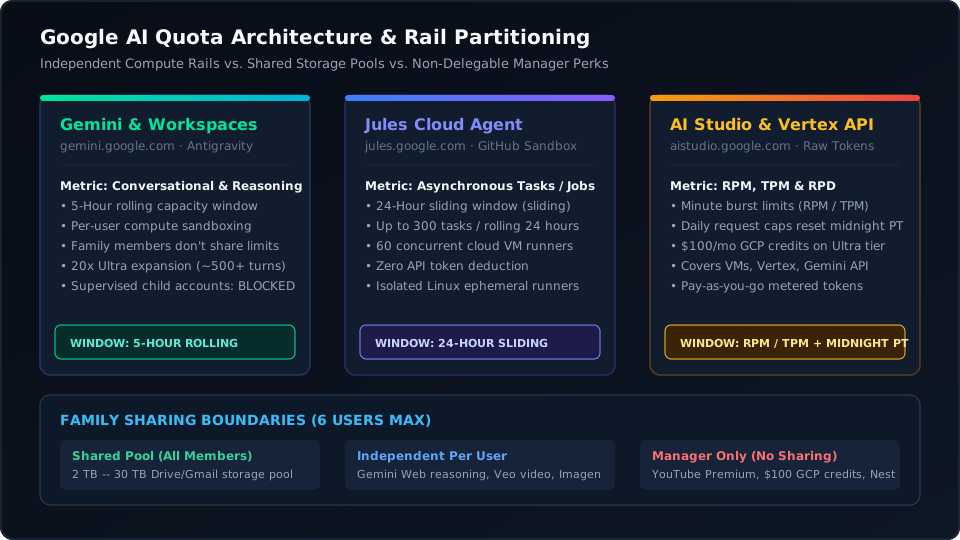
- ✗ Family members share your Gemini rate limits and query pools. Heavy terminal sessions, automated code generation, or complex reasoning queries run by one family member do not exhaust or throttle anyone else’s usage. Each adult member in a Google Family Group receives an independent 5-hour rolling compute window and distinct model quotas.
- ✗ Family sharing includes bundled YouTube Premium. Even on the $200/mo Ultra plan that includes an individual YouTube Premium membership at no added charge, YouTube benefits are locked strictly to the primary plan manager’s account. Subaccounts and family members continue to see ads unless enrolled in a standalone YouTube Family Plan.
- ✗ Jules and Google AI Studio pull from the same API token quota. Jules and Google AI Studio operate on two completely isolated infrastructure rails. Jules tracks subscription-managed tasks, concurrent repo sandboxes, and PR dispatches. AI Studio tracks requests per minute (RPM) and tokens per minute (TPM) tied to Google Cloud project quotas. Exhausting capacity in one never affects the other.
- ~ Google Cloud developer credits cover all billing charges. The monthly developer credits (e.g. $100/mo on Ultra) cover core infrastructure – Compute Engine Linux VMs, GKE clusters, Vertex AI endpoints, Cloud Storage, and paid Gemini API tokens in AI Studio. However, they strictly exclude third-party marketplace software charges and domain registrations.
1. The Family Sharing Architecture: Shared Pools vs. Independent Ceilings
Google allows plan managers to share their subscription with up to 5
additional family members via Google Family Groups
(families.google.com). However, the system divides benefits
into two distinct operational models:
Independent Per-User Ceilings
These features are partitioned into isolated sandboxes. Usage by one member has zero impact on the quotas of another:
- Gemini Web and Advanced Models: Each member (aged 18+) accesses Gemini through their own personal Google identity. Prompts, history, custom instructions, and context windows remain private. When an individual user exhausts their high-tier compute allocation during a rolling 5-hour window, only their account falls back to lightweight models (such as Flash-Lite); other members continue with full Pro and Deep Think access.
- Media and Creative Generation: Daily generation allotments for generative media (Veo video animations, Imagen high-resolution generation, and Google Photos Remix) reset individually on each user profile.
- Gemini in Workspace Apps: Each member gets personal side-panel assistance inside Gmail, Google Docs, Sheets, and Slides linked to their individual Google account.
Global Shared Pools
These resources draw from a single shared reservoir across all group members:
- Cloud Storage Bucket: The 2 TB, 5 TB, or 30 TB storage pool is shared collectively across Gmail, Google Drive, and Google Photos. If one member stores large dataset backups or video files consuming 15 TB, that capacity is unavailable to everyone else. Files remain private to each account, but volume consumption is shared.
- Google Flow and Studio Credits: Discretionary creative credits (such as monthly Flow credits for generative projects) draw from the master account pool.
The Age Restriction Boundary
Google enforces a strict policy gate on advanced reasoning: - Ages 18 and Older: Full access to Gemini Pro models, Deep Think extended reasoning, Deep Research multi-step report generation, and creative media synthesis. - Under 18 or Supervised Accounts: Advanced models, code generation engines, and creative image/video tools are entirely disabled. Supervised accounts retain basic storage sharing and core family perks, but they cannot inherit advanced AI capabilities.
2. Manager-Only Perks: What Fails to Share
Several of the most valuable bundled perks remain tied exclusively to the primary billing account and cannot be delegated:
- YouTube Premium / YouTube Premium Lite: Bundled ad-free playback, offline downloads, and YouTube Music access remain strictly bound to the manager. Family members receive no YouTube perks.
- Monthly Google Cloud Developer Credits: Promotional credits are deposited solely into the Google Cloud Billing Account linked to the primary manager.
- Google Home Premium and Nest History: Cloud video event recording and home automation Gemini enhancements do not extend to secondary family accounts.
- Google Store Cash Back: Hardware purchase rebates and promotional store credits accrue exclusively to the primary purchaser.
3. Jules vs. Google AI Studio: Two Different Engines
For software engineers, understanding the operational separation between Jules and Google AI Studio is critical for designing reliable dev workflows.
+-------------------------------------------------------------------------+
|                              GOOGLE AI                                  |
+------------------------------------+------------------------------------+
|               JULES                |          GOOGLE AI STUDIO          |
|    (jules.google.com)              |       (aistudio.google.com)        |
+------------------------------------+------------------------------------+
| - Asynchronous Repo Agent          | - Raw Model API Access             |
| - Isolated Cloud Sandbox / VM      | - Direct Token Streaming           |
| - Governed by AGENTS.md            | - Governed by Cloud Quotas         |
| - Output: Git Branch & PR          | - Output: Direct API Responses     |
| - Quota: Concurrent Tasks          | - Quota: RPM / TPM / RPD           |
| - Zero API Token Billing           | - Pay-As-You-Go / GCP Credits      |
+------------------------------------+------------------------------------+
Jules: Asynchronous Repository Automation
Jules (jules.google.com) is an autonomous coding agent.
Instead of running inline inside an editor, Jules operates
asynchronously in an isolated cloud sandbox:
- Repository Connection: You link your GitHub account and grant repository access. (Jules is currently hard-coupled to GitHub via the Google Labs GitHub App; it does not support direct generic Git URLs or self-hosted webhooks).
- Context Ingestion (
AGENTS.md): Jules inspects up to 30,000 lines of codebase context. It reads your project’sAGENTS.mdto discover build commands, test suites (such aspytest,npm test, ormake validate-content), and linting rules. - Execution: Jules plans changes, creates a feature branch, modifies files, runs your test suites inside its virtual machine to verify correctness, and opens a GitHub Pull Request with a visual diff and test summary.
- Quota Metric: Jules consumption is measured in concurrent tasks and active background jobs, not token counts. On the Ultra tier, you receive priority task queues and higher concurrency.
Google AI Studio: Raw Token Streaming and Terminal Agents
Google AI Studio (aistudio.google.com) is a developer
portal for direct API integration:
Direct API Access: Generate API keys bound to a Google Cloud Project to call Gemini 3 Pro, Gemini 3 Flash, and Astra models directly.
Terminal and Local CLI Integration: You export the API key in your Linux terminal to power agentic harnesses:
export GEMINI_API_KEY="AIzaSy..."This key powers local developer agents such as Antigravity, Aider, OpenCode, LiteLLM, or custom Python pipelines.
Quota Metric: AI Studio requests are tracked purely by RPM (Requests Per Minute), TPM (Tokens Per Minute), and RPD (Requests Per Day).
Because the systems run on independent rails, running an automated script in AI Studio that exhausts your RPM limit will never stop Jules from continuing its repository tasks.
The Three Distinct Quota and Reset Schedules
Neither Jules nor Google AI Studio uses the consumer Gemini app’s 5-hour rolling window. The three engines operate on completely different schedules:
- Gemini Web and Antigravity Workspaces:
- Metric: Conversational queries and Deep Think reasoning.
- Reset Window: Rolling 5-hour window.
- Ultra Capacity: 20-fold Pro headroom documented in Google AI plan specs (~500+ heavy queries per 5-hour cycle).
- Jules (
jules.google.com):- Metric: Asynchronous tasks and active concurrency.
- Reset Window: Rolling 24-hour sliding window (not a fixed midnight reset). If you launch 20 tasks at 2:00 PM, those 20 task slots open back up at 2:00 PM the following day.
- Ultra Capacity: Up to 300 tasks per rolling 24 hours and 60 concurrent jobs in flight simultaneously.
- Google AI Studio
(
aistudio.google.com):- Metric: Tokens and raw API requests.
- Reset Window: Short-burst RPM/TPM minute caps + Daily RPD resetting at midnight Pacific Time (PT) + monthly calendar billing cycle on Google Cloud.
- Ultra Capacity: Standard developer tier rate limits, funded by your $100/mo Cloud Developer Credits.
Connecting Non-GitHub and Self-Hosted Forges (GitLab, Gitea, Forgejo, Bitbucket) to Jules
Because Jules currently couples directly to GitHub via the Google Labs GitHub App, engineering teams on alternative platforms face an immediate integration barrier. This affects organizations running GitLab as well as teams using lightweight engines like Forgejo and Gitea, or enterprise platforms like Bitbucket Data Center. Jules offers no direct generic Git-over-SSH remotes or webhooks for these environments.
To bridge this gap without abandoning your primary forge, two operational patterns are used in practice:
Pattern A: The Two-Way Push Mirror Bridge
If organizational security policies permit sanitized code passing
through an intermediary private GitHub account: 1. Create a private
GitHub mirror repository and install the Jules GitHub App. 2. Configure
your primary forge’s native push mirroring – such as GitLab’s Repository
Mirroring
(Settings > Repository > Mirroring repositories), or
equivalent push mirroring in Forgejo, Gitea, and Bitbucket – to
replicate designated feature branches to the private GitHub repository.
3. Dispatch tasks to Jules against the GitHub mirror. 4. Once Jules
completes its execution, pull the resulting PR branch or commit back
into your primary forge via Git CLI or webhook. This offloads
compute-heavy refactoring, test drafting, and lint repairs to Google’s
cloud VMs while maintaining GitLab or your internal forge as the
authoritative source of truth.
Pattern B: Local Headless Agents via AI Studio Key (Zero External Exposure)
If code cannot touch external third-party cloud infrastructure due to
air-gapped networks, export controls, or strict data residency mandates:
1. Generate a paid Gemini API key in Google AI Studio (funded by your
$100/mo monthly Cloud credits). 2. Run an open-source terminal agent
(such as Aider, OpenCode, Antigravity, or custom Python scripts) locally
against your local clone, regardless of whether your origin is GitLab,
Gitea, Forgejo, Bitbucket, or a bare SSH server:
bash pip install aider-chat export GEMINI_API_KEY="your-ai-studio-key" aider --model gemini/gemini-2.5-pro --message "Implement structured error handling in auth.go" git push origin <feature-branch>
3. Open the Merge Request (MR in GitLab) or Pull Request natively inside
your private forge’s web UI or CLI. This keeps your entire source tree
within your perimeter while putting your monthly developer credit pool
to active use.
Can Jules Use
Repository Skills (.agents/skills/)?
For engineering teams that maintain structured skill directories
(such as Prompt Swap packages under .agents/skills/ or
.claude/skills/), Jules can leverage them, but with
specific architectural constraints:
As Prompt and Policy Directives (Yes): Because skills are committed directly into git as plain Markdown specifications (
SKILL.md), Jules has full filesystem access to them inside its ephemeral VM. When directed byAGENTS.mdor a task prompt, Jules reads the skill file, parses the heuristics, and strictly applies those rules to its code synthesis.As Deterministic Verification Scripts (Yes): When a skill bundles runnable linters (such as Python validation gates,
node scripts/check-prose-copyediting.mjs, ormake validate-content), Jules runs them inside its VM loop to verify diffs before opening a PR.As Dynamic MCP Servers or Workstation Binaries (No): Jules runs in a closed, Google-managed agent sandbox. It cannot communicate with external MCP (Model Context Protocol) servers on your local workstation, nor can it execute workstation-only package managers like
pswdirectly. The skills must be materialized in the repo.Managing the 30,000-Line Context Budget: Jules indexes approximately 30,000 lines of codebase context on launch. Inlining dozens of comprehensive skills into
AGENTS.mddirectly will blow past this ceiling. The proven pattern is an on-demand skill routing table inAGENTS.md:## Specialized Domain Skills (Read on Demand) - Editorial & prose style: read `.agents/skills/copy-editing/SKILL.md` - Pain-first SEO planning: read `.agents/skills/pain-first-content-strategy/SKILL.md` - JSON-LD & entity schema: read `.agents/skills/schema-markup/SKILL.md`This instructs Jules to load the detailed skill instructions only when working on tasks that explicitly touch those domains.
Inside the Jules Cloud VMs: What Works (and What Times Out)
When Jules begins a task, Google provisions an ephemeral, isolated
Linux virtual machine with approximately 20 GB disk space: - VM
Lifecycle: Boots, pulls your git branch, installs runtime
dependencies (npm, pip, cargo,
go), plans and edits code, runs validation test scripts,
pushes a branch or PR, and is immediately destroyed. - Execution
Privileges: VMs have outbound network egress to fetch public
package dependencies. However, you do not get interactive SSH
access.
Is Jules Suitable for Mutation Testing?
- Running Raw Mutation Suites (No): Mutation testing frameworks (such as Stryker, mutmut, or cargo-mutants) generate hundreds or thousands of code mutants and execute the full test suite against each one. Because Jules VMs are tuned for fast CI validation and agent reasoning (typically concluding in 10-20 minutes), running large brute-force mutation suites risks hitting wall-clock execution timeouts. In addition, Google provides fixed vCPU and RAM allocations without custom instance sizing.
- Killing Surviving Mutants (Yes): The high-leverage workflow is to run mutation testing on your local workstation or dedicated CI runner, collect the surviving mutants, and hand the diagnostic report to Jules as a discrete task: > “Here is our mutation test report for pkg/auth. Mutant #14 (flipped conditional on line 82) and Mutant #19 (omitted error check on line 114) survived. Write targeted unit tests in auth_test.go that kill both mutants without breaking existing test suites.” Jules will write the tests, verify they compile and pass, and open a PR.
What Counts as a “Task” in Jules?
- 1 Dispatch = 1 Task: Entering a prompt and clicking Run (or executing via CLI) consumes 1 task slot.
- In-Flight Iterations: Providing feedback during active review before finalizing the run (such as asking Jules to update test mocks) counts within the same task lifecycle.
- Outcome Independence: Whether Jules produces a clean passing PR or aborts on an unresolvable build loop, the compute run is counted against your 24-hour allocation once concluded.
- Suggested Tasks: Approving automated repo recommendations (such as dependency updates or TODO fixes) consumes 1 task each.
Operating via the Jules
CLI (@google/jules)
Developers can control Jules directly from a Linux terminal rather than the web UI:
Installation and Auth:
npm install -g @google/jules
jules login
Dispatching Tasks: Inside a local checkout of a connected GitHub repository, Jules detects the remote automatically:
jules remote new --session "Refactor worker pool to use context cancellation"Local Patch Ingestion (
jules remote pull): The most powerful feature of the CLI is bypassing full GitHub PR merges. You can pull work-in-progress patches directly into your local working tree to inspect, test, or build locally:jules remote pull --session <session-id>Teams maintaining repositories on GitLab, Forgejo, or Bitbucket can bridge to Jules cleanly. Push feature branches to your private GitHub mirror, dispatch Jules via CLI, and pull the diff locally to verify before merging upstream.
4. Maximizing the $200/mo Google AI Ultra Tier
The $199.99/month Google AI Ultra plan, providing a 20-fold quota expansion over standard Pro tiers, supports compute-heavy agentic development, large codebase analysis, and deep technical synthesis. To justify the cost, developers should leverage five key capabilities:
1. The 2 M Token Context Ceiling and 1,500-Page Document Ingest
Ultra expands single-file upload limits to 1,500 pages and maintains full 2-million-token context windows in the primary web interface. You can upload entire specification suites, architectural blueprints, or decades of regulatory RFCs for semantic search and synthesis without preprocessing or chunking.
2. High-Capacity NotebookLM Workspaces
Standard tiers cap NotebookLM workspaces at 50 source documents. The Ultra tier expands this ceiling to 600 sources per notebook. This enables developers to ground an entire software ecosystem: - Full repository markdown documentation - Historical git commit histories and architecture decision records (ADRs) - Upstream third-party API specifications - System architecture diagrams and deployment manifests
The resulting notebook acts as a fully grounded semantic reference that answers architectural queries without hallucination.
3. Automated Browser Workflows (Gemini Spark)
Signed-in Chrome sessions in supported regions unlock automated multi-step browser tasks. Gemini can navigate authenticated dashboards, query operational metrics, parse vendor interfaces, and automate repetitive web administrative workflows without custom Puppeteer scripts.
4. Directing the $100/mo Google Cloud Credits
Ultra subscribers receive $100 per month in promotional Google Cloud credits via the Google Developer Program.
How to Activate:
- Navigate to the Google Developer Program Dashboard
(
developers.google.com/profile). - Select the Benefits tab and locate the monthly Google Cloud credit allotment.
- Select your active Google Cloud Billing Account and click Apply.
Eligible Workloads:
- Paid AI Studio Token Ingestion: When your terminal agents exceed free-tier rate limits, paid Gemini 3 Pro requests consume from this $100 pool before charging your credit card.
- Compute Engine Linux VMs: Host headless agent loops, continuous test runners, or compilation servers.
- Google Kubernetes Engine (GKE): Deploy containerized backend microservices and development preview clusters.
- Vertex AI Endpoints and Model Garden: Run specialized open-weights models and private fine-tuning.
- Cloud Storage: Store large training datasets, build artifacts, and image backups.
Ineligible Workloads:
- Third-party software licenses purchased through Google Cloud Marketplace.
- Domain registrations and DNS renewals via Cloud Domains.
- Extra consumer Google One storage or standalone media credit add-on packs.
5. Production Linux CLI Configuration
When running agentic coding loops on Linux workstations, configure budget safety gates to prevent unexpected charges if an agent enters an infinite retry cycle.
In your Google One / AI Studio billing settings: 1. Set the overage
policy to “Never charge overages” or set a strict
monthly budget alert at $100. 2. In your local development profile,
isolate project credentials:
bash # ~/.bashrc or project .env export GEMINI_API_KEY="AIzaSy..." export GEMINI_MODEL="gemini-2.5-pro" # Fail closed if token limit approached export AGENT_MAX_TURNS=25
5. Promotional Paths, Carrier Perks, and Eligibility Checks
While Google rarely offers traditional checkout promo coupon codes, several promotional paths and subsidized partner tiers exist:
- Carrier Subsidies:
- Google Fi Wireless: Select Unlimited Plus plans include or heavily discount Google One storage tiers and AI add-ons.
- Mobile Carriers and App Bundles: Telecom providers (such as Verizon through myPlan perk credits or T-Mobile bill credits) offer monthly subsidies on Google One plans.
- Hardware Bundles:
- Google Pixel Devices: Purchasing a Pixel Pro or Pixel Fold smartphone routinely bundles 6 to 12 months of Google AI Pro or Google One AI at no extra cost.
- Chromebook Plus Perks: New Chromebook Plus buyers
can claim 3 to 12 months of Google AI subscription access via
google.com/chromebook/perks.
- Student Verification: Enrolled university students
with verified
.educredentials (via SheerID or institutional SSO) frequently qualify for up to 12 months of subsidized or zero-cost access. - Trial Eligibility Verification: Open an incognito
browser window, navigate to
gemini.google/subscriptionsorone.google.com/about/google-ai-plans, and log into your primary account. Any introductory 1-month or 2-month $0 trial offers appear directly on the tier selection buttons.
Summary Comparison: Standard AI Premium vs. AI Ultra (20-Fold Quota)
The core technical trade-offs between the consumer and developer tiers break down across five dimensions:
- Compute Allowance: Standard AI Premium (~$20/mo) provides baseline Pro model access for conversational use. AI Ultra (~$200/mo) delivers a 20-fold compute expansion documented in Google AI plan specifications, offering ~500-600 heavy reasoning queries per 5-hour rolling window.
- Context Depth: Standard supports standard document uploads; Ultra expands file capacity to 1,500 pages per file and 600 sources per NotebookLM workspace.
- Developer Financing: Standard includes zero Google Cloud credits; Ultra deposits $100/mo into your linked Google Cloud Billing Account.
- Bundled Media Perks: Standard includes YouTube Premium Lite (where available); Ultra includes full individual YouTube Premium with YouTube Music.
- Agent Concurrency: Standard provides standard Jules background processing; Ultra unlocks priority task queueing and expanded repository analysis up to 30k lines.
Understanding where the plan partitions compute, pools resources, and enforces account boundaries turns an opaque consumer bundle into a predictable, high-throughput developer platform.