
The 19,000 % Alchemy Spread: Why Fusion Rewrites Transmutation
Purely on a raw material basis, transmuting mercury (Hg) into gold
(Au) is wildly profitable. Bulk industrial mercury trades between $50
and $650 per kilogram, according to USGS
Mineral Commodity Summaries. Pure gold trades near $130,000 per
kilogram (~$130/g), making gold 200 to 2,500 times more
valuable by mass.
Because nuclear transmutation converts atoms on a 1-to-1 basis, atomic weights govern the physical yield. Natural mercury averages 200.59 g/mol, while stable gold (197Au) weighs 196.97 g/mol. Transmuting 1 kg of mercury retains 98.2 % of the input mass, yielding 0.982 kg of gold worth over $127,000 against $50 to $650 in feedstock costs.
Ignoring reactor capital and process expenses, that spread represents a gross feedstock margin exceeding 19,000 %. If humanity converted its entire annual mercury supply of 1,500 to 4,000 metric tons into gold, global output would jump by 1,470 to 3,930 metric tons per year. According to World Gold Council supply data, that addition would expand global gold mining output (3,300 t/yr) by 45 % to 119 %.
For eight decades, process costs made this margin inaccessible
because particle accelerators and thermal fission reactors consumed
millions of dollars of electricity per gram produced. In late 2025 and
2026, fusion neutronics research led by Marathon Fusion
(arXiv:2507.13461) changed the engineering calculus.
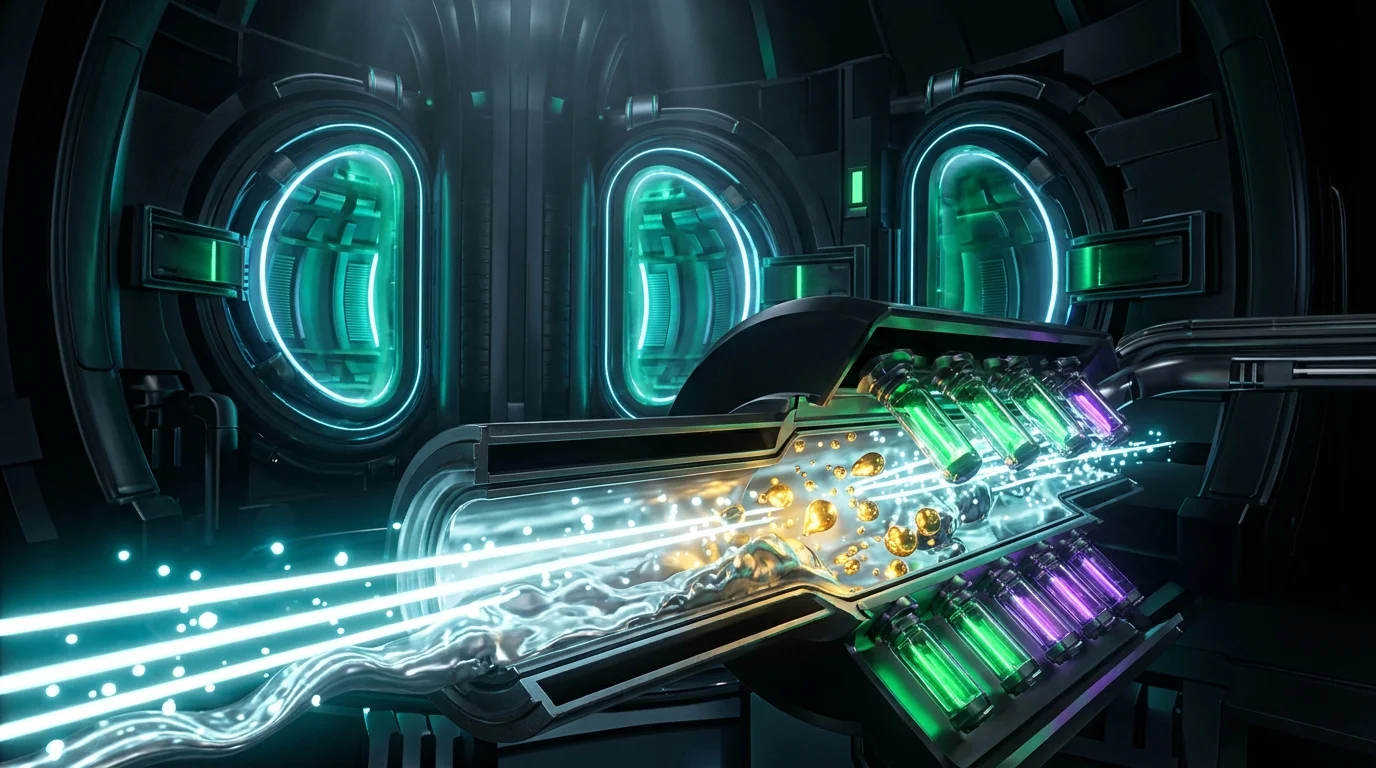
Instead of running a dedicated accelerator, a Deuterium-Tritium (D-T)
fusion power plant can use liquid mercury-198 (198Hg) inside
its breeding blanket as a fast-neutron multiplier.
The 14.1 MeV fusion neutrons drive an (n, 2n) reaction on 198Hg. Each reaction knocks out one neutron and releases two lower-energy neutrons that still breed tritium in lithium-6 (6Li) at a Tritium Breeding Ratio (TBR) of 1.19. A 1.5 GWth fusion plant can synthesize 2,909 kg of stable 197Au per year as a parasitic co-product, roughly doubling total plant revenue.
Yet gold is only the baseline commodity application of 14.1 MeV
neutron alchemy. As demonstrated in follow-on research on high-specific-activity fusion
radioisotopes (arXiv:2511.02814), the same fast-neutron
physics unlocks trans-elemental (n, p) and (n, α)
reactions that fission reactors cannot access. Those pathways synthesize
carrier-free cancer therapeutics like Actinium-225 (225Ac)
worth millions of dollars per gram, transmute toxic heavy-metal waste
stockpiles, and subsidize clean baseload electricity for the grid.
1. The raw material math: mercury vs. gold feedstock economics
Chemical reactions rearrange electrons while leaving atomic nuclei untouched. Nuclear transmutation alters the nucleus itself by changing its proton count (Z) and neutron count (N). Mercury sits at atomic number Z = 80, immediately above gold at Z = 79 on the periodic table.
Converting a mercury atom into a gold atom requires removing one proton (or converting one proton into a neutron via electron capture) and adjusting the neutron count to reach N = 118. Gold has only one stable, naturally occurring isotope: 197Au, comprising 79 protons and 118 neutrons.
Atomic mass balance and theoretical margin
Because transmutation operates atom by atom, one mole of mercury atoms (6.022 × 10²³ atoms) produces exactly one mole of gold atoms. We calculate the mass retention ratio directly from standard atomic weights in the NIST Atomic Weights and Isotopic Compositions dataset:
Mass Yield Factor = M(197Au) ÷ M(Hgnatural) = 196.96657 g/mol ÷ 200.592 g/mol ≈ 0.9819 (98.2 %)
Starting with enriched 198Hg (197.96677 g/mol) instead of natural mercury raises mass retention to 196.96657 / 197.96677 ≈ 99.49 %. Either way, reactions shed under 2 % of feedstock mass as nucleons and binding energy.
| Metric | Mercury (Hg) Feedstock | Gold (197Au) Product | Feedstock-to-Product Ratio |
|---|---|---|---|
| Atomic Number (Z) | 80 (80 protons) | 79 (79 protons) | −1 proton (via electron capture) |
| Standard Atomic Mass | 200.59 g/mol (natural mix) | 196.97 g/mol (100 % 197Au) | 98.2 % mass retained per atom |
| Market Price per Gram | $0.05 to $0.65 / g | ~$130.00 / g | 200-fold to 2,600-fold value jump |
| Market Price per Kilogram | $50 to $650 / kg | ~$130,000 / kg | +$129,350 / kg price spread |
| 1 kg Transmutation Value | 1.000 kg Hg (~$50 to $650 cost) | 0.982 kg Au (~$127,660 value) | >19,000 % gross feedstock margin |
As the table illustrates, the raw material economics are extraordinary before operational costs enter the picture. Purchasing 1 kg of wholesale mercury for $50 to $650 and recovering 0.982 kg of pure gold worth $127,660 generates a gross feedstock margin above 19,000 %.
2. Global supply scenarios: what if we converted all mercury into gold?
How much new gold would enter the global economy if we transmuted the world’s entire annual mercury output? Global mercury production statistics vary depending on whether we count only primary cinnabar (HgS) mine extraction or include secondary industrial byproduct recovery and recycling.
Primary mining vs. total global mercury supply
Global primary mine production ranges between 1,500 and 2,000 metric tons per year, led by China, Mexico, Tajikistan, and Peru. These baseline figures come from the USGS Mineral Commodity Summaries for Mercury and the UN Environment Programme Global Mercury Assessment report.
When we include secondary mercury recovered from oil and gas scrubbing, non-ferrous zinc and copper smelting, retired chlor-alkali industrial cells, and recycling, total annual supply reaches 3,500 to 4,000 metric tons per year. Applying the 98.2 % atomic mass retention factor gives two clear global supply scenarios:
| Mercury Supply Scope | Annual Mercury Available | Resulting Gold Yield (98.2 % Mass) | Equivalent in Troy Ounces | Addition to Global Gold Mining (3,300 t/yr) | Annual Market Value (at $130k / kg) |
|---|---|---|---|---|---|
| Scenario A: Primary Mine Output Only | 1,500 to 2,000 t/yr | 1,473 to 1,964 t/yr | 47.3 million to 63.1 million oz | +44.6 % to +59.5 % | $191.5B to $255.3B / yr |
| Scenario B: Total Global Supply (Mine + Byproduct + Recycled) | 3,500 to 4,000 t/yr | 3,437 to 3,928 t/yr | 110.5 million to 126.3 million oz | +104.1 % to +119.0 % | $446.8B to $510.6B / yr |
| Legacy Government & Industrial Stockpiles (One-Time Inventory) | ~14,000 t (US DOE/DoD + EU) | ~13,748 t (or 1,393 t from 198Hg alone) | 442.0 million oz (44.8 million oz from 198Hg) | 4.16 years of global gold mining | $1.78T total ($181B from 198Hg fraction) |
Doubling annual mine flow vs. expanding above-ground stock
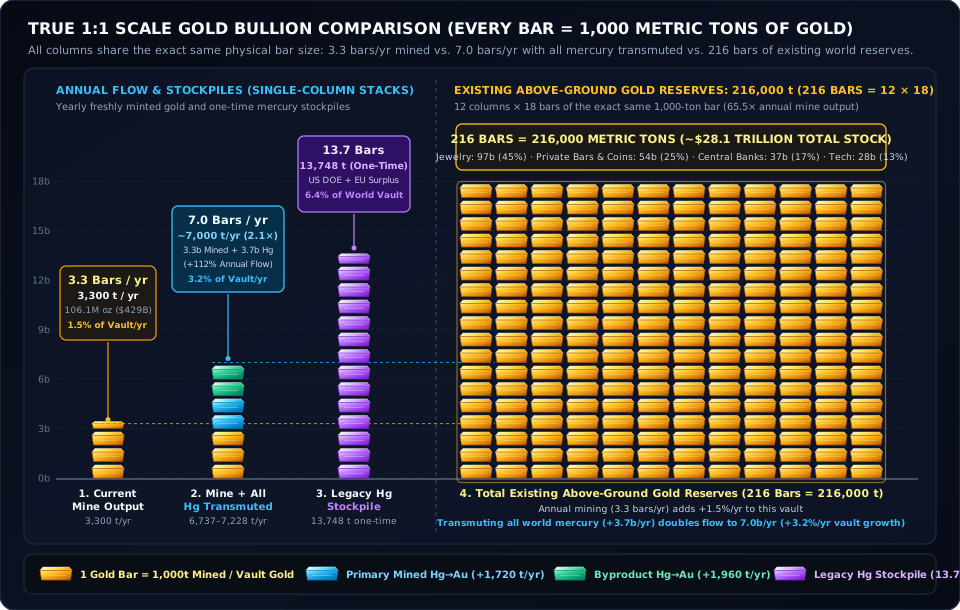
Worldwide gold mine production hovers around 3,300 to 3,600 metric tons per year according to World Gold Council production datasets. Converting primary mined mercury alone would increase global freshly minted gold output by 45 % to 59 %. Converting all primary, byproduct, and recycled mercury (3,500 to 4,000 t/yr) would add 3,437 to 3,928 metric tons of gold annually, more than doubling global mine supply (+104 % to +119 %).
However, gold prices behave differently from consumable commodities like crude oil or wheat. Oil and wheat are burned or eaten within months, so doubling annual production crashes prices immediately. Gold is virtually indestructible, meaning prices reflect the stock-to-flow ratio across all cumulative above-ground reserves.
Humanity has mined roughly 216,000 metric tons of gold across all recorded history. Baseline mining (3,300 t/yr) expands that above-ground stock by roughly 1.5 % per year. Adding 3,700 metric tons of transmuted mercury gold per year would add another 1.7 % to the total historical stock annually, bringing total stock growth to 3.2 % per year.
Turning a toxic hazardous waste liability into a sovereign asset
Under the Minamata Convention on Mercury, mercury is classified as a severe neurotoxin and persistent bioaccumulative pollutant. The United States Mercury Export Ban Act and European Union regulations prohibit exporting surplus elemental mercury, forcing governments to store thousands of tons of liquid mercury indefinitely in high-security warehouses.
According to the U.S.
Department of Energy Long-Term Mercury Management Environmental Impact
Statement (DOE/EIS-0423-S2), the U.S. government and
domestic industrial facilities hold roughly 7,000 to 10,000 metric tons
of surplus elemental mercury, including 4,436 metric tons from Cold War
lithium isotope separation at Oak Ridge. Combined with European
chlor-alkali decommissioning stockpiles, roughly 14,000 metric tons of
hazardous mercury sits in long-term containment.
Even if fusion reactors only transmute the 10.0 % natural 198Hg fraction inside that 14,000-ton waste stockpile, the yield is massive. Those 1,400 metric tons of 198Hg convert into 1,393 metric tons of stable 197Au worth roughly $181 billion. Instead of paying perpetual hazardous storage fees, sovereign repositories could convert a banned neurotoxin into pure monetary and industrial bullion.
3. Why historical transmutation failed (and how 14.1 MeV fusion neutrons change the physics)
If the raw feedstock margin exceeds 19,000 %, why haven’t nuclear operators been printing gold since 1941? The answer lies in nuclear cross-sections, isotopic abundance, and the energy cost of generating free neutrons.
The 1941 Sherr-Bainbridge-Anderson experiments and thermal reactor limits
Nuclear transmutation of mercury into gold was first demonstrated in
1941 by Rubby Sherr, Kenneth Bainbridge, and Herbert Anderson using the
Harvard cyclotron, as published in Physical
Review (PhysRev.60.473). Later experiments at Oak Ridge
National Laboratory and CERN’s ISOLDE and LHC facilities confirmed the
nuclear pathways, including ALICE
ultraperipheral lead-ion photonuclear measurements.
Historically, researchers tried to make stable 197Au in thermal fission reactors via radiative neutron capture, denoted (n, γ). In a thermal reactor, a slow neutron hits mercury-196 (196Hg), forming unstable 197Hg, which decays into stable 197Au.
That thermal fission route fails commercially for three physical reasons documented in the ENDF/B-VIII.0 evaluated nuclear data library:
- Tiny isotopic abundance of 196Hg: Natural mercury contains seven stable isotopes: 196Hg (0.15 %), 198Hg (10.0 %), 199Hg (16.9 %), 200Hg (23.1 %), 201Hg (13.2 %), 202Hg (29.9 %), and 204Hg (6.85 %). Because 196Hg makes up only 0.15 % of natural mercury, 99.85 % of unenriched mercury consists of heavier isotopes that cannot become 197Au by absorbing a slow neutron.
- Parasitic neutron absorption by 199Hg: In a thermal neutron spectrum, 199Hg (16.9 % natural abundance) has an enormous thermal capture cross-section of roughly 2,150 barns. It acts as a neutron sponge, stealing neutrons to become stable 200Hg while poisoning the reactor’s neutron economy.
- Destructive burnup of product gold: Stable 197Au itself has a high thermal neutron capture cross-section (~98.7 barns). Leave gold inside a thermal reactor flux, and it absorbs another neutron to become radioactive 198Au (T1/2 = 2.69 days), which beta-decays right back into stable mercury (198Hg).
The Deuterium-Tritium 14.1 MeV (n, 2n) breakthrough
In August 2025, fusion physicists Adam Rutkowski, Jake Harter, and
Jason Parisi at Marathon Fusion published a landmark neutronics study.
Titled Scalable
Chrysopoeia via (n, 2n) Reactions Driven by Deuterium-Tritium Fusion
Neutrons (arXiv:2507.13461), the work was followed
in October 2026 by high-rate commercial blanket engineering milestones.
Their insight was to invert the reaction from slow neutron capture
(n, γ) on rare 196Hg to fast neutron knockout
(n, 2n) on abundant 198Hg.
A Deuterium-Tritium (D-T) fusion plasma burns heavy hydrogen isotopes according to:
D + T → 4He (3.5 MeV) + n (14.1 MeV)
Unlike nuclear fission, where nascent neutrons emerge around 1 to 2 MeV, or D-D fusion (2.45 MeV), D-T fusion releases 80 % of its energy as a monochromatic 14.1 MeV fast neutron. That 14.1 MeV energy sits well above the ~8.5 to 9.0 MeV nuclear binding energy threshold required to knock a neutron out of a 198Hg nucleus:
198Hg + n (14.1 MeV) → 197Hg + 2n → 197Au (stable, via EC, T1/2 = 64.14 h)
The reaction also populates the nuclear isomer 197mHg (T1/2 = 23.8 hours), which decays 94.7 % by internal transition to 197Hg and 5.3 % by direct electron capture to 197Au. Within days of pumping the liquid mercury out of the blanket, the unstable 197Hg decays into pure, non-magnetic solid gold that precipitates out of the liquid mercury stream.
Why mercury acts as a symbiotic neutron multiplier rather than a poison
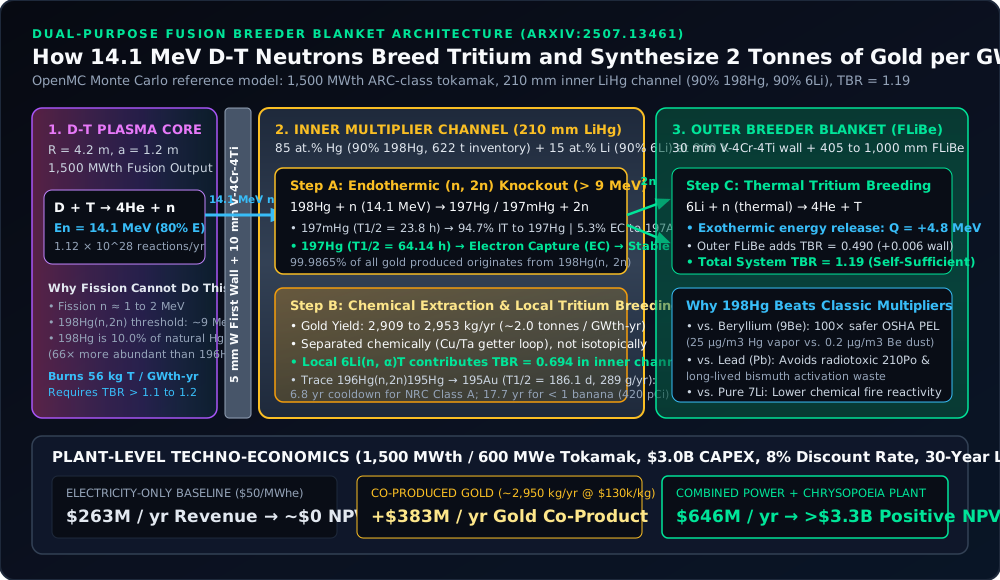
Every commercial D-T fusion power plant must breed its own tritium fuel from lithium to remain self-sustaining. This fuel cycle requires a Tritium Breeding Ratio (TBR) above 1.0, and typically TBR ≥ 1.1 to cover decay and processing losses. Because 6Li(n, t)4He consumes one neutron per tritium atom bred, fusion blankets require a fast-neutron multiplier in the first wall – traditionally toxic beryllium (Be) or liquid lead (Pb).
As shown in Figure 2, 198Hg has a 2.1-barn (n, 2n) cross-section at 14.1 MeV, roughly matching lead. When a 14.1 MeV fusion neutron strikes 198Hg, it transmutates one mercury atom into gold and emits two lower-energy neutrons! Those two secondary neutrons then get captured by 6Li in the inner liquid metal alloy (85 at.% Hg, 15 at.% Li) and outer FLiBe molten salt blanket to breed tritium.
The OpenMC Monte Carlo reference tokamak simulation models a 1,500 MWth fusion plant with major radius R = 4.2 m and minor radius a = 1.2 m. Its 210 mm inner channel holds 622 metric tons of mercury enriched to 90 % 198Hg, achieving:
- Tritium Breeding Ratio (TBR): 1.190 total (0.694 in the inner Hg-Li channel, 0.490 in the outer FLiBe zone, and 0.006 in the structure), exceeding fuel self-sufficiency requirements.
- Annual 197Au Gold Production: 2,953 kg/yr instantaneous rate, or 2,909 kg/yr accounting for continuous burnup and depletion – roughly 2 metric tons of gold per GWth-year.
- Pathway Purity: 99.9865 % of all 197Au comes from the fast 198Hg(n, 2n) channel rather than thermal capture.
Photochemical mercury enrichment and the 195Au cooldown clock
Using natural unenriched mercury in the blanket reduces gold output to roughly 360 kg per GWth-year because heavier mercury isotopes compete for fast neutrons. Enriching natural mercury from 10.0 % to 90 % 198Hg unlocks the full 2 t/GWth-yr yield.
Unlike uranium enrichment, which requires massive cascades of gas
centrifuges, mercury can be enriched cheaply via photochemical
isotope separation. First demonstrated by Tunnicliffe and
Sherwood in 1971 and modeled in arXiv:2507.13461
Appendix B, the process uses a standard 254 nm UV-C mercury vapor
lamp. Loaded with pure 198Hg, the lamp emits resonance
photons that selectively excite only 198Hg atoms in a natural
mercury vapor stream.
Excited 198Hg* reacts chemically with oxygen or hydrogen chloride gas to form solid mercuric oxide (HgO) or calomel (Hg2Cl2), which precipitates out of the gas stream. Four photochemical stages enrich 198Hg to 99.2 % purity using just 270 kW of electrical power per 100 metric tons per year. At $0.10 / kWh, enrichment electricity costs roughly $2.40 per kg and requires under $1 million in lamp capital.
Photochemical enrichment also solves the primary radiological hurdle of fusion gold: trace 195Au contamination. Fast 14.1 MeV neutrons hit residual 196Hg impurities (0.015 % in enriched feedstock) or drive rare (n, 3n) reactions on 197Hg. This side channel produces about 289 grams per year of unstable 195Au, which has a half-life of 186.1 days.
- After 6.8 years of storage: The gold decays below the U.S. NRC 10 CFR §61.55 Class-A low-level waste threshold (< 700 Ci/m3).
- After 13.7 years of storage: Specific activity drops below the 49 CFR §173.436 exempt material concentration limit (2.7 × 10⁻³ μCi/g, or 2,700 pCi/g).
- After 17.7 years of storage: A 15 g gold ring contains less radioactivity than a common banana (420 pCi from natural 40K). Each 10-fold reduction in initial 196Hg during photochemical enrichment cuts required cooldown storage by 1.7 years.
4. What fusion gold means for the gold market and power grid economics
At $130,000 per kg, a single 1.5 GWth (~600 MWe net electric) fusion power plant producing 2,909 kg/yr of 197Au generates $378 million per year in gross gold revenue. Newly extracted ingots must sit in a shielded vault for 13 to 17 years while 195Au decays. However, financial markets can immediately custody and collateralize that vault inventory via forward contracts or tokenized warehouse receipts at a modest time-value discount.
Doubling fusion power plant revenue to subsidize clean electricity
Compare that $378 million annual gold stream against electricity sales. A 600 MWe fusion plant operating at a 90 % capacity factor delivers 4.73 million MWh of electricity per year. At a wholesale industrial electricity price of $70 / MWh, electricity sales generate $331 million per year.
Co-producing gold in the breeding blanket more than doubles the power plant’s annual revenue without consuming a single extra watt of fusion plasma power or sacrificing tritium breeding! In capital-intensive infrastructure – much like the self-financing civil engineering loops we analyzed in continental pumped-hydro megaprojects and grid reliability economics – high-margin co-products transform project bankability.
First-of-a-kind (FOAK) fusion reactors face steep capital recovery hurdles ($5B to $8B CAPEX). Adding over $300 million per year in gold co-product revenue cuts the levelized cost of electricity (LCOE), letting operators sell clean baseload power at competitive wholesale rates.
Will fusion crash the price of gold?
Could commercial fusion fleets flood the gold market and trigger a
16th-century Spanish silver-style price collapse? Let us run the scaling
math from arXiv:2507.13461
Section VI:
- Matching current global gold mining (3,300 t/yr) requires 1,650 GWth of fusion: Neutron economy caps yield near 2 metric tons of 197Au per GWth-year. Matching existing gold mine output requires 1,650 GWth (~660 GWe) of fusion plants, whereas all 415 fission reactors today total 375 GWe.
- Mercury feedstock limits the long-term ceiling: A 1.5 GWth plant requires a 622-ton initial inventory of 90 % enriched 198Hg, plus 3 t/yr of makeup 198Hg. Extracting 622 tons of 198Hg from natural mercury (10 % abundance) requires processing roughly 6,220 tons of natural mercury per reactor startup.
- Self-correcting economic equilibrium: Existing global mercury stockpiles (14,000 t) and cumulative mining over the next two decades can fill only 15 to 25 full-scale chrysopoeia fusion blankets before exhausting cheap mercury supplies.
Thus, fusion chrysopoeia cannot collapse the global gold standard overnight. Instead, the first 15 to 30 GWth of commercial fusion reactors will capture an early-adopter windfall of 30 to 60 t/yr of gold ($4B to $8B annually, or <2 % of global mining). That revenue pays down early fusion plant construction costs while permanently retiring the world’s toxic mercury waste stockpiles.
5. Higher-value applications: what 14.1 MeV fusion transmutation unlocks beyond gold
As lucrative as $130 per gram gold is, using a 14.1 MeV fusion neutron to make gold leaves 4 to 5 orders of magnitude of economic and humanitarian value on the table. Gold is an (n, 2n) isotopic stripping product, meaning the product first forms as a mercury radioisotope (197Hg) that must decay into gold.
In November 2025, Jason Parisi, Adam Rutkowski, Jake Harter, Jacob
Schwartz, and Steffi Chen published a companion study, Production of
High-Specific-Activity Radioisotopes Using High-Energy Fusion
Neutrons (arXiv:2511.02814). They showed that 14.1
MeV fusion neutrons unlock trans-elemental reactions –
specifically (n, p), (n, d), (n,
t), and (n, α) – that are energetically forbidden in
thermal fission reactors.
1. High-Specific-Activity (HSA) medical radioisotopes for targeted cancer therapy
When a thermal fission reactor makes a medical radioisotope via (n, γ) neutron capture (such as 98Mo(n, γ)99Mo or 176Lu(n, γ)177Lu), the new radioactive atom remains the exact same chemical element as the stable target. Chemical separation cannot distinguish isotopes of the same element, leaving the product with low specific activity (wi ≪ 0.01). Over 99 % of the output consists of inactive stable “carrier” atoms that clog tumor receptor sites without delivering therapeutic radiation.
To bypass this limit in fission, the medical supply chain fissions weapons-grade or high-assay low-enriched Uranium-235 (235U) in aging research reactors. Operators then chemically extract the 6.1 % 99Mo fission product, generating high-level nuclear waste and proliferation risks.
Fast 14.1 MeV fusion neutrons solve this cleanly. When a 14.1 MeV neutron knocks a proton (n, p) or alpha particle (n, α) from a target nucleus, the product becomes a different chemical element (Z − 1 or Z − 2). Standard wet chemistry or ion-exchange chromatography separates the pure radioisotope from the target at near-100 % isotopic purity (wi → 1.0, known as “carrier-free” or High-Specific-Activity).
| Medical Isotope | Clinical Application | 14.1 MeV Fusion Transmutation Pathway | Specific Activity (As) & Isotopic Purity (wi) | Yield per MWth-yr (arXiv:2511.02814) |
Fusion Power to Meet 100 % Global Demand |
|---|---|---|---|---|---|
| Actinium-225 (225Ac) | Targeted Alpha Therapy (TAT) for metastatic prostate, neuroendocrine, and hematologic cancers | 226Ra(n, 2n)225Ra → 225Ac (β−) | 5.8 × 10⁴ Ci/g (wi = 0.98, near zero 227Ac) | 521 g / MWth-yr | 280 W (on 11 g 226Ra) yields 650-fold current world supply |
| Molybdenum-99 (99Mo → 99mTc) | Workhorse diagnostic SPECT imaging (40 million+ patient scans/yr globally, 80 % of nuclear medicine) | 102Ru(n, α)99Mo or 100Mo(n, 2n)99Mo | 3.3 × 10⁵ Ci/g via 102Ru (wi = 0.69) | 229 to 640 g / MWth-yr | 1 to 5 MWth replaces entire global 235U fission fleet |
| Lutetium-177 (177Lu) | FDA-approved β− radioligand therapy (Pluvicto / Lutathera) for prostate & neuroendocrine tumors | 177Hf(n, p)177Lu or 178Hf(n, d)177Lu | 9.8 × 10⁴ Ci/g (wi = 0.93, ultra-low 177mLu) | 84 to 400 g / MWth-yr | < 1 MWth supplies millions of therapeutic doses |
| Copper-67 (67Cu) | Theranostic β− therapy paired with 64Cu PET imaging for lymphoma and bladder cancer | 67Zn(n, p)67Cu or 70Zn(n, α)67Ni → 67Cu | 7.0 × 10⁵ Ci/g (wi = 0.92) | 63 to 95 g / MWth-yr | < 0.5 MWth unlocks clinical trials currently starved of supply |
| Scandium-47 (47Sc) & Terbium-161 (Tb-161) | Next-generation Auger/conversion-electron and β− micro-metastasis cancer therapies | 50V(n, α)47Sc and 162Dy(n, d)Tb-161 | 8.3 × 10⁵ Ci/g (47Sc, wi = 1.00) | 77 g (47Sc) to 266 g (Tb-161) | < 0.5 MWth creates commercial supply where none exists |
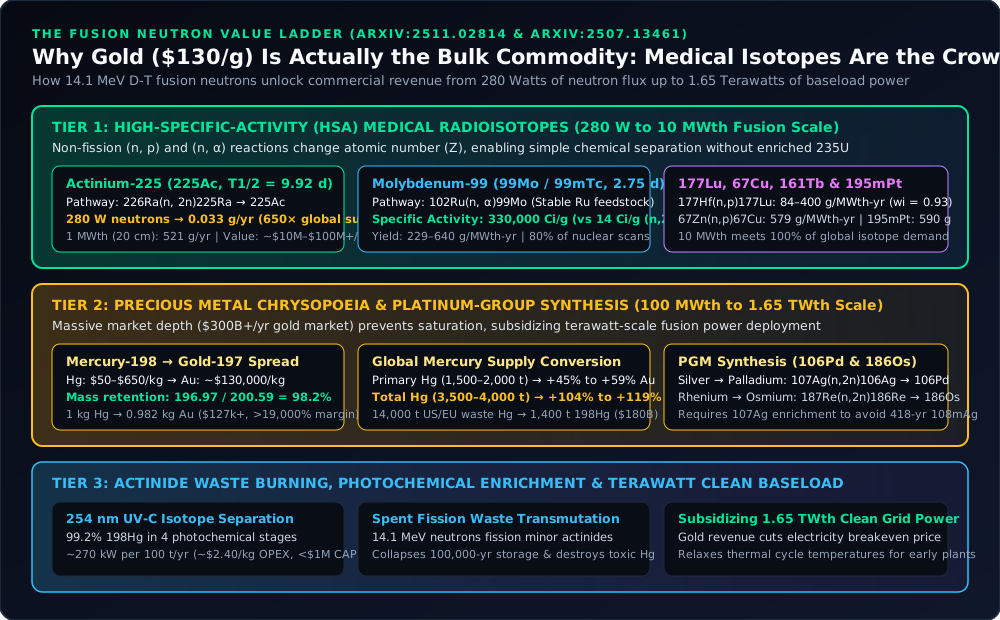
Look closely at the Actinium-225 (225Ac) row in the table above. Often called the rarest drug on Earth, 225Ac fires four high-energy alpha particles that obliterate cancer DNA within a 2-to-3 cell radius while sparing healthy tissue. This targeted clinical mechanism complements the precision oncology pipelines we examined in our open-source canine mRNA cancer vaccine research. Today, global production totals less than 0.05 grams (~2 to 3 Ci) of 225Ac per year, pricing it around $15 million per gram and leaving thousands of cancer patients without access.
As simulated in arXiv:2511.02814,
a sub-megawatt D-T fusion source needs just 280 Watts of fusion
neutron power on 11 grams of Radium-226 (226Ra).
That compact target yields 0.033 g/yr (~1,900 Ci/yr) of 98 % pure
225Ac – 650 times the entire current global
supply – with near-zero 227Ac contamination.
Even better, a 1 to 10 MWth medical isotope fusion machine does not need net energy gain (Q > 1) or a tritium breeding blanket (TBR > 1). A 10 MWth fusion source burns only 0.56 kg of tritium per year. Operators can purchase that tritium from existing heavy-water CANDU fission reactors (3 kg/yr global output) for roughly $15 million while generating billions of dollars in medical isotopes.
2. Synthesizing platinum-group metals: Palladium-106 and Osmium-186
Fast (n, 2n) transmutation is not limited to mercury
and gold. In arXiv:2507.13461
Table I, the authors evaluated every stable isotope on the chart of
nuclides for fast-neutron (n, 2n) synthesis where a cheap
parent element sits one atomic number above or below a precious
metal:
- Silver to Palladium (107Ag → 106Pd): Natural silver costs roughly $1.00 / g and contains 51.8 % 107Ag. Bombarding 107Ag with 14.1 MeV neutrons drives 107Ag(n, 2n)106Ag, which decays with a 24-minute half-life into stable Palladium-106 (106Pd, worth ~$35 / g) for catalytic converters, hydrogen purification membranes, and electronics.
- Rhenium to Osmium (187Re → 186Os): Natural rhenium (62.6 % 187Re) undergoes 187Re(n, 2n)186Re (T1/2 = 3.7 days), decaying into stable Osmium-186 (186Os, worth ~$400 / g).
- Why Platinum-198 to Gold fails: Historical physics demos used 198Pt(n, γ)199Pt → 199Au, but 199Au is unstable (T1/2 = 3.1 days) and decays into stable mercury (199Hg), turning expensive platinum into cheap mercury! Mercury-198 is uniquely positioned on the nuclear chart as the ideal feedstock for stable gold.
3. Industrial photochemical isotope separation and nuclear waste transmutation
Two additional industrial spinoffs emerge directly from the fusion chrysopoeia stack:
- Commercial Photochemical Isotope Enrichment: The 254 nm UV-C photochemical enrichment process separates 198Hg at $2.40 / kg and adapts to other isotopes with hyperfine optical shifts. Key targets include Zinc-64 (64Zn, used to reduce cobalt-60 radiation in reactor coolant loops), Silicon-28 (28Si, for high-thermal-conductivity semiconductor wafers and quantum spin qubits), and Lithium-6 (6Li).
- Transmuting Long-Lived Nuclear Fission Waste (Minor Actinide Burning): Fast 14.1 MeV D-T fusion neutrons induce fission and (n, 2n) transmutation in transuranic waste like Neptunium-237 (237Np), Americium-241 (241Am), and Curium. This pathway converts 100,000-year geological repository liabilities into short-lived fission products that decay to background levels within 300 years.
6. Key takeaways for engineers and energy investors
When we separate alchemy folklore from nuclear engineering math, four conclusions stand out:
- The >19,000 % mass-balance spread is unlocked by 14.1 MeV (n, 2n) neutronics: Transmuting 1 kg of mercury (~$50 to $650) retains 98.2 % of its mass, yielding 0.982 kg of 197Au (~$127,660). Using liquid 198Hg as a fusion blanket neutron multiplier yields ~2 metric tons of gold per GWth-year at a 1.19 Tritium Breeding Ratio.
- Global mercury supplies cap the long-term gold market shock: Converting all annual mercury (1,500 to 4,000 t/yr) adds 1,470 to 3,930 t/yr of gold (+45 % to +119 % of mining). Mercury inventory limits mean the first 15 to 30 GWth of fusion plants will capture an early windfall while consuming 14,000 tons of hazardous mercury waste.
- Medical radioisotopes are the immediate, Sub-Megawatt prize: Compact 1 to 10 MWth D-T fusion sources (Q < 1, no breeding blanket required) can operate long before grid-scale tokamaks. Using (n, p) and (n, α) pathways, they synthesize carrier-free 225Ac, 99Mo, 177Lu, and 67Cu worth millions per gram.
- High-value co-products accelerate clean baseload energy: Turning the fusion breeding blanket into an isotopic factory subsidizes reactor capital costs and pulls forward the timeline for zero-carbon baseload electricity.
Primary References & Technical Data
- Rutkowski, A., Harter, J., & Parisi, J. (2025). Scalable Chrysopoeia via (n, 2n) Reactions Driven by Deuterium-Tritium Fusion Neutrons. Marathon Fusion preprint, arXiv:2507.13461.
- Parisi, J. F., Rutkowski, A., Harter, J., Schwartz, J. A., & Chen, S. (2025). Production of High-Specific-Activity Radioisotopes Using High-Energy Fusion Neutrons. Marathon Fusion preprint, arXiv:2511.02814.
- U.S. Geological Survey (2025). Mineral Commodity Summaries 2025: Mercury and Gold. USGS Periodicals.
- U.S. Department of Energy (2022). Long-Term Management and
Storage of Elemental Mercury Supplemental Environmental Impact Statement
(
DOE/EIS-0423-S2). DOE NEPA Repository. - U.S. Nuclear Regulatory Commission. 10 CFR §61.55 Waste Classification & 49 CFR §173.436 Exempt Material Activity Concentrations. Electronic Code of Federal Regulations.