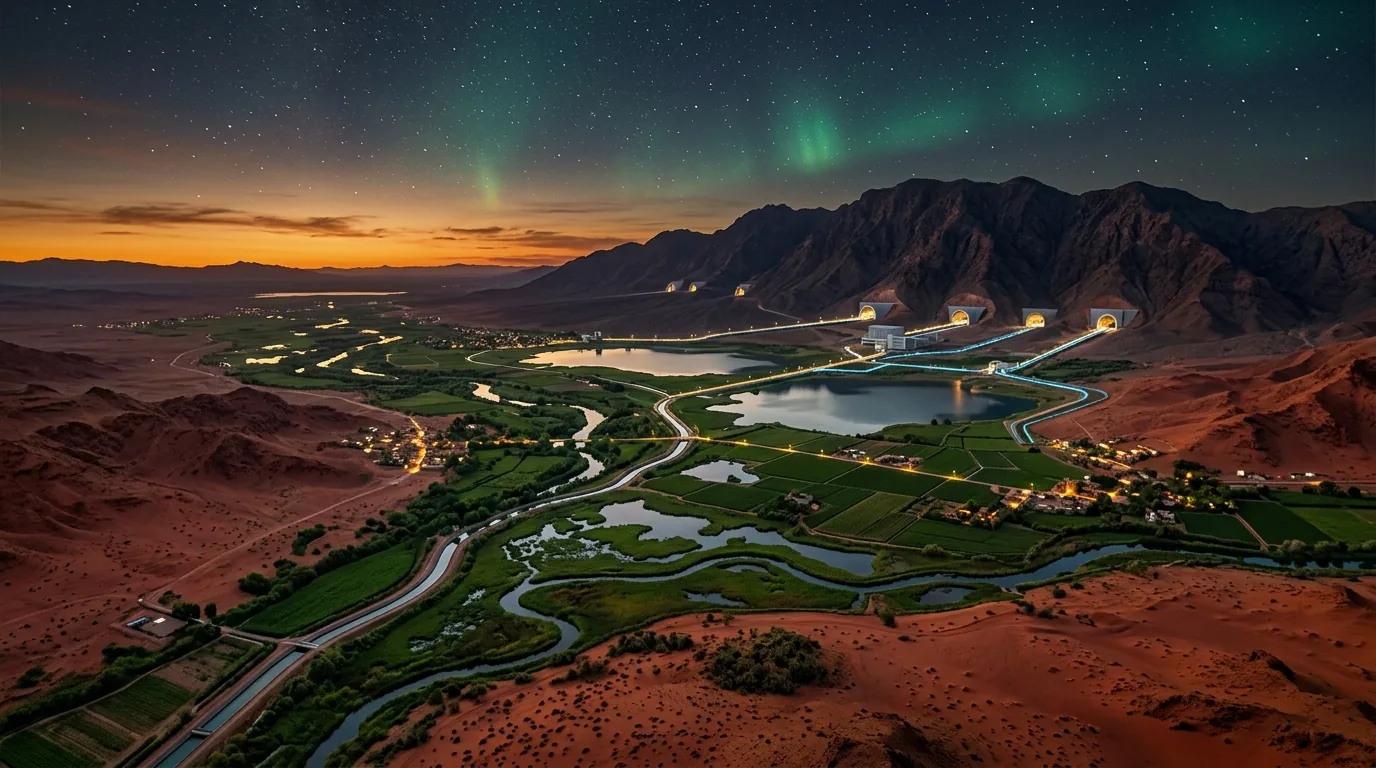
Civilization faces a compounding environmental dilemma. We witness prolonged agricultural megadroughts, depleted regional aquifers, catastrophic wildfire seasons, and blistering heat domes. Simultaneously, the global energy transition struggles to find long-duration storage that does not rely on toxic, short-lived chemical battery supply chains.
Most contemporary climate plans focus narrowly on incremental decarbonization. They add solar panels and wind turbines while treating existing water scarcity and landscape desiccation as unchangeable facts of geography.
Planetary hydrology presents a far bolder paradigm: macro-scale civil engineering that moves water across natural elevation gradients and continental basins. By redirecting seasonal deluge floods, refilling dry tectonic depressions, and establishing regional water loops, society can terraform arid landscapes, stabilize regional climates, and generate multi-gigawatt zero-emission power as a self-financing engine.
This synthesis examines four continental hydrology fronts where moving water rewires human geography, environmental public health, and ecological survival.
The Terraforming Imperative: Beyond Incremental Adaptation
Water is the primary thermostat and biological engine of planet Earth. When landscapes lose water through drainage, over-pumping, or desertification, a destructive feedback loop takes hold:
- Thermal Amplification: Dry soil has low heat capacity. Solar radiation heats bare earth rapidly, creating persistent high-pressure heat domes that deflect rainstorms and bake surrounding regions.
- Aquifer Depletion and Land Subsidence: Pumping ancient groundwater without managed recharge causes permanent compaction of pore space, collapsing regional storage capacity forever.
- Toxic Dust Generation: Shrinking terminal lakes expose pesticide-laden silt beds, generating airborne dust storms that poison downwind communities with heavy metals and fine particulate matter.
- Tinderbox Ecosystems: Dropping water tables drain riparian corridors, turning vast forests and brushlands into continuous fuel beds for uncontrollable wildfires.
Continental-scale water engineering breaks this cycle. Flooding dry depressions and saturating alluvial plains restores soil moisture, generates convective humidity plumes, suppresses toxic dust, and revives critical wildlife flyways.
Energy generation is not the primary purpose of these projects. Rather, gravitational potential energy and pumped-storage power serve as the mechanical catalyst and economic engine that makes planetary-scale civil earthworks financially sustainable.
The Physics of Water as an Energy Engine
When water moves across topography, gravity provides a reliable mechanical power source. The potential energy E stored in a mass of water is governed by Newtonian physics:
E = m ⋅ g ⋅ h
Here, m represents the mass of water in kilograms, g is gravitational acceleration (9.81 m/s2), and h is the net hydraulic head in meters.
A single cubic meter of water (1, 000 kg) falling through a 100 m vertical drop yields approximately 0.981 MJ, or roughly 0.272 kWh of gross energy. When harnessed through modern hydroelectric turbines operating at efficiencies above 90%, gravitational potential energy delivers firm, dispatchable power without chemical degradation.
According to data from the National Renewable Energy Laboratory Hydropower Study, pumped storage hydropower provides over 93% of all utility-scale energy storage capacity in the United States today. Unlike chemical batteries that degrade over thousands of charge cycles, civil hydro installations operate reliably across generational timescales of 80 to 100+ years.
The Solar-Evaporative Engine: Perpetual Inflow Without River Outlets
In conventional hydroelectric dams, water flow depends on upstream rainfall and melting mountain snowpacks. But in hyper-arid desert basins that sit below sea level, engineering can construct a perpetual hydrological engine.
When a deep tectonic depression sits below sea level near a marine coast, intense desert solar irradiance acts as a colossal thermal pump. In arid regions, solar heat evaporates surface water at rates between 1.8 and 2.5 meters per year.
By boring subterranean intake tunnels through coastal ridges, engineers can direct seawater into the low-lying depression. The descending ocean water drives hydroelectric turbines, producing clean electricity while filling the basin into a permanent inland sea:
Qin = Asurface × Eevaporation
Once the lake surface reaches an equilibrium elevation where evaporative losses match inflow, incoming water volume stabilizes. The basin never overflows because the sun continuously removes water vapor into the atmosphere. This vapor moderates local temperatures and builds humidity plumes across downwind landscapes.
Four Continental Macro-Hydrology Fronts
This investigation analyzes four transformative regional engineering initiatives:
1. Egypt’s Qattara Depression: Greening the Eastern Sahara
Plunging 133 meters below Mediterranean sea level across 19,600 square kilometers, Qattara represents Africa’s deepest natural sink. Boring a 55-kilometer subterranean conduit from the Mediterranean creates a 12,000-square-kilometer inland sea. Beyond producing 370 megawatts of continuous baseload and up to 5.0 gigawatts of pumped peaking power, the lake moderates blistering Saharan heat, boosts agricultural dew along coastal margins, and creates industrial aquaculture centers. Read the full analysis in The Qattara Depression: Turning Egypt’s 133-Meter Desert Basin into a Solar-Evaporative Sea.
2. Australia’s Lake Eyre and the Bradfield Scheme
The Lake Eyre Basin spans 1.2 million square kilometers across the arid Australian outback, terminating in a vast salt playa 15 meters below sea level. By evaluating the historic 1938 Bradfield Scheme alongside modern tunnel boring technology, we examine diverting monsoon floodwaters from wet coastal rivers inland through the Great Dividing Range. Combined with pumped hydro storage in the high-relief Flinders Ranges, this infrastructure drought-proofs continental agricultural heartlands and cools the central desert. Explore the engineering trade-offs in Flooding the Red Heart: Lake Eyre, the Bradfield Scheme, and Australia’s Unbuilt Inland Seas.
3. Depression Hydrology: The Dead Sea and Salton Sea
The Dead Sea sits at -430 meters elevation, presenting the highest hydrostatic drop on Earth. A conduit from the Red Sea harnesses this 43.2-bar natural pressure to assist reverse-osmosis desalination membranes. This supplies fresh drinking water to regional communities while halting catastrophic sinkhole collapse. Simultaneously, importing ocean water into California’s shrinking Salton Sea (-69 meters) suppresses toxic particulate dust that harms children across the Imperial Valley, while supporting geothermal lithium extraction. Read the operational framework in Depression Hydrology: The 430-Meter Head of the Dead Sea and Global Closed-Basin Stabilization.
4. California’s Closed-Loop Macro-Water Capture
During atmospheric river winters, California discharges over 30 million acre-feet of freshwater into the Pacific Ocean while communities face flood devastation. Meanwhile, the state continues extracting 4.4 million acre-feet annually from the over-allocated Colorado River. Diverting 15% of peak flood surges into Flood-Managed Aquifer Recharge (Flood-MAR) restores historic Tulare Lake wetlands. This allows California to forfeit its Colorado River straw, eliminate interstate water disputes, and establish hydrated living firebreaks that extinguish wildfires. Read the complete blueprint in California’s Untapped Deluge: Ending Colorado River Reliance and Fireproofing the State via Macro-Water Capture.
Comparative Civil Engineering Matrix
The summary below highlights the primary humanitarian impacts, hydrological mechanisms, and clean energy co-benefits across each regional front:
- Egypt (Qattara Depression): Primary Benefit: Regional microclimate cooling, Sahara greening, and marine aquaculture. Hydrological Mechanism: Solar-evaporative seawater sink (-133 m). Clean Energy Co-Benefit: 370 MW baseload and 2.5 to 5.0 GW pumped peaking capacity.
- Australia (Lake Eyre Basin): Primary Benefit: Drought-proofing pastoral heartlands, wetland restoration, and convective humidity. Hydrological Mechanism: Trans-mountain monsoon river diversion (Bradfield Scheme). Clean Energy Co-Benefit: 1.0 to 2.5 GW high-head pumped storage in Flinders Ranges.
- Middle East (Dead Sea Peace Conduit): Primary Benefit: Regional water security, transboundary peace, and sinkhole stabilization. Hydrological Mechanism: 430 m hydrostatic gravity conduit from Red Sea. Clean Energy Co-Benefit: Direct membrane pressure assistance and 400 to 800 MW Pelton generation.
- United States (California Salton Sea & Central Valley): Primary Benefit: Toxic dust suppression, Colorado River peace, and living wildfire firebreaks. Hydrological Mechanism: Atmospheric river capture, Flood-MAR, and marine basin stabilization. Clean Energy Co-Benefit: 15 to 30 TWh seasonal storage and geothermal lithium co-production.
Generational Societal Dividends vs. Upfront Capital
Mega-hydrology projects require substantial capital expenditure, ranging from $5 billion to $40 billion for major tunneling and canal works. However, evaluating these civil works through short-term fiscal horizons overlooks their generational returns.
Chemical batteries carry a levelized cost of storage between $120 and $180 per megawatt-hour according to the Lazard Levelized Cost of Storage Report. In contrast, long-life pumped hydro civil assets routinely achieve levelized storage costs below $45 per megawatt-hour over a 60-year operational horizon.
Beyond electrical storage, continental water infrastructure yields four compounding societal dividends:
- Regional Climate Moderation: Large inland water bodies absorb extreme heat, increase relative humidity, and suppress blistering summer temperatures through evaporative cooling.
- Agricultural Drought Immunity: Recharged regional alluvial aquifers provide multi-year drought reserves, safeguarding food supplies during extended dry spells.
- Wildfire Suppression: Saturated soil moisture levels and hydrated riparian corridors act as natural, living firebreaks that slow and extinguish wind-driven flame fronts.
- Public Health and Toxic Dust Mitigation: Maintaining terminal lake levels keeps pesticide-laden sediment beds submerged, eliminating hazardous airborne dust that drives childhood respiratory illness.
As civilization confronts climate volatility and resource limits, macro-scale water engineering provides the physical foundation for regional stability, ecological prosperity, and enduring peace.