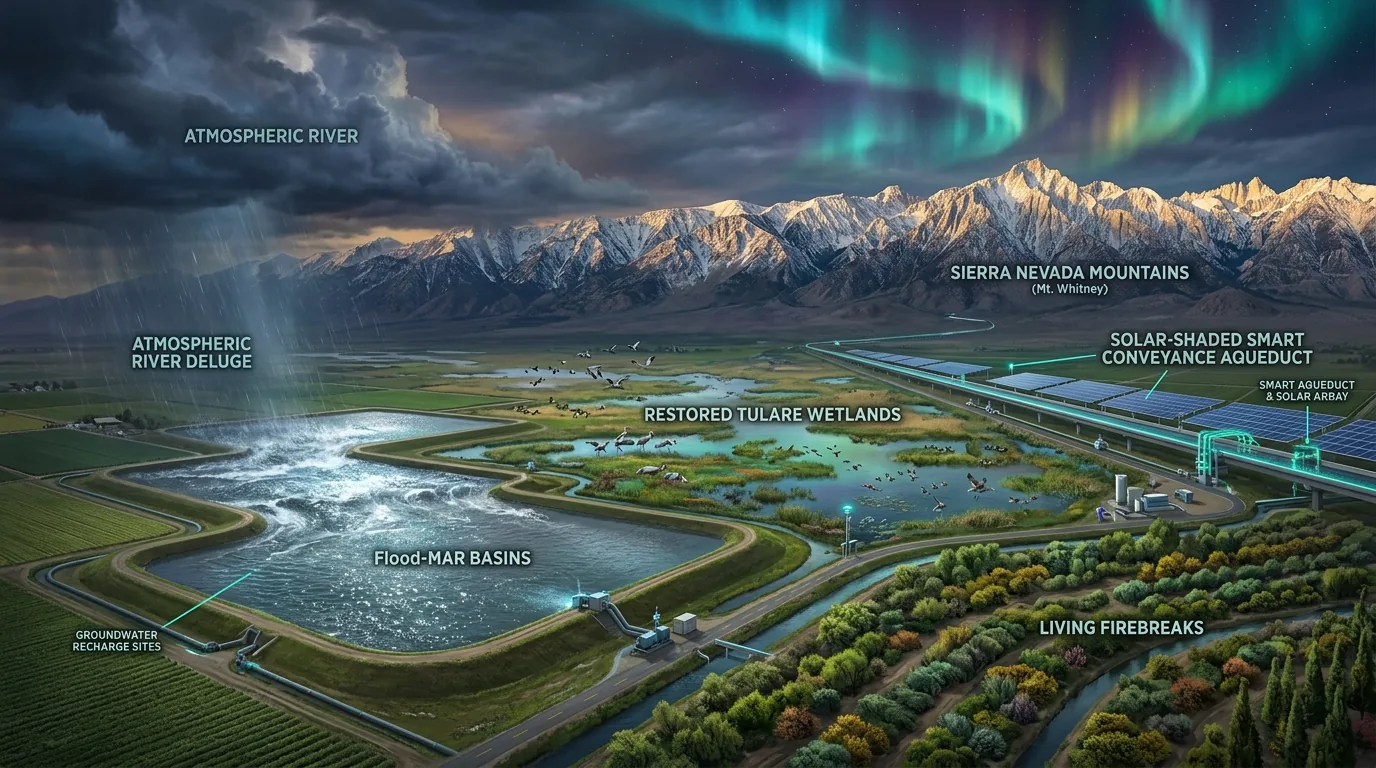
California’s water debate remains trapped in an artificial scarcity mindset. Policymakers endlessly litigate shrinking reservoirs, fallowed acreage, and endangered fish, treating every dry cycle as an insurmountable crisis.
Yet California lacks water capture infrastructure rather than water volume. Legacy 20th-century aqueducts reflect a historical climate regime that no longer exists.
The state vacillates between severe multi-year droughts and ferocious winter atmospheric rivers. In wet seasons, atmospheric rivers transport water vapor equivalent to multiple Mississippi Rivers, dumping over 30 million acre-feet of precipitation across the Sierra Nevada and coastal ranges.
The vast majority of this deluge rushes uncaptured into the Pacific Ocean through the Sacramento-San Joaquin Delta or breaches levees to flood Central Valley farmlands.
Meanwhile, California continues to draw 4.4 million acre-feet of water annually from the declining, over-allocated Colorado River. Capturing just a fraction of winter atmospheric river runoff allows California to permanently forfeit its Colorado River draw, replenish depleted Central Valley aquifers, and build living wildfire barriers across the state.
The Atmospheric River Deluge vs. The Colorado Straw
The scale of California’s seasonal winter runoff dwarfs its Colorado River allocation.
Under the 1922 Colorado River Compact, California holds senior rights to 4.4 million acre-feet (MAF) per year. This supply feeds the Imperial Irrigation District and provides municipal drinking water to 19 million Southern California residents through the Colorado River Aqueduct.
Yet the Colorado River is chronically overdrawn, with Lake Mead and Lake Powell hovering near dead-pool thresholds. Senior rights spark continuous interstate friction with Arizona, Nevada, and regional tribes.
Now compare that 4.4 MAF straw to California’s atmospheric river storms. According to hydrology data from the California Department of Water Resources Flood Management Report, the 2023 winter storms generated over 35 million acre-feet of unimpaired runoff across the state.
Capturing just 15% of that seasonal deluge yields 5.25 MAF of high-quality water. That volume entirely replaces California’s legal allocation from the Colorado River, permanently freeing up water for the entire American Southwest.
Underground Mega-Reservoirs: Managed Aquifer Recharge (MAR)
Building massive new surface dams in California is economically and environmentally constrained. The best river canyons already hold dams, and surface reservoirs suffer heavy evaporative losses during hot summers.
The true storage frontier lies underground.
Decades of agricultural deep-well pumping have drained the Central Valley’s alluvial aquifers, leaving a storage deficit exceeding 140 million acre-feet. This empty pore space represents the largest potential reservoir on the North American continent.
Capturing atmospheric river surges requires understanding valley geology:
- Hydraulic Conveyance Capacity: Diverting 15% of peak floods requires instantaneous diversion rates exceeding 1, 500 m3/s during intense storm windows. This volume exceeds concrete aqueduct limits, necessitating wide agricultural bypasses and unlined flood channels.
- Geological Targeting: The impermeable subterranean Corcoran Clay layer impedes vertical percolation across the western valley floor. Effective Flood-MAR targets coarse, unconfined alluvial fans along the eastern valley margins to recharge deep aquifers.
- Economic Advantage: Underground storage requires zero steel or concrete dams. According to economic audits by the Public Policy Institute of California Water Policy Center, managed aquifer recharge stores water at capital costs between $100 and $200 per acre-foot. That is less than one-tenth the cost of ocean desalination plants ($2,000 to $2,500 per acre-foot).
Reviving Tulare Lake: Planned Retention vs. Accidental Catastrophe
The dramatic re-emergence of Tulare Lake in 2023 demonstrated the irresistible power of California’s natural hydrology.
Before 19th-century agricultural drainage, Tulare Lake was the largest freshwater lake west of the Mississippi River, expanding to over 1,780 square kilometers during wet spring thaws. In 2023, record snowmelt from the Kings, Kaweah, Tule, and Kern rivers overwhelmed levees, flooding over 100,000 acres of farmland.
Treating Tulare Lake as an emergency catastrophe is a planning failure.
By purchasing low-lying flood-prone acreage through public conservation easements, California can re-engineer the Tulare Basin as a managed, permanent flood-retention reservoir. During wet years, excess Sierra runoff fills the lake, creating tens of thousands of acres of waterfowl habitat on the Pacific Flyway while recharging regional groundwater.
During dry periods, stored water can be pumped back for regional irrigation, turning an accidental flood hazard into a strategic state reserve.
Landscape Hydration as Wildfire Defense
California’s wildfire crisis is directly linked to its artificial drainage history.
Over the past century, draining Central Valley wetlands, channeling rivers into narrow concrete canals, and lowering water tables dried out the regional landscape. Sierra foothill forests and valley margins became desiccated tinderboxes vulnerable to wind-driven catastrophic fires.
Macro-scale water capture provides a direct physical defense:
- Riparian Firebreaks: Maintaining high water tables and wide, saturated floodplain corridors re-establishes lush, fire-resistant vegetation such as willows and cottonwoods along migration paths.
- Thermal Heat Sinks: High soil moisture levels absorb thermal energy, slowing flame front progression and creating natural obstacles that aerial firefighting crews can reinforce.
- Microclimate Humidity: Large, distributed wetland networks elevate regional humidity levels during dry late-summer fire seasons, reducing dry fuel ignition probability.
Off-Stream Pumped Hydro: Pairing Water with Renewable Energy
Storing water also solves California’s renewable grid stability puzzle.
California curtails gigawatt-hours of utility-scale solar energy every spring because generation exceeds midday demand. Off-stream reservoirs like the planned Sites Reservoir in Colusa County (1.5 MAF capacity) and San Luis Reservoir provide ideal topology for closed-loop pumped hydro:
- Pumping with Surplus Solar: During spring afternoons, cheap curtailed solar power pumps diverted floodwater into elevated off-stream storage basins.
- Summer Peak Generation: During hot August and September evenings, water flows down through reversible pump-turbines, delivering thousands of megawatts of firm electricity during critical net-peak demand hours.
California does not need to choose between abundant water, reliable electricity, and healthy ecosystems. By investing in macro-scale atmospheric river capture and groundwater recharge, the Golden State can achieve water independence while fireproofing its natural landscape.