The lowest dry land surface on planet Earth sits 430 meters below global sea level: the surface of the Dead Sea.
Plunging along the tectonic Jordan Rift Valley between Jordan, Israel, and the West Bank, this hyper-saline terminal lake is collapsing. According to regional hydrological studies by the United Nations Environment Programme, upstream agricultural diversions consume over 90% of the historic Jordan River flow.
Consequently, the Dead Sea drops by more than one vertical meter every year. This precipitous retreat leaves behind over 6,000 dangerous sinkholes that swallow roads, farmland, and buildings.
Seven thousand miles to the west, California’s Salton Sea (-69 meters) faces an identical crisis. Upstream water conservation has curtailed agricultural runoff, shrinking the lake and exposing toxic, pesticide-laden playa dust to desert winds.
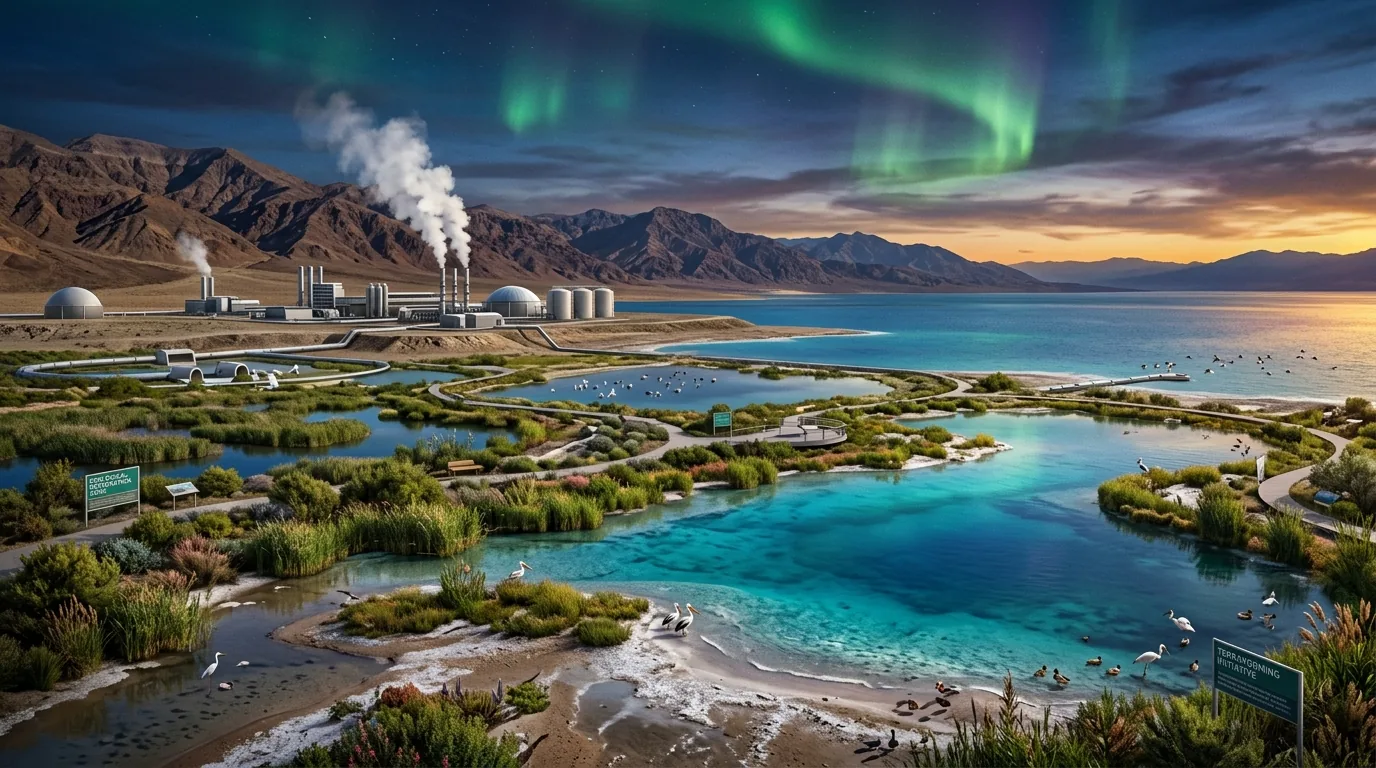
Restoring these depressions is not merely an energy project. It is an urgent public health and humanitarian mission. By piping ocean water into these low-lying basins, society can halt toxic dust storms, stabilize international borders, and harness natural gravity to assist regional desalination.
The 430-Meter Plunge: Natural Hydrostatic Pressure
Standard seawater reverse osmosis (SWRO) facilities require massive electric pumps to push saltwater through semi-permeable membranes. Plants operate between 55 and 70 bar (5.5 to 7.0 MPa) to overcome natural osmotic pressure.
In conventional facilities, electricity accounts for roughly 40% of total potable water costs according to the International Desalination Association Cost Benchmark.
In a deep geological depression, gravity replaces a major fraction of the electric pump workload. The hydrostatic pressure P generated by a falling liquid column is governed by fluid mechanics:
P = ρ ⋅ g ⋅ h
For seawater with a density of 1, 025 kg/m3, a vertical drop of 430 meters generates natural hydrostatic pressure:
P = 1, 025 kg/m3 × 9.81 m/s2 × 430 m ≈ 4.32 MPa ≈ 43.2 bar
Red Sea water has an initial osmotic pressure of 28 to 31 bar. A natural hydrostatic head of 43.2 bar exceeds this threshold, enabling low-recovery filtration (15% to 20%) without high-pressure feed pumps.
Engineering studies published by the World Bank Water Global Practice Report evaluate pairing this natural head with modest booster pumps. Reaching 65 bar yields standard 45% to 50% recovery while cutting electricity demand by half.
The Red Sea-Dead Sea Peace Conduit and Regional Diplomacy
The proposed Red Sea-Dead Sea Conveyance envisions an intake on the Gulf of Aqaba. Seawater is pumped over the southern Arava divide before entering a 180-kilometer pipeline descending to the Dead Sea.
This infrastructure functions as a combined humanitarian and ecological lifeline:
- Potable Water Security: Pressurized water passes through desalination facilities, generating 100 to 200 million cubic meters of fresh drinking water annually for water-stressed urban communities in Amman and the West Bank.
- Hydroelectric Generation: Residual falling brine drives Pelton turbines, generating 400 to 800 megawatts of clean electricity during peak grid demand hours.
- Halting Sinkholes: Discharging residual brine into the Dead Sea stabilizes water levels, checking the drop that causes catastrophic groundwater dissolution sinkholes.
Transboundary water projects remain politically delicate. In 2021, Jordan cancelled the tripartite agreement due to regional diplomatic friction, pursuing the sovereign Aqaba-Amman National Water Carrier instead. Yet the physical reality remains unchanged: without marine replenishment, the Dead Sea will continue its terminal decline.
The Salton Sea Crisis: Public Health and Toxic Dust
California’s Salton Sea presents an acute environmental health disaster. Formed in 1905 when Colorado River floodwaters breached an irrigation headgate, the lake filled the ancient Cahuilla basin to an elevation of -69 meters.
For a century, agricultural runoff from the Imperial Valley sustained the lake. However, state water transfer pacts have redirected water to urban coastal centers. The lake surface is shrinking rapidly.
The human cost is concentrated in nearby communities:
- Toxic Particulate Pollution: Evaporating water exposes thousands of acres of dried lakebed containing decades of agricultural pesticides, arsenic, and selenium. High desert winds carry fine PM2.5 and PM10 dust directly into populated towns.
- Childhood Asthma Epidemic: Research published by the California Department of Public Health Report reveals Imperial County children suffer asthma hospitalizations at triple the state average. Over 20% of local children now carry asthma diagnoses.
- Ecological Desolation: Hyper-salinity exceeding 75 grams per liter has decimated fish populations, disrupting a critical feeding sanctuary on the Pacific Flyway.
Piping ocean water from the Sea of Cortez or Pacific Ocean into the -69 meter sink permanently submerges exposed dust beds, protecting regional public health.
Geothermal Hybrids and Clean Battery Minerals
Stabilizing depression hydrology yields major economic co-benefits when paired with subsurface geothermal assets.
Both the Jordan Rift Valley and California’s Salton Trough sit on active tectonic plate boundaries with intense geothermal gradients.
The Salton Sea Known Geothermal Resource Area represents one of the richest brine reservoirs in the world. According to resource evaluations by the United States Geological Survey Energy Assessment, the Salton basin holds an estimated 3,400 kilotons of dissolved lithium, enough to manufacture batteries for 375 million electric vehicles.
Importing ocean water stabilizes surface hydrology and provides essential cooling supplies for geothermal power plants, allowing clean energy production and lithium extraction to proceed without depleting scarce local freshwater.
Continental Depressions as Planetary Assets
Sub-sea-level basins are not useless geographic liabilities.
Through macro-scale civil engineering, deep depressions serve as self-pressurizing desalination conduits, toxic dust barriers, and clean energy foundations.
Investing in long-horizon water conveyance transforms environmental catastrophe into public health protection, regional stability, and lasting cross-border peace.