-
Generate potable and Ultrapure Water (UPW) below 70 °C:
How progressive vacuum lets Low-Temperature Multi-Effect Distillation
(LT-MED)Low-Temperature
Multi-Effect Distillation (LT-MED)Cascading sub-atmospheric evaporator chambers that
boil seawater or brackish feed at 45 to 70 °C below the calcium sulfate
anhydrite scaling threshold, producing 5 to 10 ppm TDS distillate at 1.0
to 1.94 kWhe/m3 pumping
power.Veolia
/ SIDEM LT-MED Physics → and hybrid
AD/MEDADproduce 13,715 to 44,120 m3/day of boron-free distillate plus 5 to 20 °C chilled water per 100 MWth. -
Cross the 70,000 mg/L membrane barrier without boilers:
Why standard Reverse Osmosis (RO) stalls at an Osmotic Pressure
WallReverse Osmosis Osmotic
Wall (~70,000 mg/L)Standard polymeric
RO membranes burst or foul above 80 to 85 bar (1,200 psi) hydraulic
pressure, capping brine concentration near 70,000 to 75,000 mg/L TDS –
well below the 260,000 mg/L saturation threshold needed to crystallize
solid
salt.Lenntech
UHPRO Limits → around 7 % to 8 % salinity, whereas 45
to 75 °C AI coolant drives Vacuum Membrane Distillation (VMD)Vacuum Membrane
Distillation (VMD)A non-boiling
membrane process that pulls a 12 to 28 kPa vacuum across a hydrophobic
microporous barrier so 45 to 70 °C brine flashes pure water vapor across
the pores while rejecting > 99.9 % of dissolved salts up to
saturation.KMX
VMD Architecture →,
HDH, andFOpast 260,000 mg/L to dry solids. - Separate sorbent selectivity from thermal evaporation: Why evaporation alone cannot isolate dilute lithium from sodium and calcium, and how Direct Lithium Extraction (DLE)Direct Lithium Extraction (DLE)Selective alumina-intercalate sorbents, ion-exchange beads, or membranes that pull lithium ions out of raw geothermal or oilfield brine into a clean lithium chloride eluate in hours rather than multi-year open solar ponds.BHE & TerraLithium DLE → captures lithium first while AI server heat warms alumina columns (> 50 °C) and concentrates eluate.
- Size a 100 MW net-water-positive campus: Why concentrating DLE eluate for 500 to 1,700 metric tons/year of lithium carbonate on a multi-effect train takes < 1 MWth, leaving 99 MWth across a multi-effect Gained Output Ratio (GOR)Gained Output Ratio (GOR)The mass of distilled water produced multiplied by the latent heat of vaporization, divided by external thermal energy input. Multi-effect MED and VMD trains recycle condensation heat across stages to reach a GOR of 3.7 to 12.DOE / Utah Multi-Effect GOR → to export municipal potable water or crystallize up to 217,000 metric tons/year of Zero Liquid Discharge (ZLD)Zero Liquid Discharge (ZLD)A closed-loop water treatment train that recovers nearly all liquid as reusable freshwater and precipitates dissolved minerals as dry, saleable crystalline salts, eliminating deep-well wastewater injection.Saltworks AirBreather ZLD → salts.
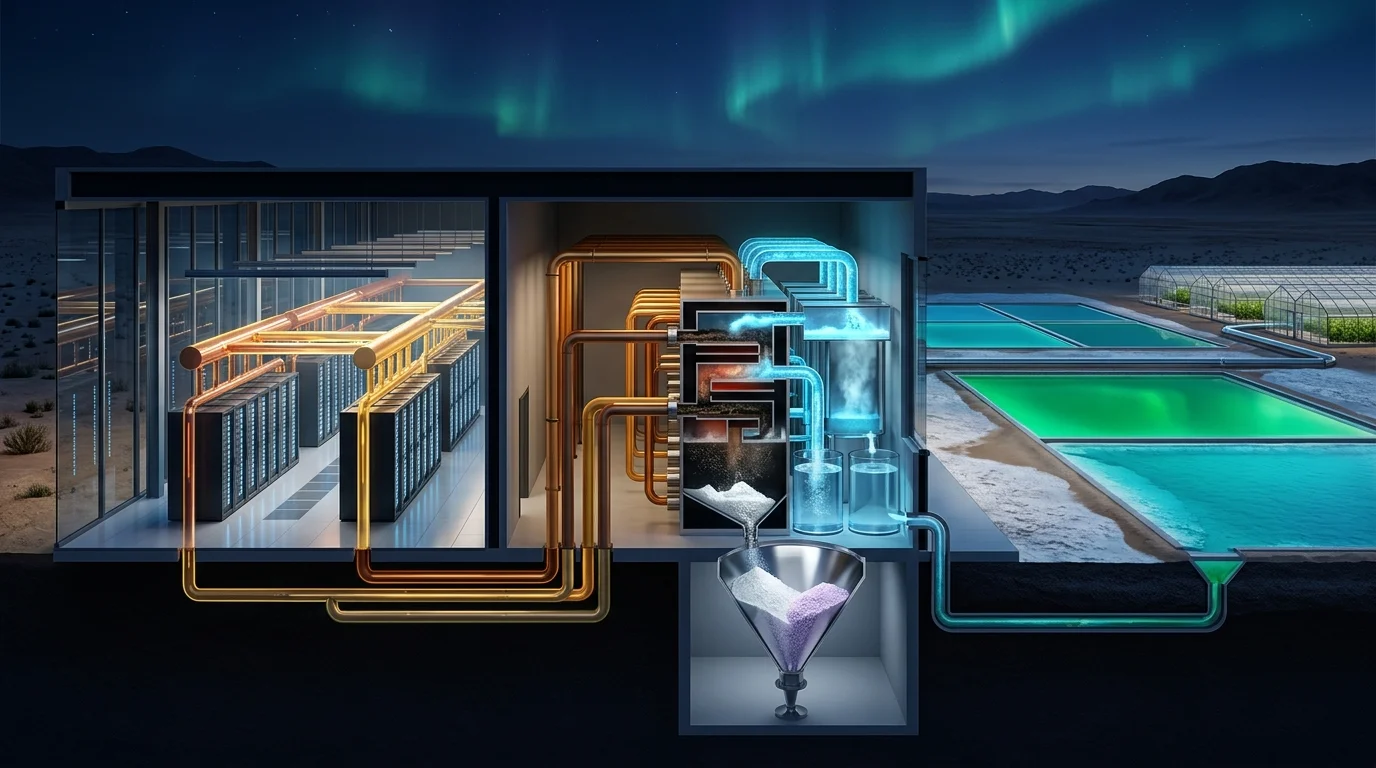
Turning an Arid Cooling Liability Into a Clean Water and Mineral Refinery
In our companion analysis of AI data center district heating and thermal batteries, we showed how northern utilities in Finland, Sweden, Denmark, and the American Midwest pipe 45 °C to 65 °C server coolant into municipal heat grids, greenhouses, and indoor aquaculture. Yet a huge share of global AI compute is landing where nobody wants winter space heating. Across West Texas, Arizona, California’s Imperial Valley, Nevada, Singapore, Spain, and the Arabian Gulf, abundant solar, wind, gas, or geothermal power sits directly atop acute freshwater scarcity.
In those warm corridors, conventional evaporative cooling towers
consume 1,000 to 2,000 m3/day of potable
water for a single 100 MW AI campus (whose
rack-level power math we broke down in our B200/B300 InferenceX
analysis). Meanwhile, coastal seawater, inland brackish aquifers,
municipal effluent, and lithium-bearing oilfield brines sit right
beneath or beside those same parcels. Coupling 45 °C to 75
°C liquid-cooled AI racks to low-temperature thermal
desalination and non-boiling brine concentrators converts that 100 MW
heat liability into two high-value industrial engines: clean
potable and Ultrapure Water (UPW) production, and
hypersaline Zero Liquid Discharge (ZLD) mineral
recovery.
A dual-mode AI waste-heat water and brine refinery couples 45 to 75 °C return coolant from direct-to-chip or immersion-cooled GPU halls to two pressure-decoupled thermal regimes. Below 70,000 mg/L salinity, sub-atmospheric Low-Temperature Multi-Effect Distillation (LT-MED) and Adsorption Desalination (AD / MEDAD) multiply latent heat across cascading vacuum chambers to produce 5 to 10 ppm TDS potable and Ultrapure Water plus 5 to 20 °C chilled cooling water. Above the 70,000 mg/L Reverse Osmosis ceiling, non-boiling Vacuum Membrane Distillation (VMD), Humidification-Dehumidification (HDH), and Thermolytic Forward Osmosis (FO) concentrate hypersaline brines to 260,000 to 450,000 mg/L dry salts alongside Direct Lithium Extraction (DLE).
Just as closed-loop
Western catch basins and ventless
heat-pump dryers condense moisture instead of venting it, thermal
water recovery flips AI campuses from municipal water sinks into net
water exporters. Where coastal or brackish aquifers dominate, a 100
MWth server loop supplies clean water for cities, citrus
orchards, green hydrogen electrolyzers, and semiconductor fabs; where
oilfield or geothermal brines dominate, the same thermal loop eliminates
deep-well disposal while co-producing industrial salts
(NaCl, CaCl2, Mg(OH)2,
KCl), bromine, and battery-grade lithium
(Li2CO3 and LiOH).
1. Clean Water Production Below 70
°C: LT-MED, Adsorption Cogeneration, and Industrial
UPW
Before examining hypersaline oilfield brines, consider the primary
clean-water mission facing coastal and arid-inland data centers:
converting seawater (35,000 to 45,000 mg/L TDS) or brackish
groundwater (2,000 to 15,000 mg/L TDS) into municipal
drinking water, agricultural irrigation supply, and industrial Ultrapure
Water (UPW). Liquid-cooled AI halls running NVIDIA
GB200/GB300, Vera Rubin
(45 °C supply / ~55 °C
return), and AMD Instinct MI355X/MI400 racks under
ASHRAE W45 warm-water classes deliver steady, 24/7 reject water at
45 °C to 70 °C.
Sub-Atmospheric
LT-MED at < 65 °C: Sensible
Water vs. Isothermal Vapor
At sea-level atmospheric pressure (1.00 bar), water
boils at 100 °C – far hotter than any GPU cold plate can tolerate.
Low-Temperature Multi-Effect Distillation
(LT-MED) solves that mismatch by evacuating serial
evaporator chambers to progressive sub-atmospheric vacuum: water boils
at 70 °C at 0.32 bar, 65 °C at 0.25
bar, and 45 °C at 0.10 bar, as documented in
Veolia
/ SIDEM’s thermal desalination engineering curves. Steam flashed in
the first chamber condenses inside the tube or plate bundle of the next
lower-pressure chamber, recycling its 2,350 kJ/kg latent heat across
effect after effect.
Keeping the Top Brine Temperature (TBT) below 65
°C delivers a major chemical dividend. Calcium sulfate
(CaSO4) exhibits retrograde solubility in seawater (Warsinger et al.,
MIT, Desalination 2015): hard anhydrite scale precipitates
aggressively above 70 °C to 80 °C, alongside brucite
(Mg(OH)2) and calcium carbonate. Operating below 65 °C
avoids anhydrite scaling at 1.5× to 2.0× seawater concentration,
allowing titanium corrugated-plate units like the Alfa
Laval MEP (engineered for
≥ 50 °C hot water), IDE
Technologies LT-MED, and Veolia
/ SIDEM MED to run with chemical Clean-in-Place
(CIP) roughly once per year – ten times
less often than seawater RO. Better still, electrical pumping power
drops to 1.0 to 1.94 kWhe/m3
(30 % to 70 % less electricity than seawater RO’s 3.0 to
4.5 kWhe/m3), cutting energy OPEX to $0.06
to $0.18/m3 when server heat arrives free.
Rigorous campus sizing must respect one thermodynamic distinction
established by the National Renewable Energy Laboratory (NREL
OSTI 1457663) and the University of
Utah (OSTI 1848553):
single-phase sensible hot water versus two-phase isothermal
vapor:
- Unboosted Single-Phase Hot Water (
4 to 6Effects,GOR = 3.73 to 5.1): Because liquid server water cools down by 13 °C to 22 °C as it transfers sensible heat into the first effect, temperature pinch and feed preheating cap optimal forward-feedLT-MEDaround 4 to 6 effects (forward feed produces+7.5 %more water than parallel feed by keeping peak salinity out of the hottest chamber). At a 65 °C hot-water inlet, Utah’s 4-effect model verifiesGOR = 3.73at1.94 kWh_e/m3, translating to 13,715 to 18,750 m3/day (3.62 million to 4.95 million gal/day) per 100 MWth. - Two-Phase Isothermal Vapor or Hybrid
MEDAD(8 to 14Effects,GOR = 6.0 to 12.0): When two-phase cold plates, low-lift vapor recompression, or adsorption bottom-stage lowering supply isothermal 65 °C to 75 °C condensation across 8 to 14 stages (~2.5 to 3.5 K per effect),GORclimbs to 6 to 12 – yielding 22,060 to 44,120 m3/day (5.83 million to 11.65 million gal/day) per 100 MWth. At utility scale, Kuwait’s Az Zour North Phase 1 plant (10SIDEM MED units producing 405,000 to 486,400 m3/day) achievesGOR = 11at0.9 kWh_e/m3. - Why Unrecuperated Single-Stage Membrane Distillation
Loses: Multi-effect heat recovery is mandatory for bulk
clean-water economics. A 2025 Lund University / RISE case study on a
1.5 MW liquid-cooled data center in Barcelona (Wyon
2025) proved that coupling
30 to 65 °Ccoolant to single-stage Direct Contact Membrane Distillation (DCMD) without latent heat recovery (GOR < 1) yielded< 16.8 m3/dayat 3.3 to 4.8 EUR/m3 (2.94 EUR/m3pump electricity alone) versus ~1.0 EUR/m3 municipal water.
Adsorption
Desalination and Chilled-Water Cogeneration (AD &
MEDAD)
What if the same 50 °C to 75 °C server loop could
generate both < 10 ppm potable distillate
and 5 °C to 20 °C chilled cooling
water simultaneously? Adsorption Desalination
(AD), pioneered at the National University of
Singapore (NUS) and King Abdullah University of Science and Technology
(KAUST), eliminates mechanical vapor compressors and operates with
zero rotating or reciprocating parts inside the vapor
chamber (Thu et
al. 2013; Ng et
al. 2016).
An AD skid alternates porous hydrophilic sorbent beds
between two half-cycles: during adsorption, dry sorbent
pulls a deep vacuum (1 to 3 kPa) on a saline chamber so
seawater flashes at 5 °C to 20 °C, chilling facility
cooling water that returns straight to server rear-door exchangers;
during desorption, 50 °C to 75 °C GPU
return water heats the saturated sorbent, driving off pure water vapor
that condenses into potable distillate:
- Verified Data Center Cooling + Water Performance:
NUS experiments proved advanced heat-recovered silica-gel
ADremains operational down to 50 °C hot-water inlet (4.3 m3distillate per metric ton of sorbent per day, rising to 15 m3/t/day at 70 °C). In 2026, Cho & Moon (Energy Reports 16) modeled an immersion-cooled data center driving a two-bed adsorption heat pump on 53 °C server coolant to produce 20 °C chilled water atCOP = 0.77, trimming net effective cooling PUE from1.051down to1.031. Commercial silica-gel chillers from Sorption Technologies similarly deliverCOP = 0.50 to 0.65on50 to 95 °Chot water. - Why
Al-FumarateMOF Beats Legacy Silica Gel at65 °C: Below 70 °C, sorbent isotherm shape decides everything. Comparative testing by Youssef et al. (2018) showed that when regeneration heat drops from 85 °C down to 65 °C while producing 10 °C chilled water, Aluminum Fumarate (Al-Fumarate) MOF retains 98.9 % of its water output (3.47to3.43 m3/t/dayplus19.88 Rton/tcooling), whereas legacy RD silica gel collapses by 75 % andAQSOA-Z02zeolite drops 86 %. - Hybrid
MEDADBottom-Stage Vacuum Pull: Standalone coastalLT-MEDmust stop its coldest effect around 38 °C to 40 °C in warm Gulf or Red Sea waters. Coupling anADsorbent bed to the finalMEDchamber – demonstrated at 10,000 L/day by KAUST’sMEDADpilot – pulls bottom-stage vapor down to ~5 °C, expanding the working temperature cascade without raisingTBTabove 65 °C and projecting desalinated water at $0.48/m3 (2to3times standaloneMEDyield).
Boron-Free
Orchard Irrigation and Industrial Ultrapure Water (UPW)
Symbiosis
Thermal distillation holds a decisive chemical moat over single-pass
Seawater Reverse Osmosis (SWRO): single-pass ionic,
silica, and boron purity. Seawater carries 4.0 to 7.0
mg/L of boron primarily as uncharged boric acid
(H3BO3, pKa = 9.2) at ocean pH ~8.0 (Lenntech).
Standard polyamide SWRO membranes reject neutral
H3BO3 poorly, leaving 1.0 to 2.0 mg/L
boron and 200 to 500 ppm TDS in first-pass
permeate. By contrast, sub-65 °C LT-MED and AD
produce 5 to 10 ppm TDS
(< 10 to 20 μS/cm) and
< 0.1 to 0.5 mg/L boron in a single
pass without caustic chemicals, creating high-margin industrial
co-location across three sectors:
| Co-Located Clean-Water Offtaker | Critical Purity Threshold | Why Single-Pass SWRO
Struggles |
How < 65 °C AI
Waste-Heat Distillate Wins |
|---|---|---|---|
| Citrus, Avocado, Grape & Berry Drip Irrigation | < 0.5 mg/L
boron (FAO & GCC orchard toxicity
limit) |
Leaves 1.0 to 2.0 mg/L boron
unless dosed with caustic NaOH to
pH ≥ 9.5 in a costly 2nd-pass RO. |
Delivers
< 0.1 to 0.5 mg/L boron directly
for coastal/arid orchard Water Purchase Agreements or SWRO
blending. |
| Green Hydrogen PEM & Alkaline Electrolyzers | ASTM D1193 Type I /
II (≤ 0.056 to 1.0 μS/cm,
< 10 ppb silica; ~9 to 11 L/kg H2) |
Requires multi-pass RO + heavy
deionization (50 to 60 m3/day per 10 MW
stack). |
5 to 10 ppm distillate needs
only light EDI polishing; Alfa
Laval HyDuo lifts green-H2 plant efficiency
up to 30 % (deployed on Europe’s 10 MW North Sea
HOPE project). |
Leading-Edge Semiconductor Wafer
Fabs (SEMI F63) |
Boron 50 to 100 ppt
(28 nm) → 100 ppq to 5 ppt (2 nm
GAA); 18.2 MΩ·cm |
Boron is an active p-type silicon
dopant; SWRO requires primary RO + caustic pH 9.5 2nd-pass
RO + heavy resin regeneration (SnowPure). |
Bypasses high-pressure primary and caustic
2nd-pass RO entirely; feeds straight into degassing, EDI,
and boron-chelating resin (still required because trace
H3BO3 volatilizes above 55 °C per KAUST
Alpatova et al. 2018). |
2. The 70,000 mg/L Osmotic Wall: Why Reverse Osmosis Fails on Brines
What happens when the local water source is not 35,000 mg/L ocean water, but 70,000 to 250,000+ mg/L inland RO concentrate, cooling-tower blowdown, geothermal fluid, or oilfield produced water? Standard Reverse Osmosis (RO) hits a hard mechanical boundary known as the osmotic pressure wall.
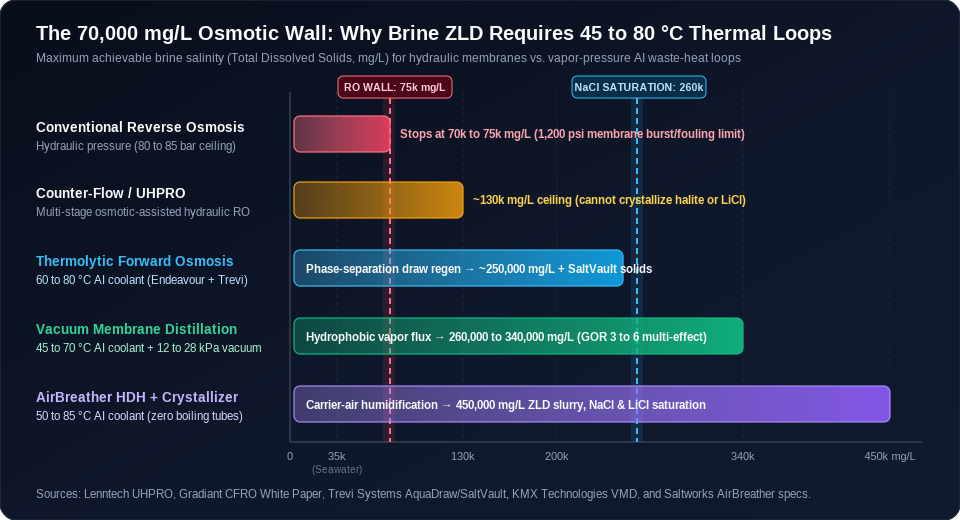
Seawater enters a coastal RO plant at roughly 35,000 mg/L Total Dissolved Solids (TDS), exerting about 27 bar of natural osmotic pressure. Recovering 50 % of that water doubles the leftover brine reject to 70,000 mg/L TDS, pushing osmotic back-pressure near 59 bar. Overcoming that osmotic pressure plus membrane friction requires 80 to 85 bar (1,160 to 1,200 psi) of hydraulic pump pressure – the structural burst and compaction limit of commercial spiral-wound polymeric RO vessels, as documented by Lenntech, Gradiant, and International Desalination and Reuse Association benchmarks.
Even specialized multi-stage Counter-Flow RO (CFRO) and
Ultra-High-Pressure RO (UHPRO) systems top out around
130,000 mg/L TDS. That leaves a wide thermodynamic gap
before minerals crystallize:
- Halite (
NaCl) saturation requires concentrating brine to roughly 260,000 mg/L (26 wt % salt). - Oilfield produced waters in the Permian and Smackover basins often emerge from the wellhead already at 100,000 to 250,000+ mg/L TDS, rendering standard RO unusable on day one.
- Lithium chloride (
LiCl) saturation sits near 600,000 mg/L, requiring deep water removal after selective lithium capture.
Crossing Saturation Without 100 °C Boiling
Historically, crossing the 70,000 mg/L RO wall required Mechanical Vapor Recompression (MVR) evaporators or steam-heated boilers running at 100 °C to 130 °C. Those titanium-tube evaporators consume 25 to 60 kWh of electricity per cubic meter (or heavy natural gas firing) because boiling hypersaline brine at atmospheric pressure incurs severe boiling-point elevation and mineral scale.
Three non-boiling hypersaline separation mechanisms avoid metal-wall boiling scale and run directly inside the 45 °C to 80 °C AI server coolant window:
- Vacuum Membrane Distillation (
VMDandV-MEMD): Pulling a sub-atmospheric vacuum (12 to 28 kPa absolute) on the permeate side of a hydrophobic PTFE or polypropylene membrane (120 to 125degree contact angle) lowers vaporization into the 45 °C to 65 °C range. Liquid brine cannot wet the hydrophobic pores; only pure water vapor crosses and condenses as< 10 ppmdistillate even at 200,000 to 340,000 mg/L TDS, per Colorado School of Mines / DOE testing andAGMDboron studies showing> 99 %rejection. - Humidification-Dehumidification (
HDH): Instead of boiling brine against metal tubes that crust over with gypsum and halite, systems like Saltworks’AirBreatherspray > 50 °C heated brine through a packed tower against a closed loop of dry carrier air. Warm air absorbs moisture at atmospheric pressure and condenses pure water on a cold coil, concentrating brines smoothly up to 450,000 mg/L TDS. - Retrograde Thermolytic Forward Osmosis
(
FO): Trevi Systems uses a high-osmotic-pressure polymer/glycol draw solution to pull water passively out of hypersaline brine across a low-pressure membrane. Heating the diluted draw solution to 60 °C to 80 °C with AI server coolant triggers an abrupt liquid-liquid phase separation (cloud-point demixing), releasing clean water without vaporizing the entire volume.
3. Global Data Center Water-Production, Reuse, and Brine Deployments
Between 2021 and late 2026, hyperscalers and infrastructure operators moved decisively away from open-loop potable evaporation – across both operating municipal reuse / zero-discharge utilities and commercial waste-heat desalination and brine pilots.
| Project / Platform | Counterparties & Status | Heat / Process Architecture | Feedstock Treated | Verified Scale & Reported Impact |
|---|---|---|---|---|
| Thermolytic FO + ZLD Rollout | Endeavour
(Edged / ThermalWorks) + Trevi
Systems (Commercial partnership, Oct 2026) |
60 to 80 °C AI liquid
cooling driving AquaDraw FO + SaltVault
ZLD |
Brackish groundwater & oilfield produced water | Concentrates up to ~250,000 ppm TDS; vendor projects up to 757 m3/MW/day on brackish feed (189 m3/MW/day on produced water). |
| West Texas Zero-Surface-Discharge AI Campus | Gradiant
HyperSolved (Turnkey contract, Sept 2026) |
High-recovery membrane +
MLD/ZLD (SmartOps AI
control) |
Non-freshwater brackish & wastewater sources | Turnkey supply + treatment achieving 95 %+ water recovery with zero discharge to surface water in arid West Texas. |
| Oilfield Produced Water & Blowdown VMD | KMX Technologies (Commercial pilots, Dec 2025 - Oct 2026) | 45 to 70 °C hollow-fiber PTFE Vacuum Membrane Distillation | Permian produced water & cooling-tower blowdown | Desalinates hypersaline oilfield water
into > 95 %-recovery distilled cooling makeup and
concentrates blowdown toward ZLD. |
| Waste-Heat Atmospheric Sorbent WPA | AirJoule + Nexus Data Centers & NZIH (Field pilots, 2025 - 2026) | < 65 °C
MOF sorbent vacuum regeneration (< 160 Wh/L
elec.) |
Ambient air humidity & industrial vapor | 1,000 to 3,000 L/day per
module; advancing toward an onsite WPA at Nexus’s 600 MW
Hubbard, TX campus and Denmark’s Net Zero Innovation
Hub. |
Quincy Water Reuse Utility
(QWRU) |
Microsoft + City of Quincy, WA (Operating since June 2021) | Closed-loop lime softening + UF + ion exchange + RO + evap ponds | High-TDS data center cooling blowdown | $31 million utility
(48 km piping) recycling blowdown with zero surface
discharge, saving 138 million gal/yr
(522,000 m3/yr) of potable groundwater. |
Municipal Reclaimed &
NEWater Loops |
Loudoun Water (VA), AWS (US / Singapore) & Khazna (UAE) | Tertiary membrane reclamation
(PUB NEWater MF + RO + UV; UAE TSE) |
Municipal treated wastewater effluent | Loudoun delivered
> 750 million gal to ~40 DCs in
2025; AWS runs 100 % NEWater in Singapore
and scales to 120+ US sites saving 530 million
gal/yr. |
| WWTP Co-Location & Biosolids Sludge Drying | UT Austin Cockrell School & WWTP Pilots (2025 - 2026) | 35 to 65 °C server heat into digesters & low-temp belt dryers | Reclaimed municipal effluent & dewatered sewage sludge | Warms 37 to 55 °C
anaerobic digesters (boosting biogas) and dries biosolids from ~20 % to
~85 % solids, cutting sludge trucking mass by 60 % to 75
%. |
Reading Vendor Projections vs. Operating Utility Benchmarks
Separating mature operating utilities from first-of-a-kind thermal pilots clarifies how these technologies stack together on a real campus:
- Municipal Reclaimed Water Sets the Baseline
(
Quincy,Loudoun,AWS,PUB NEWater,Khazna): Where municipal wastewater exists, reclaimed loops already operate at massive scale. Singapore’sPUB NEWater(760,000 m3/dayacross five plants) supplies 100 % of AWS Singapore cooling water alongside semiconductor wafer fabs, Loudoun Water’s Broad Run facility delivered over 750 million gallons to Northern Virginia data centers in 2025, Khazna integrates Treated Sewage Effluent (TSE) in the UAE, and Microsoft’s $31 million Quincy Water Reuse Utility offsets 138 million gallons/year of Washington groundwater. Yet in places like Goodyear, Arizona – where high-TDS brine limits forced Microsoft to switch newer halls to air cooling – and West Texas – where Gradiant’s September 2026HyperSolvedcontract mandates zero surface-water discharge – closing the final brine loop requires thermal concentration. - Endeavour (
Edged Energy) + Trevi Systems (FO+SaltVault): Announced in October 2026 across US and Iberian (Edged/ Merlin) pipelines,ThermalWorksroutes 60 °C to 80 °C waterless server cooling into Trevi’sAquaDrawForward Osmosis regenerator. Endeavour projects up to 200,000 gal/day (~757 m3/day) per MW on low-salinity brackish groundwater (and 50,000 gal/day per MW on oilfield produced water). As Section 6 proves, pure single-effect evaporation yields ~36.8 m3/MWth/day; hitting hundreds of cubic meters per MW relies on osmotic draw pressure doing bulk separation on dilute brackish feed while server heat only demixes the thermolytic polymer draw at ~10 kWh/m3 electric. - KMX
VMD, AirJouleMOF, and Municipal Sludge Drying: KMX Technologies targets Permian produced water and cooling-tower blowdown ZLD using 45 to 70 °C PTFE hollow-fiberVMD. AirJoule harvests atmospheric humidity at< 160 Wh/Lelectrical using< 65 °Creject heat (1 to 3 m3/dayper module – ideal for closed-loop makeup at Nexus’s Hubbard, Texas site and Denmark’s Net Zero Innovation Hub with Google, Microsoft, Data4, Vertiv, and Danfoss, though 100× smaller in volume thanLT-MED). Meanwhile, co-locating beside a municipal WWTP lets 50 °C to 65 °C air coils dry dewatered sewage sludge without burning utility natural gas.
4. Lithium, Bromine, Potash, and Salt: Separating Chemistry From Hype
Can a 60 °C AI data center cooling loop produce battery-grade lithium, bromine, potash, and industrial salt? Yes – provided engineers never confuse water removal with ion selectivity.
Raw oilfield or geothermal brine is a complex chemical soup dominated
by sodium (Na+), calcium (Ca2+), magnesium
(Mg2+), and potassium (K+) chlorides, with
lithium (Li+) present only in trace concentrations
(25 to 668 mg/L). If you pump raw Permian brine (30
mg/L Li and 150,000 mg/L NaCl) straight into a waste-heat evaporator
without selective chemistry, halite (NaCl) precipitates
first, trapping lithium inside wet salt cake pores while calcium and
magnesium chlorides turn into a viscous bittern.
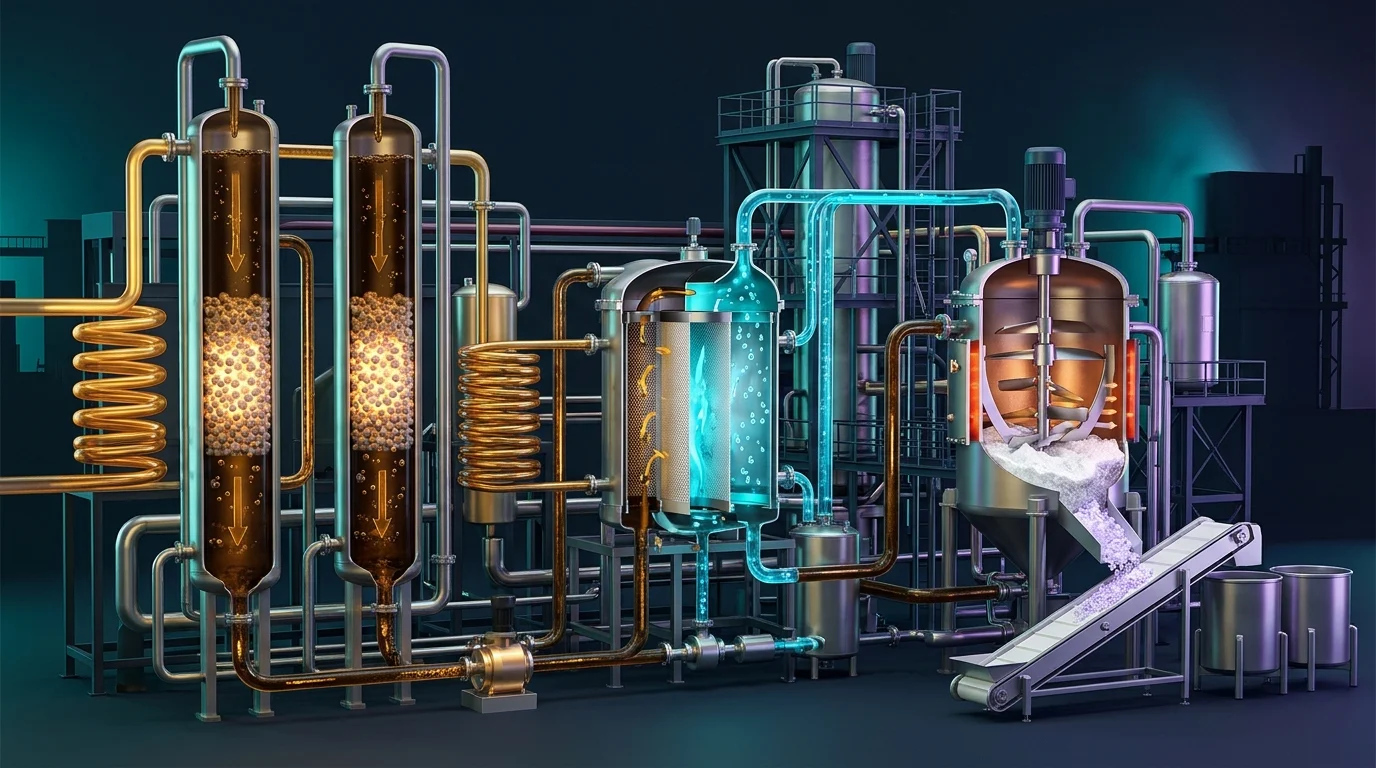
In a real industrial train, sorbents do the chemical separation and AI server waste heat does the water removal and kinetic heating across four exact steps:
- Keeping Alumina-Intercalate
DLEColumns Warm (50 °C to 75 °C): While ion-exchange (IX) manganese/titanium beads run near ambient temperature (20 to 30 °C), commercial layered lithium-aluminum-hydroxide intercalation sorbents (LiCl·2Al(OH)3) – such as Vulcan Energy’sVULSORBand LithiumBank’scDLE– require 50 °C to 75 °C feed brine for rapid lithium diffusion kinetics (IDTechEx; LithiumBank 70 °C pilot). When surface brines or cooled oilfield waters sit at 20 °C, 60 °C AI server return water pre-heats the brine and desorption wash water for free. - Concentrating Dilute
DLEEluate (2,000 mg/L→50,000 mg/L Li): Stripping aDLEcolumn with fresh wash water produces a clean but dilute lithium chloride (LiCl) eluate at 500 to 5,000 mg/L Li. Before soda ash (Na2CO3) precipitation or Mangrove Lithium electrochemical conversion into battery-gradeLi2CO3orLiOH·H2O, that eluate must be concentrated 10× to 50× – an ideal match for 55 to 70 °CVMD,LT-MED,AirBreatherHDH, or SaltworksBrineRefine. - Direct Membrane Distillation-Crystallization
(
MDC): UK-based WaterCycle Technologies combines lithium-selective hollow-fiber membranes with Membrane Distillation-Crystallization (DLEC/MDC) to precipitate> 99.5 %battery-gradeLi2CO3crystals directly from concentrated UK and Italian geothermal brines (The Chemical Engineer). - Fractional Crystallization of
Mg,Ca,Na, andKCo-Products: What happens to the lithium-depleted brine (raffinate) or oilfield produced water? In May 2025, researchers at the U.S. Department of Energy National Energy Technology Laboratory (NETL) and Columbia University (Desalination 613, OSTI2587710) modeled a waste-heat Vacuum Air-Gap Membrane Distillation (VAGMD) ZLD train on hypersaline produced water. Staging chemical softening with thermal concentration recovered 97 % of magnesium, 99 % of calcium, and 90 % of sodium as> 99 %-pure commodity solids (Mg(OH)2,CaCO3, andNaCl), shrinking residual liquid brine below 4 % of feed volume.
Even coastal gourmet sea-salt production has a proven low-grade thermal precedent: Iceland’s Saltverk evaporates 3 % Arctic seawater to 28 % halite flake crystals in open pans heated entirely by ~97 °C geothermal loops with zero fuel combustion – an artisanal proof-of-physics that closed-loop HDH and VMD crystallizers scale by three orders of magnitude while condensing 100 % of the evaporated freshwater.
5. Co-Located Basins: Where AI Power, Brines, and Critical Minerals Meet
Where on Earth do gigawatt-scale power, hyperscale AI data center demand, water scarcity, and mineral-rich brines overlap on the same parcel? Four geological basins stand out across North America and Europe.
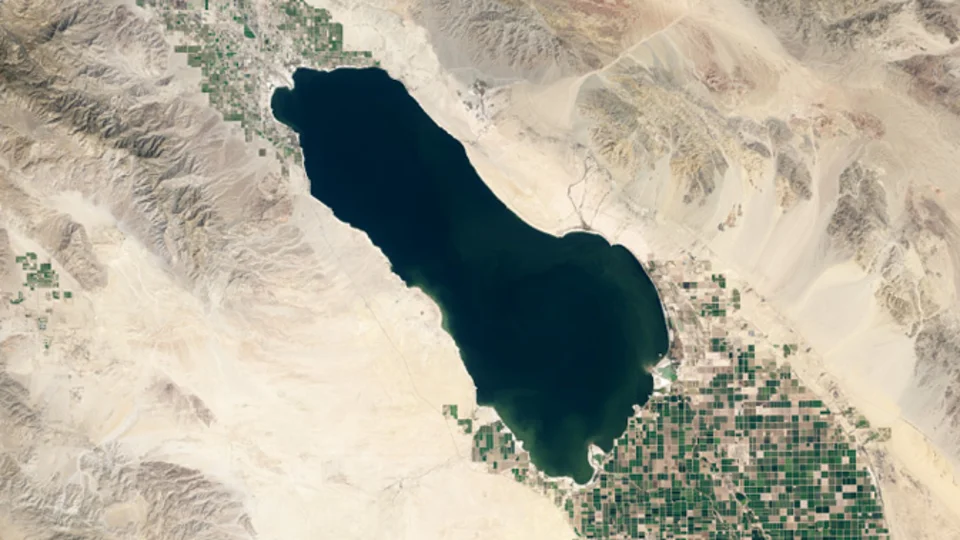
1. Salton Sea / Imperial Valley, California (“Power + Compute + Lithium”)
Beneath the southern shore of California’s Salton Sea lies a
superheated geothermal reservoir (up to 390 °C) holding an estimated
4.1 million metric tons of lithium
(~198 mg/L Li in produced brine, per Lawrence Berkeley
National Laboratory). In September 2025 and October 2026,
Controlled Thermal Resources (CTR) and
Baker Hughes advanced a definitive agreement at the
Hell’s Kitchen project (FAST-41 federally
permitted) for up to 500 to 650 MW of 24/7 baseload geothermal
power explicitly marketed for co-located hyperscale AI data
centers, alongside 25,000 metric tons/year of Stage 1
battery-grade Li2CO3 (Batteries
International; Think
GeoEnergy).
Right next door in Imperial County, EnergySource Minerals
(Project ATLiS) secured a $1.36 billion to
$1.4 billion U.S. DOE loan commitment to supply Ford with
lithium hydroxide (C&EN),
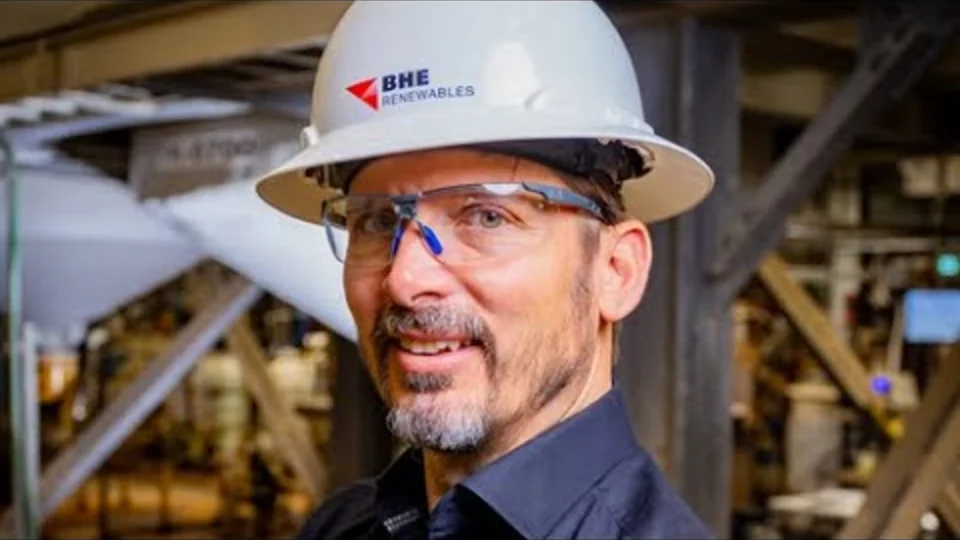
while BHE Renewables and Occidental’s
TerraLithium confirmed battery-grade
Li2CO3 and LiOH conversion at their Calipatria
commercial demonstration in October 2026 (BHE
Renewables). Here, the geothermal wellhead supplies primary steam
for power, the AI campus monetizes
> 98 %-capacity-factor baseload electricity on site,
and 55 to 70 °C AI cooling reject heat can drive
LT-MED or VMD to desalinate brackish Imperial
agricultural drain water – relieving the valley’s Colorado River
freshwater burden (3,400 acre-feet/year on
ATLiS alone).
2. The Smackover Formation (SW Arkansas & East Texas): Multi-Mineral Intensity
Stretching from Southwest Arkansas into Northeast Texas, the Jurassic
Smackover limestone aquifer hosts North America’s
highest-grade conventional lithium brines (400 to 668 mg/L
Li) alongside commercial concentrations of elemental
bromine, potash (KCl), and calcium chloride
(CaCl2):
- Standard Lithium + Equinor
(
Smackover Lithium): Advancing a 22,500 t/yrLi2CO3Phase 1 plant in Southwest Arkansas (with binding offtakes signed in 2026 with Trafigura and LG Energy Solution), plus the East Texas Franklin resource holding 2.16 million tons LCE at 668 mg/L Li, 15.4 million tons potash (KCl), and 2.64 million tons bromide (Standard Lithium). - ExxonMobil, Chevron, and TETRA Technologies:
ExxonMobil (
> 300,000net acres targeting 2027 first lithium) and Chevron (~125,000net acres entered in March 2026) joined longtime Arkansas bromine producer TETRA Technologies, whose acreage holds 5.25 million tons of bromine plus 234,000 tons LCE (TETRA resource filing). For ERCOT and SPP AI clusters expanding across East Texas and Arkansas, 60 °C server heat matches bothDLEeluate concentration and fractionalKCl/CaCl2crystallization.
3. West Texas Permian Basin & Europe’s Upper Rhine Valley
- Permian Basin (West Texas & SE New Mexico): Oil
and gas wells across the Permian pump over 20 million barrels
per day (~3.2 million m3/day) of hypersaline
produced water carrying 25 to 55 mg/L Li (~170,000 t/yr
LCE total basin flux). Operators including
LibertyStream (
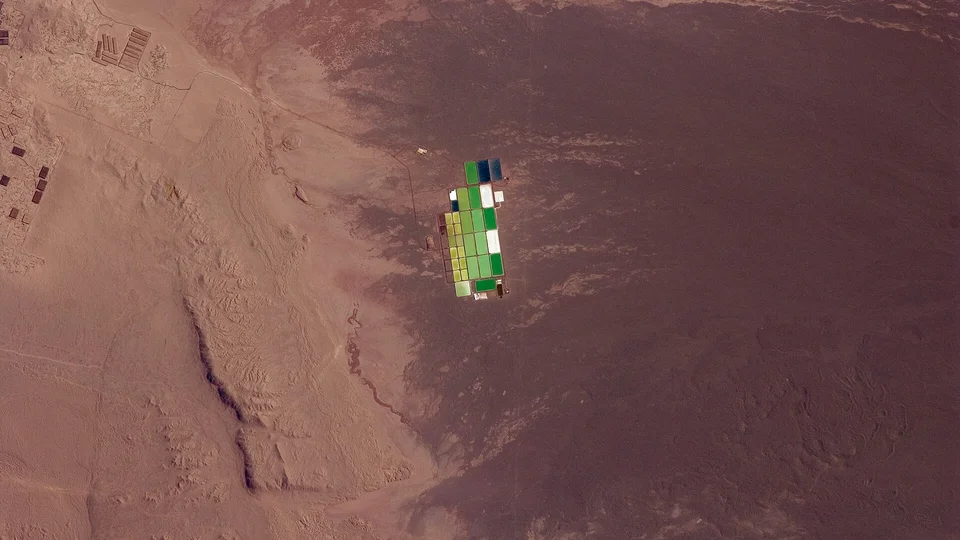
11,573 bbl/dayfield DLE run), Element3, GradiantalkaLi(commercialEC2produced-water lithium plant in the Marcellus), and Texas Tech University + Caprock (October 2026 polymer sorbent patent) are proving oilfield lithium capture right as hyperscale AI campuses surge into Abilene, San Angelo, and Midland-Odessa. Here, water pays first: desalinating produced water for cooling and avoiding seismic deep-well disposal underwrites the evaporator, while DLE lithium rides as high-margin co-product upside. - Upper Rhine Valley, Germany
(
Vulcan Energy): Close to Europe’s largest data center hub in Frankfurt, Vulcan Energy reached EUR 2.2 billion financial close on Project Lionheart (24,000 t/yrLiOH·H2O+ 275 GWh/yr power + 560 GWh/yr heat) and published its September 2026 Project Ludwig study (21,100 t/yrLi2CO3+ 3,125 GWh/yr heat) using its> 50 °CVULSORBalumina sorbent.
6. 100 MW AI Campus Mass and Energy Balance
Let us run transparent, auditable thermodynamics on a 100 MW
liquid-cooled AI campus rejecting 100 MWth
(100,000 kJ/s = 8,640 GJ/day) of steady-state heat
at 55 °C to 70 °C across 8,760 hours per year.
At 60 °C, the latent heat of vaporization of water
(hfg) is 2,350 kJ/kg
(2.35 GJ/m3), yielding 3,677 m3/day per
unit GOR. Comparing clean-water sub-atmospheric
LT-MED / MEDAD trains
(GOR = 3.73 to 12.0) against hypersaline ZLD trains
(AirBreather HDH at 4.0 GJ/m3 and multi-effect
VMD / VAGMD at GOR = 4.0):
V̇distillate = (Q̇AI × GOR) ÷ hfg
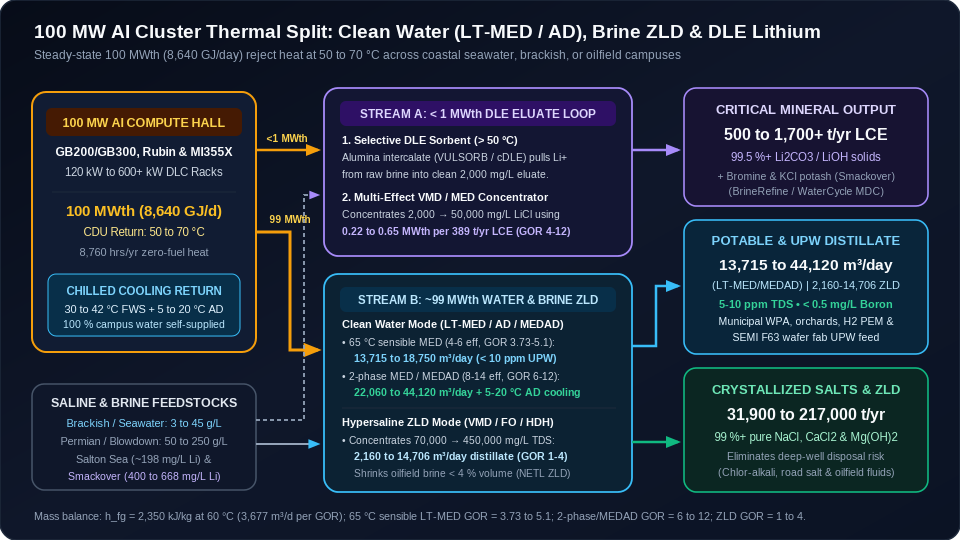
UPW
distillate (via LT-MED / MEDAD) or 14,706
m3/day of hypersaline ZLD water and 217,000 metric tons/year
of pure industrial salts.
| Thermal Architecture (100 MWth Input) | Operating Regime &
GOR |
Clean Distillate Produced | Annual Water Yield | Mineral / Co-Product Output | Campus Water Balance (vs. 1,500 m3/d Tower) |
|---|---|---|---|---|---|
Single-Effect
AirBreather HDH (Hypersaline ZLD) |
4.00 GJ/m3
(≤ 450,000 mg/L) |
2,160 m3 / day (0.57 million gal/d) | 0.79 million m3 / yr | ~31,900 t / yr dry ZLD salt | Net Water-Positive (+660 m3/d surplus) |
Multi-Effect VMD /
VAGMD ZLD (Produced Water) |
0.59 GJ/m3
(GOR = 4.0) |
14,706 m3 / day (3.88 million gal/d) | 5.37 million m3 / yr | ~217,000 t / yr
NaCl / CaCl2 / Mg(OH)2 |
Oilfield ZLD Exporter (+13,206 m3/d surplus) |
Sensible Hot-Water
LT-MED (65 °C, 4 to 6
Effects) |
0.46 to 0.63 GJ/m3
(GOR = 3.73 to 5.1) |
13,715 to 18,750 m3 / day | 5.01 million to 6.84 million m3 / yr | < 10 ppm potable,
orchard & UPW feed (1.94 kWh_e/m3) |
Municipal WPA Exporter (+12,215 to +17,250 m3/d) |
2-Phase Vapor LT-MED
/ Hybrid MEDAD (8 to 14 Effects) |
0.20 to 0.39 GJ/m3
(GOR = 6.0 to 12.0) |
22,060 to 44,120 m3 / day | 8.05 million to 16.10 million m3 / yr | Boron-free UPW +
5 to 20 °C AD chilled
water |
City-Scale Water Utility (serves 100,000 to 250,000 residents) |
The
Lithium Thermal Split: < 1 MW_th for
DLE Eluate vs. 99 MW_th for Water & Bulk
ZLD
Look closely at the lithium math
(1 kg Li = 5.323 kg Li2CO3 Lithium Carbonate Equivalent,
LCE), because it governs how clean water and critical
minerals share a 100 MW campus:
- Concentrating Post-
DLEEluate Takes< 1 MW_thon Multi-Effect Trains: Suppose an adjacentDLEplant extracts lithium into 100 m3/day of clean eluate at 2,000 mg/L Li (200 kg Li/day = 1,065 kg LCE/day = 389 metric tons/year LCE). Concentrating that 100 m3/day stream twenty-five-fold down to 4 m3/day at 50,000 mg/L Li evaporates 96 m3/day (1.11 kg/s) of water: a bare single-effect HDH tower (4.0 GJ/m3) draws 4.44 MWth, whereas multi-effectVMDorLT-MED(GOR = 4 to 12) requires just 0.22 to 0.65 MWth. Consequently, under 1 MWth of multi-effect server heat drives the entire eluate concentration train for a 500 to 1,700 t/yr LCE lithium refinery (worth $7.5 million to $25.5 million/yr at $15,000/t LCE). - Clean Water and Bulk ZLD Own the Other
99 MW_th: On coastal seawater or brackish aquifers, those remaining 99 MWth feedLT-MEDorMEDADto supply 13,715 to 44,120 m3/day of< 10 ppmwater for cities, citrus/avocado irrigation, green hydrogen, or wafer fabs. On inland produced-water basins where 99 MWth processes 14,706 m3/day of raw brine atGOR = 4, the lithium contained inside that daily throughput (captured upstream byDLEbefore halite crystallization) scales with basin grade:- Permian Produced Water
(
30 to 55 mg/L Li): 857 to 1,572 t/yr LCE contained alongside 200,000+ t/yr ofNaCl/CaCl2salts. - Salton Sea Geothermal Brine
(
198 mg/L Li): 5,657 t/yr LCE contained. - Smackover Arkansas / East Texas Brine
(
400 to 668 mg/L Li): 11,429 to 19,087 t/yr LCE contained, plus commercial bromine and potash (KCl).
- Permian Produced Water
(
- Avoided Natural Gas Burn: Generating 8,640 GJ/day of 65 °C evaporative heat in an 80 %-efficient gas boiler would burn 10,800 GJ/day (3.94 million GJ/year, or ~3.74 million MMBtu/year) of natural gas. Because AI GPUs must be cooled 24/7 regardless, that thermal input arrives with zero fuel cost and zero combustion emissions.
7. Six-Step Engineering Checklist for Arid, Coastal, and Brine-Basin AI Siting
When evaluating an AI data center site in West Texas, Arizona, California’s Imperial Valley, Arkansas, Singapore, Iberia, or the Middle East, apply six engineering gates in sequence:
- Standardize on ASHRAE W45 Warm-Water or Two-Phase Liquid
Cooling: Specify 40 to 45 °C CDU supply and
55 to 68 °C facility return headers on GB200/GB300,
Vera Rubin, and MI355X/MI400 halls. Holding return water between 60 °C
and 65 °C maximizes
LT-MED,AD,VMD, andFOdriving force while staying below the 65 °CCaSO4anhydrite scaling cliff. - Match the Desalination Train to Feed Salinity and Boron
Specs: Below
45,000 mg/L TDSwhere municipal water,< 0.5 mg/Lboron orchard irrigation, green hydrogen, orSEMI F63fabUPWis the goal, deploy forward-feedLT-MEDorAl-FumarateAD/MEDADcogeneration (1.0 to 1.94 kWh_e/m3). For mildly brackish water (3,000 to 25,000 mg/L) without strict boron limits, run cheap RO up to ~65,000 mg/L first, then route RO reject above70,000 mg/Linto non-boilingVMD,FO, orHDHfor ZLD. - Isolate the AI Loop Behind Titanium or Super-Duplex Plate
Exchangers: Hot seawater and hypersaline chlorides
(
35,000 to 250,000+ mg/L) pit standard 304/316 stainless steel rapidly. Keep the server Facility Water System (FWS) closed and clean, transferring heat strictly across Grade 2 titanium, super-duplex 2507, or fluoropolymer-lined exchangers with automated conductivity trips. - Place Selective
DLEand Chemical Softening Upstream of Crystallizers: On lithium-bearing oilfield or geothermal brines, strip silica, iron, and divalent hardness (Mg2+/Ca2+) and pass brine through selectiveDLEcolumns before halite crystallization so lithium never co-precipitates into bulk salt cake. - Underwrite on Water Self-Sufficiency,
UPWOfftake, and Disposal Savings First: Anchor project cash flows on zero-groundwater permitting, municipal/agricultural Water Purchase Agreements (WPAs), green-hydrogen/fabUPWsupply, and avoided $1.00 to $3.50/barrel oilfield saltwater disposal fees. TreatLi2CO3, bromine, potash, and chlor-alkaliNaClrevenues as stacked mineral upside. - Pair With Dry Coolers or Adsorption Chillers for Maintenance
Trim: Thermal evaporators pause periodically for
CIPwashes (~1×/yr on< 65 °CtitaniumLT-MED, more frequently on ZLD crystallizers). Keep closed-loop dry coolers,ADchilled-water beds, or subterranean thermal buffers in parallel so 100 MW of AI compute never throttles during descaling.
Sources & Primary References
- NREL (
OSTI 1457663) & University of Utah (OSTI 1848553) – Sensible Hot-WaterLT-MEDPhysics &GOROptimization: https://www.osti.gov/servlets/purl/1457663 (Sharan, Neises & Turchi, forward-feed vs. parallel-feed sensible MED & 142,600 ppm brine reduction) and https://www.osti.gov/servlets/purl/1848553 (Mohammadi, McGowan & Powell 2021, 65 to 95 °C 4-to-7-effect sensibleGOR = 3.73 to 6.06at1.12 to 1.94 kWh_e/m3). - Alfa Laval
MEP, Veolia / SIDEMMED-TVC& IDE Technologies – Industrial Low-TemperatureMED(< 65 to 70 °C): https://www.alfalaval.com/products/process-solutions/fresh-water-generation/multi-effect-desalination/mep-multi-effect-plate-evaporator/, https://www.sidem-desalination.com/expertise/smart-desalination/thermal-desalination-process, https://www.veoliawatertechnologies.com/en/technologies/multiple-effect-distillation-med-tvc, and https://www.water-technology.net/projects/az-zour-north-independent-water-and-power-project/ – Sub-atmospheric boiling (0.10 to 0.32 bar),5 to 10 ppm TDSdistillate,~1x/yrCIP, and Kuwait Az Zour North405,000 to 486,400 m3/day(GOR = 11,0.9 kWh_e/m3). - Adsorption Desalination + Cooling (
AD&MEDAD) – NUS, KAUST, Birmingham & Data Center Immersion AHP: https://scholarbank.nus.edu.sg/handle/10635/85540 (Thu et al. 2013, operational down to 50 °C at4.3 to 15 m3/t/day,< 10 ppm TDS), https://doi.org/10.1016/j.egyr.2026.109590 (Cho & Moon 2026, 53 °C immersion DC adsorption chillerCOP = 0.77, PUE1.031), https://pure-oai.bham.ac.uk/ws/portalfiles/portal/91489964/1_s2.0_S1876610217363075_main.pdf (Youssef et al. 2018,Al-FumarateMOF98.9 %output retention at 65 °C), and https://www.kaust.edu.sa/en/news/medad-wins-meed-sustainability-medal- (MEDAD10,000 L/daypilot,~5 °Cbottom stage,$0.48/m3). - Boron Removal, Green Hydrogen
UPW(HyDuo/HOPE) & SemiconductorSEMI F63Wafer Fab Standards: https://www.lenntech.com/processes/desalination/post-treatment/post-treatments/boron-removal.htm, https://www.alfalaval.us/industries/energy-and-utilities/sustainablesolutions/sustainable-solutions/clean-energy/clean-hydrogen/water-purification-for-green-hydrogen/, https://hope-h2.eu/hope-year-in-review/, https://www.snowpure.com/boron-control-in-ultrapure-water-for-advanced-semiconductor-nodes/ (28 nm50 to 100 pptto2 nm100 ppq to 5 ppt), and https://pmc.ncbi.nlm.nih.gov/articles/PMC7600657/ (> 99 %AGMD boron rejection; see also Alpatova et al. 2018PMID: 29550556on> 55 °CH3BO3volatility). - Global Data Center Water Reuse, Zero-Discharge &
Single-Stage
DCMDCounter-Benchmark: https://idrawater.org/news/gradiant-secures-major-water-contract-for-hyperscaler-ai-data-center-campus-in-west-texas/ (GradiantHyperSolvedWest Texas), https://www.epa.gov/waterreuse/water-reuse-case-study-quincy-washington (Microsoft Quincy$31 million,138 million gal/yr), https://www.loudounwater.org/commercial-customers/reclaimed-water-program (> 750 million galin 2025), https://www.datacenterdynamics.com/en/news/amazon-to-expand-number-of-data-centers-using-recycled-water-to-120/ (AWS120+US sites saving530 million gal/yr+ SingaporePUB NEWater), and https://lup.lub.lu.se/luur/download?func=downloadFile&recordOId=9198095&fileOId=9198100 (Wyon 2025, Lund Univ. Barcelona1.5 MWunrecuperatedDCMDat3.3 to 4.8 EUR/m3). - Endeavour (
Edged Energy/ThermalWorks) & Trevi Systems Partnership (Oct 22, 2026): https://www.wcia.com/business/press-releases/cision/20261022NY78731/every-megawatt-of-ai-capacity-can-make-up-to-200-000-gallons-of-clean-water-per-day/ and https://www.trevisystems.com/technology – Forward Osmosis (AquaDraw) + 60 to 80 °C retrograde thermolytic draw regeneration +SaltVaultcrystallization up to ~250,000 ppm TDS. - KMX Technologies – Vacuum Membrane Distillation Data Center Entry & Produced Water Desalination (Dec 2025 & Oct 2026): https://kmxtechnologies.com/kmx-insights-quarterly-update-october-2026/ and https://kmxtechnologies.com/kmx-technology/ – Sub-atmospheric hollow-fiber VMD for cooling-tower blowdown ZLD, West Texas oilfield produced water, and lithium eluate concentration.
- Saltworks Technologies –
AirBreatherNon-Boiling HDH Evaporator &BrineRefineLithium Conversion: https://www.saltworkstech.com/spec-sheet/airbreather.pdf and https://www.saltworkstech.com/wp-content/uploads/2023/02/Lithium-Brochure.pdf –> 50 °Cwaste-heat carrier-air evaporation (~4.0 GJ/m3) up to 450,000 mg/L TDS plus battery-gradeLi2CO3/LiOHrefining; field-proven on engine-jacket heat in Geoscience BC Project 2020-001. - U.S. DOE NETL & Columbia University – Multi-Component
ZLD Precipitation via Waste-Heat VAGMD (Desalination 613, May
2025): https://www.osti.gov/biblio/2587710
– Zhang, Atia & Fthenakis (
OSTI 2587710), demonstrating 97 % Mg, 99 % Ca, and 90 % Na recovery at> 99 %purity with residual brine< 4 %of feed. - Reverse Osmosis Osmotic Pressure Wall & Scaling
Compendium (Lenntech, Gradiant, IDRA & MIT): https://www.lenntech.com/processes/uhrpo.htm,
https://www.gradiant.com/wp-content/uploads/2023/04/Gradiant-CFRO-whitepaper.pdf,
https://wc.idadesal.org/wp-content/uploads/2024/11/idrawc24stover.pdf,
and https://doi.org/10.1016/j.desal.2014.06.031
– Hydraulic 80 to 85 bar ceiling capping conventional RO at 70,000 to
75,000 mg/L TDS and retrograde
CaSO4scaling physics. - AirJoule Technologies & UT Austin Cockrell School –
Waste-Heat MOF WPA & Texas Produced Water: https://airjouletech.com/ and https://cockrell.utexas.edu/news/can-salty-dirty-water-cool-data-centers/
–
< 65 °CMOF sorbent regeneration at Hubbard, Texas / Denmark NZIH and Permian water-energy nexus modeling. - Salton Sea (
CTRHell’s Kitchen,BHE/TerraLithium,ATLiS), Smackover (Standard Lithium,TETRA),WaterCycle&Vulcan Energy: https://www.batteriesinternational.com/news/partners-in-500-mw-geothermal-plan-for-us-lithium-valley/, https://www.bherenewables.com/joint-venture-meeting, https://cen.acs.org/energy/energy-storage-/US-bets-new-lithium-extraction/103/web/2025/01 ($1.36 billionDOE loan), https://www.standardlithium.com/projects/smackover/south-west-arkansas/, http://www.thechemicalengineer.com/news/weardale-lithium-and-watercycle-technologies-produce-lithium-carbonate-from-geothermal-brines-in-north-east-england/, and https://www.idtechex.com/en/research-article/navigating-the-landscape-of-direct-lithium-extraction-technologies/34543.