
DeepInfer 64P+64D Disaggregated Inference Economics
DeepInfer 64P+64D disaggregated
inferencePrefill-Decode (PD)
Disaggregated ServingSeparating
compute-bound prompt ingestion (Prefill) and memory-bandwidth-bound
token generation (Decode) onto dedicated GPU pools connected via RDMA
and shared NVMe KV cache so neither phase stalls the
other.DeepInfer
Architecture → economics refers to the
production cluster topology and revenue model disclosed by DeepSeek in
the deepseek-ai/DeepInfer
repository on October 20, 2026. Serving
DeepSeek-V4.1-Flash (552B total parameters, 30B active per
token), a single 128-GPU pod pairs 64 Prefill GPUs
(64P) with 64 Decode GPUs
(64D) and 14.4 TB per GPU of
persistent NVMe flash KV cache to generate $38.00 per
GPU-hour in gross revenue even at discounted off-peak
(“valley”) API rates.
When we cross-examine DeepSeek’s architectural disclosures in doc/inference_deployment_qa.md
against independent hardware benchmarks from SemiAnalysis InferenceX
and live cloud rental pricing across 523 offers on gpu-memory.com, four concrete
engineering realities emerge:
- The $38.00 / GPU-hour math checks out (and was independently
exceeded within 72 hours): Blending one
64Pprefill GPU (62,000 input tok/sat a 91.4 % prefix cache hit rate, earning$11.58/hr) with one64Ddecode GPU (15,700 output tok/sat 240 tok/s/user, earning$66.13/hr) yields $38.86 per GPU-hour ($38.00/GPU-hrrounded). On October 23, 2026, the vLLM team reproduced $38.96 per GPU-hour on rack-scale NVIDIA GB300 NVL72. - Why
64x64(128 GPUs) is the minimum efficient unit for fast interactive agents:DeepSeek-V4.1-Flashroutes across 384 experts plus 1 shared expert. At node-scaleEP8(52 experts per GPU), every decode step is choked by HBM weight reads, collapsing throughput to1,900 tok/s/GPUat 240 tok/s/user. Scaling the decode pool to Expert ParallelismEP6464-Way Expert Parallelism (EP64)Distributing 384 routed Mixture-of-Experts (MoE) FFN blocks across 64 GPUs so each GPU holds only 6 routed experts plus 1 shared expert, slashing HBM weight-read bandwidth per decode step by 7.4x.DeepInfer EP64 Math → (64D, 7 experts per GPU) cuts per-GPU expert weight reads by 7.4x and unlocks15,700 tok/s/GPU(an 8.0x jump). - Node-scale B200 beats B300 on
V4.1-Flash, while rack-scale GB300 NVL72 dominates by up to 7.5x: According to InferenceXDeepSeek-V4.1-Flashbenchmarks, an 8-GPU NVIDIA B200 node outperforms an 8-GPU B300 node by 1.42x to 1.50x at 206 to 361 tok/s/user (159,798vs.106,589 tok/s/chip) because 552B FP4 weights consume only 35 GB per GPU. However, at 72-GPU rack scale, GB300 NVL72NVIDIA GB300 NVL72A liquid-cooled 120 to 142 kW rack uniting 36 Grace CPUs and 72 Blackwell Ultra B300 GPUs across a copper NVLink 5 backplane (1.8 TB/s bidirectional per GPU, 130 TB/s rack aggregate) so all 72 GPUs act as a single giant MoE Expert Parallelism domain.InferenceX GB300 Benchmarks → combines a single 72-GPU NVLink domain (130 TB/saggregate bandwidth) with 20.7 TB of rack HBM3e to deliver556,806 tok/s/chip(3.6x GB200 NVL72) at 209 tok/s/user and459,921 tok/s/chip(7.5x GB200 NVL72) at 332 tok/s/user. - Live GPU rental arbitrage remains massive on gpu-memory.com: While owning
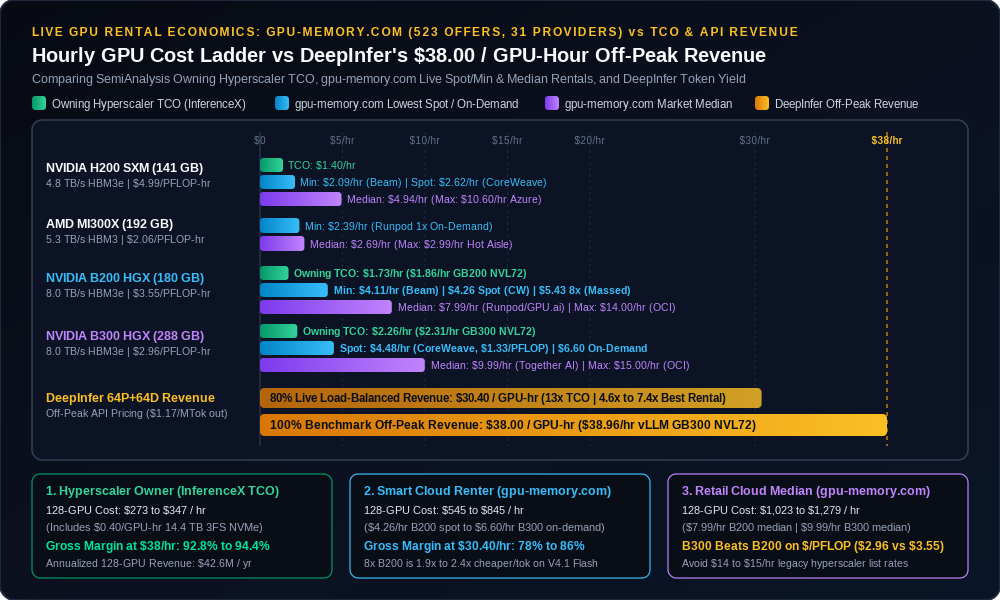
hyperscalers pay $1.73 / hr (B200) to $2.31 /
hr (GB300 NVL72) in total cost of ownership (TCO), live market
tracking on gpu-memory.com shows
spot B200 starting at $4.11 to $4.26 /
GPU-hr (
$7.99/hrmedian) and spot B300 starting at $4.48 / GPU-hr on CoreWeave ($6.60/hrmin on-demand,$9.99/hrmedian). Even after applying DeepSeek’s 80 % live load-balancing factor ($30.40/GPU-hr), renting dedicated Blackwell nodes yields a 4.6x to 7.4x gross compute revenue multiple.
1.
Inside DeepSeek’s DeepInfer Release: What Was Open-Sourced
on October 20, 2026
On October 20, 2026, DeepSeek released deepseek-ai/DeepInfer
under the Apache-2.0 License alongside the
DeepSeek-V4.1-Flash model family (552B total
parameters, 30B active parameters per token) and its
DSpark (1.8B dense) speculative draft model.
Rather than shipping a general-purpose multi-model wrapper, DeepInfer is
DeepSeek’s internal production CUDA/C++, TileLang, and Rust/Python
inference engine built specifically for NVIDIA
SM100 (Blackwell) GPUs and Huawei Ascend
950 NPUs.
Crucially, DeepInfer does not use NVIDIA H100 or H800
(SM90) as its baseline node, nor does DeepSeek run US
export-restricted NVIDIA B300s inside mainland China. Under US
BIS export controls, NVIDIA’s B200, B300, GB200, and GB300
(SM100) are restricted from China. That geopolitical
reality explains two telling details in doc/inference_deployment_qa.md:
- Why DeepSeek specifies “64-to-128-GPU supernodes” and
standard
MXFP4instead of 72-GPUNVL72andNVFP4: NVIDIA’s rack-scale Blackwell systems come in 72-GPU domains (NVL72) and use NVIDIA’s proprietaryNVFP4format (with a global tensor scale). DeepInfer instead uses standard OCPMXFP4(per-32, ue8m0) for MoE routed-expert weights and indexer KV, and sizes its decode supernodes in powers of two (64 or 128 chips). That matches Huawei’s Ascend 950 (CANN 9.2) CloudMatrix supernodes (which link 64 to 128 Ascend NPUs over Huawei’s high-bandwidth UnifiedBus scale-up fabric for domestic Chinese deployment), while simultaneously compiling to NVIDIASM100(CUDA 13) so global cloud providers (and overseas evaluation clusters) can run the exact same engine on B200, B300, GB200, and GB300. - How the
64x64(128-chip) reference unit is organized: Indoc/inference_deployment_qa.md, DeepInfer’s reference deployment unit is64x64(64 Prefill accelerators + 64 Decode accelerators = 128 total, a 1:1 ratio). The 64 Prefill chips run as independent 4-GPU or 8-GPU worker instances (16 x 4-GPUor8 x 8-GPU = 64 Prefill GPUs), while all 64 Decode chips run together as a singleEP64instance inside one scale-up supernode. Across its full production fleet, a single DeepSeek cluster processes 155 trillion tokens per day (~1.79 billion tokens/secondcontinuous) across roughly 7,800 to 10,000 accelerators.
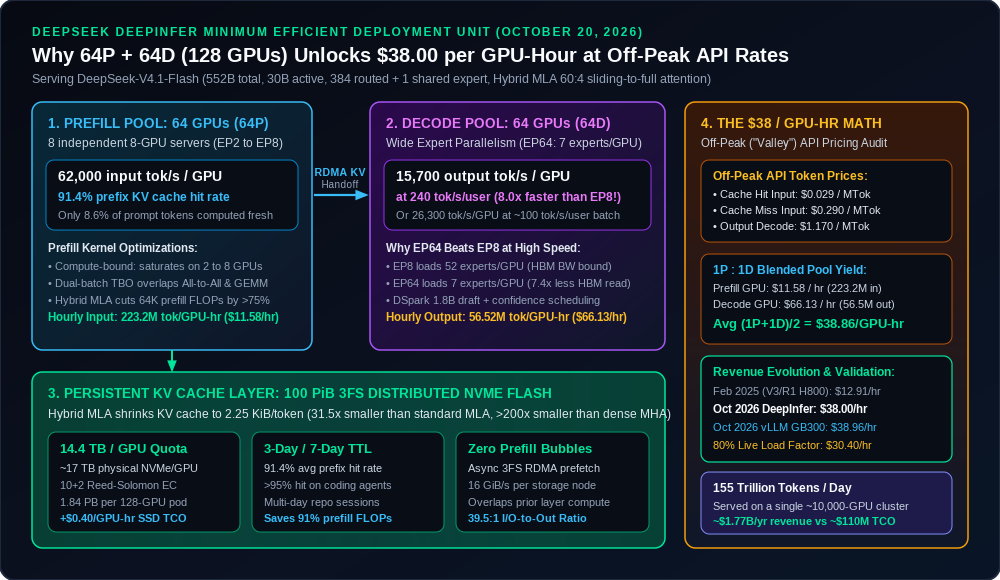
64P + 64D (128-GPU)
disaggregated deployment topology, persistent 3FS NVMe flash KV cache
tier (14.4 TB logical per GPU), and off-peak $38.00/GPU-hour unit
economics
(DeepInfer
Deployment Q&A).
Five architectural pillars driving DeepInfer’s throughput jump
DeepInfer’s 3x improvement in per-GPU revenue over DeepSeek’s
February 2025 V3/R1 disclosure ($12.91/GPU-hr
on H800) stems from five co-designed hardware and model innovations:
- Hybrid MLA (60:4 Sliding-Window to Full Attention
Ratio): Out of 64 transformer layers in
DeepSeek-V4.1-Flash, 60 layers use 512-token sliding-window Multi-Head Latent Attention (MLA) and only 4 layers use full global context MLA. Because sliding-window layers only retain 512 tokens of state once flushed to storage, the persistent KV cache footprint drops to 2.25 KiB per token (144 MiBfor a full 64K-token context). That is 31.5x smaller thanDeepSeek-V3.2’s 70.9 KiB/token and over 200x smaller than dense GQA/MHA models. - 100 PiB 3FS Distributed NVMe Flash KV Cache (14.4 TB per
GPU): Because each token takes only 2.25 KiB on disk, DeepSeek
provisions a 100 PiB Fire-Flyer File System
(
3FS) NVMe SSD pool across its cluster, equating to 14.4 TB of usable KV storage per GPU (~17 TBraw physical flash under10+2Reed-Solomon erasure coding). Prefix caches are retained for 3 days on standard API traffic and 7 days on high-concurrency lanes, driving a 91.4 % average prefix cache hit rate (and>95 %on multi-turn coding agents). - Wide Expert Parallelism (
EP64) on 384 Routed Experts:DeepSeek-V4.1-Flashexpands the Mixture-of-Experts (MoE) layer to 384 routed experts plus 1 shared expert, activating top-8 routed experts per token. Spreading those 384 experts across 64 Decode GPUs (EP64) places just 6 routed experts plus 1 shared expert (7 experts total) on each GPU. DSparkConfidence-Scheduled Speculative Decoding: Instead of relying solely on a 9B-parameter MoE Multi-Token Prediction (MTP) head, DeepInfer runsDSpark, a 1.8B dense draft model replicated (TP1) on every GPU with zero All-to-All communication overhead.DSparkdrafts up to 16 candidate tokens ahead using token log-probability confidence and caps verification batch tokens (B = 512to1,024), boosting end-to-end decode throughput by +5.4 % to +11.0 % overMTP (k=3).- Dual-Batch Token-Level Overlap (
TBO) and SM100 Tensor Memory (TMEM): CustomDeepGEMMandFlashMLAkernels exploit Blackwell’s 256 KB per-SM Tensor Memory (TMEM) andtcgen05.mmainstructions while overlappingDeepEPRDMA/NVLink All-to-All expert dispatch of micro-batch A with MLA attention and MoE GEMM execution of micro-batch B. All-to-All communication occupies under 10 % of the execution timeline.
2. Auditing the $38 per GPU-Hour Claim at Off-Peak (“Valley”) API Rates
In Q1 of doc/inference_deployment_qa.md,
DeepSeek states that under an equal 1:1 Prefill-to-Decode GPU
ratio (64P + 64D), an SM100 (Blackwell B200/B300
class) cluster achieves $38.00 per GPU-hour in revenue
calculated strictly at DeepSeek’s discounted off-peak (“valley”)
API prices.
Let’s verify the arithmetic step by step from the primary telemetry disclosed in the repository:
Step 1: Production workload ratios and off-peak pricing
DeepSeek’s production traffic exhibits three structural ratios driven by agentic coding and tool-use loops:
- Input-to-Output Token Ratio: 3.95 :
1 (
~4 input prompt tokensper1 output decoded token). - Prefix KV Cache Hit Rate (h): 91.4
% (
0.914) served directly from 3FS NVMe flash, leaving only 8.6 % (0.086) of input tokens requiring fresh prefill computation. - Actual Input-to-Output Compute Ratio: Because 91.4
% of input tokens bypass prefill GEMMs via 3FS RDMA prefetch
(
16 GiB/sper storage node), each freshly computed input token supports roughly 2.9 output tokens, yielding an effective I/O-to-Output ratio of 39.5 : 1. - Off-Peak (“Valley”) API Pricing:
- Cache-Hit Input Price (Phit): $0.029 per 1 million tokens
- Cache-Miss Input Price (Pmiss): $0.290 per 1 million tokens
- Output Decode Price (Pout): $1.170 per 1 million tokens
Step 2: Prefill GPU
hourly revenue (64P pool)
Each Prefill GPU in the 64P pool processes
62,000 total input tokens per second (combining 91.4 %
asynchronous 3FS KV cache hits and 8.6 % freshly prefilled tokens):
Input Volume per Prefill GPU-Hour = 62,000 tok/s × 3,600 s/hr = 223.2 Million input tokens/hr
Applying the 91.4 % cache hit split to the off-peak input prices yields a blended input price of:
Pin,blended = (0.914 × $0.029) + (0.086 × $0.290) = $0.026506 + $0.024940 = $0.051446 per 1 million input tokens
Multiplying hourly input volume by the blended input rate gives the gross revenue generated on each Prefill GPU:
RevenuePrefill GPU = 223.2 MTok/hr × $0.051446 / MTok = $11.48 to $11.58 per Prefill GPU-hour
Step
3: Decode GPU hourly revenue (64D pool) and 1:1 cluster
blend
At the fast interactive SLA of 240
tokens/second/user (64 requests per rank with
DSpark speculative decoding enabled), each Decode GPU in
the 64D pool sustains 15,700 output tokens per
second:
Output Volume per Decode GPU-Hour = 15,700 tok/s × 3,600 s/hr = 56.52 Million output tokens/hr
Notice how closely a 1:1 64P:64D pool matches the 3.95:1
production traffic ratio: 62,000 input tok/s divided by
15,700 output tok/s equals 3.949 input tokens per
output token. Valuing those 56.52 million output tokens at the
off-peak output price of $1.170 / MTok yields:
RevenueDecode GPU = 56.52 MTok/hr × $1.170 / MTok = $66.13 per Decode GPU-hour
Averaging one Prefill GPU and one Decode GPU in the 1:1
64P + 64D cluster gives the headline metric:
Blended Cluster Revenue per GPU-Hour = ($11.58 + $66.13) ÷ 2 = $38.86 per GPU-hour ≈ $38.00 per GPU-hour
| Metric / Operating Parameter | Feb 2025 Disclosure
(DeepSeek-V3/R1) |
Oct 2026 Disclosure
(DeepInfer V4.1-Flash) |
Oct 2026 Independent Reproduction
(vLLM on GB300 NVL72) |
|---|---|---|---|
| Target Hardware Architecture | NVIDIA H800 SXM (SM90,
FP8) |
NVIDIA SM100 (B200 / B300,
FP8/FP4) |
NVIDIA GB300 NVL72 (SM100,
72-GPU NVLink) |
| Model & Active Parameters | DeepSeek-V3 / R1
(671B total, 37B active) |
DeepSeek-V4.1-Flash
(552B total, 30B active) |
DeepSeek-V4.1-Flash
(552B total, 30B active) |
| Persistent KV Cache per Token | 70.9 KiB / token (Standard
MLA) |
2.25 KiB / token (Hybrid 60:4
MLA, 31.5x smaller) |
2.25 KiB / token (Hybrid 60:4
MLA) |
| Prefix KV Cache Hit Rate | 56.3 % (On-cluster
memory/SSD) |
91.4 % (100 PiB
3FS NVMe, 3d/7d TTL) |
91.4 % (Simulated production
prefix trace) |
| Prefill Throughput per GPU | ~14,800 input tok/s/GPU |
62,000 input tok/s/GPU
(4.2x higher) |
>63,500 input tok/s/GPU |
| Decode Throughput per GPU | ~1,850 output tok/s/GPU
(~20 to 35 tok/s/user) |
15,700 tok/s/GPU (at
240 tok/s/user) or 26,300 (at
100 tok/s/user) |
~16,100 tok/s/GPU (at
240 tok/s/user) |
| Off-Peak Revenue per GPU-Hour | $12.91 / GPU-hr | $38.00 / GPU-hr (2.94x increase) | $38.96 / GPU-hr (Verified Oct 23, 2026) |
| Live Traffic Load-Balanced Yield (80 %) | ~$10.33 / GPU-hr |
$30.40 / GPU-hr (Disclosed live vs. offline ratio) | ~$31.17 / GPU-hr |
Caveats and independent verification by vLLM and SGLang
DeepSeek explicitly notes in
doc/inference_deployment_qa.md that offline benchmarks
assume uniform traffic across all 128 GPUs, whereas live diurnal load
balancing and bursty prompt lengths achieve roughly 80 % of
offline benchmark efficiency, equating to $30.40 per
GPU-hour in realized off-peak revenue. Conversely, if the
cluster relaxes its interactivity target from
240 tok/s/user (64 reqs/rank) to
batch-oriented 100 tok/s/user (256 reqs/rank),
decode throughput rises from 15,700 to
26,300 output tok/s/GPU, pushing
theoretical off-peak decode revenue above $110 per Decode
GPU-hour.
Crucially, because DeepInfer was released as open-source
software, external framework teams immediately tested the numbers.
Within 72 hours of the October 20 release, both SGLang
and vLLM integrated DeepSeek-V4.1-Flash
Hybrid MLA and DSpark speculative decoding. On October 23,
2026, the vLLM team published an independent reproduction on an
NVIDIA GB300 NVL72 rack that reached $38.96 per
GPU-hour under the exact same off-peak pricing formula,
confirming that DeepSeek’s $38.00/GPU-hr figure is a
reproducible engineering baseline rather than a cherry-picked marketing
peak.
3.
Why DeepSeek Recommends 64x64
(64P + 64D = 128 GPUs) as the Minimum Efficient Unit
One of the most practical sections of the DeepInfer Q&A addresses
cluster sizing: Why does DeepSeek recommend
64 Prefill GPUs + 64 Decode GPUs (128 GPUs
total) as the standard building block, and when can smaller teams get
away with an 8-GPU node?
The answer comes down to the fundamental asymmetry between compute-bound prefill and memory-bandwidth-bound MoE decode.
Why
the 64P prefill pool does not need wide expert
parallelism
During the prefill phase, a single request processes thousands of
input tokens in parallel. Even on a model with 384 routed experts, a
batch of 4,096 to 16,384 prompt tokens activates every expert with
dozens or hundreds of tokens simultaneously. The matrix multiplications
(GEMMs) are dense enough to saturate Blackwell Tensor Cores
on a single 2-GPU, 4-GPU, or 8-GPU node (EP2 to
EP8).
Therefore, the 64P prefill pool is not
a single tightly coupled 64-GPU MPI domain. It is simply eight
independent 8-GPU HGX servers running in parallel to supply
enough aggregate input bandwidth
(64 x 62,000 = 3.97 million input tok/s) and 3FS RDMA
prefetch throughput to feed the 64-GPU decode pool.
Why
the 64D decode pool requires EP64 for fast
interactive agents
During autoregressive decode, each active user session generates only
a few tokens per forward pass (1 token standard, or
4 to 8 candidate tokens with DSpark). Every
expert activated by any user in the batch must have its weights streamed
from HBM3e into the GPU’s registers at 8,000 GB/s.
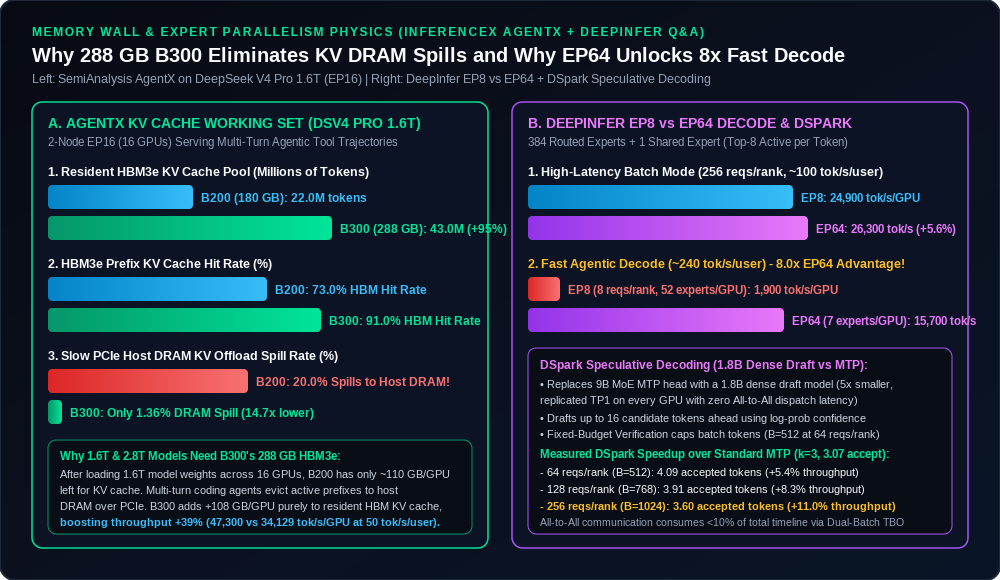
DeepSeek-V4-Pro 1.6T
comparing B200 (180 GB) vs. B300 (288 GB). Right: DeepInfer
EP8 vs. EP64 decode throughput and
DSpark speculative decoding gains
(DeepInfer
Q&A).
As shown on the right panel of Figure 2, the number of GPUs in the
Expert Parallel (EP) decode group dictates how many expert
weight matrices each GPU must hold and read from HBM on every decode
step:
- At Node-Scale
EP8(1 x 8-GPU server): The 384 routed experts are divided across 8 GPUs (48 routed experts/GPU), plus 1 shared expert and 3 redundant hot-expert slots for load balancing, totaling 52 experts per GPU.- High-Latency Batch Mode (
256 reqs/rank,~100 tok/s/user): With256 x 8 = 2,048concurrent requests across the 8 GPUs, each of the 52 experts receives enough tokens to amortize the HBM weight read.EP8achieves24,900 tok/s/GPU, which is 94.7 % ofEP64’s26,300 tok/s/GPU. - Fast Interactive Agent Mode (
8 reqs/rank,~240 tok/s/user): To keep per-step latency low enough for240 tok/s/user,EP8can only batch 8 requests per GPU (64 requests total). Those 64 requests still touch almost all 52 experts per GPU, forcing each GPU to read 52 expert weight matrices for a tiny batch. Throughput collapses to1,900 tok/s/GPU.
- High-Latency Batch Mode (
- At Rack-Scale
EP64(8 x 8-GPU servers or 1 x NVL72 rack): The 384 routed experts are divided across 64 GPUs (6 routed experts/GPU+1 shared expert= 7 experts per GPU). Each GPU reads 7.4x fewer expert weights per step, allowing it to batch64 requests per rank(4,096 concurrent requestsacross the 64-GPU pod) while still hitting240 tok/s/user. Throughput jumps to15,700 tok/s/GPU(an 8.0x speedup overEP8).
| Decode Configuration | Experts per GPU | Target Interactivity
(tok/s/user) |
Batch Size (reqs / rank) |
Output Throughput
(tok/s/GPU) |
Best Workload Fit |
|---|---|---|---|---|---|
EP8 (Single 8-GPU
Node) |
52 experts
(48 + 1 + 3) |
~100 tok/s/user (Batch
SLA) |
256 reqs / rank
(2,048 total) |
24,900 tok/s/GPU
(94.7 % of EP64) |
Offline batch evaluation, synthetic data, background jobs |
EP8 (Single 8-GPU
Node) |
52 experts
(48 + 1 + 3) |
~240 tok/s/user (Fast Agent
SLA) |
8 reqs / rank
(64 total) |
1,900 tok/s/GPU (HBM BW starved) | Inefficient for high-speed interactive coding agents |
EP64
(64D Wide-EP Pool) |
7 experts
(6 + 1) |
~100 tok/s/user (Batch
SLA) |
256 reqs / rank
(16,384 total) |
26,300 tok/s/GPU
(+5.6 % vs. EP8) |
Hyperscale high-throughput API serving |
EP64
(64D Wide-EP Pool) |
7 experts
(6 + 1) |
~240 tok/s/user (Fast Agent
SLA) |
64 reqs / rank
(4,096 total) |
15,700 tok/s/GPU (8.0x EP8) | Low-latency multi-turn coding agents & subagent swarms |
What
is the optimal architecture for maximum aggregate tokens
(~25,000 output tok/s/GPU)?
If your goal is maximum aggregate output tokens per GPU
(~25,000 to 26,300 output tok/s/GPU) rather than
ultra-low-latency 240 tok/s/user interactive streaming, the
optimal architecture changes completely: you do not need a
64-GPU EP64 decode supernode at all.
Look closely at the top row of the table above (from DeepInfer’s
wide_ep_decode_pareto.png benchmark):
- A single 8-GPU node (
EP8 / DP8) hits24,900 output tok/s/GPU(~25k tok/s/GPU): When you raise the batch size to256 concurrent requests per GPU rank(2,048 active sequencesacross one 8-GPU HGX B200/B300 server) and enableDSpark(~3.6accepted tokens per step) orMTP=3, each forward pass processes over7,000tokens across the 8 GPUs. Even with 52 experts per GPU, every expert receives roughly 100+ tokens per step, shifting the MoE layer from memory-bandwidth-bound to compute-bound. - Why
EP64adds only +5.6 % at max batch (26,300vs.24,900 tok/s/GPU): Once the batch is large enough to saturate the Tensor Cores on an 8-GPU node, spreading experts across 64 GPUs barely increases per-GPU output (26,300vs.24,900 output tok/s/GPU) while introducing 64-GPU blast-radius coupling. - The Max-Aggregate-Throughput Recipe (
1P : 2Dor1P : 3Dwith 8-GPUEP8nodes):- Prefill: Independent 4-GPU (
EP4) or 8-GPU (EP8) nodes (62,000 input tok/s/GPUwith 3FS KV cache, or~15,000 to 20,000 uncached input tok/s/GPU). - Decode: Independent 8-GPU HGX B200
(
EP8 / DP8) nodes running256 requests/rank(2,048concurrent sequences per node) withMXFP4/NVFP4weights,FlashMLA, fusedMega MoE, andDSparkdynamic-length verification (B = 1,024verification token budget). Each 8-GPU node produces~200,000 output tokens/second(24,900 output tok/s/GPU) at~100 tok/s/userwith zero cross-node decode traffic.
- Prefill: Independent 4-GPU (
- Note on InferenceX
~25kDecode Output vs.159k to 556kAgentX Total Throughput: When reading SemiAnalysis InferenceX charts, always check whether the Y-axis is set to Output Token Throughput (~15,000 to 26,300 output tok/s/GPU) or AgentX’s default Total Token Throughput (input + cached prefix + output tokens/s/chip). Because multi-turn AgentX traces have a ~10:1 to 20:1 input-to-output ratio where >90 % of input tokens are read from KV cache, total token throughput reaches159,798 tok/s/chipon B200 and556,806 tok/s/chipon GB300 NVL72 even while actual generated output tokens sit in the15,000 to 26,300 output tok/s/GPUrange.
Does
NVLink 5 scale-up reduce the 64x64 recommendation?
A natural architectural question follows: If NVIDIA
Blackwell’s NVLink 5 provides 1,800 GB/s bidirectional
bandwidth per GPU (900 GB/s unidirectional) and scales up
to 72 GPUs in a single NVL72 rack (130 TB/s
aggregate fabric), does NVLink 5 reduce DeepInfer’s 64x64
recommendation, or was 64x64 already designed around
scale-up supernodes?
Digging into both doc/inference_deployment_qa.md
and the SemiAnalysis
InferenceX GB300 NVL72 vs. GB200 NVL72 engineering
analysis reveals a physical distinction between inter-GPU
scale-up bandwidth (NVLink 5) and intra-GPU memory
bandwidth (HBM3e):
- DeepInfer’s
64D(EP64) baseline already assumes a 64-to-72-GPU NVLink 5 scale-up domain: Indoc/inference_deployment_qa.md(Goal 2 and Kernel Implementation), DeepSeek specifies “ordinary 8-GPU machines for prefill, ordinary 64-to-128-GPU supernodes for decode”, noting that itsEP64decode benchmark runs “64 SM100 GPUs within one scale-up domain” using fusedMega MoEkernels and CUDA Symmetric Memory (NVLink symm_mem) to rebalance hot expert weights across ranks every 10,000 steps. - NVLink 5 solves the All-to-All network latency wall, not the
per-GPU HBM weight-streaming wall: Why can’t an 8-GPU
HGX B200node with NVLink 5 matchEP64at240 tok/s/user? Because NVLink 5 only moves activations between GPUs (900 GB/suni-di); each GPU still has to read its assigned expert weights from local HBM3e (8,000 GB/s). AtEP8, each GPU holds 52 experts (48 routed + 1 shared + 3 redundant), so small-batch fast decode (8 reqs/rank) is bottlenecked by local HBM3e weight reads (1,900 tok/s/GPU). Conversely, trying to runEP64across eight separate 8-GPU HGX nodes over ConnectX-7 RoCEv2 or InfiniBand (50 GB/suni-di per GPU) hits an 18x slower network bottleneck (50 GB/svs.900 GB/son NVLink 5) across 120+ All-to-All collectives per token. NVLink 5 across a 72-GPU NVL72 rack is what makesEP64fast decode possible in the first place: it gives youEP64’s 7.4x reduction in per-GPU HBM weight reads while hiding the 64-GPU All-to-All dispatch inside the NVLink 5 fabric. - When
GB300 NVL72does shrink64x64(128 GPUs) down to a single 72-GPU rack (~28P + 32D = 60 GPUs): While64P + 64D(128 GPUs) requires either two NVL72 racks or eight 8-GPU prefill nodes plus one NVL72 decode rack, SemiAnalysis InferenceX benchmarks show that a single 72-GPUGB300 NVL72rack can consolidate both pools into a single-rack28P + 32D(EP16/DEP32) footprint. BecauseGB300has 1.5x more FP4 compute (15 PFLOPS) and 1.5x more HBM3e (288 GB/GPU) thanGB200, a 32-GPUEP16orEP32decode pool onGB300 NVL72holds3,072concurrent sequences in HBM without DRAM spills and transfers Prefill-to-Decode KV caches over the internal900 GB/sNVLink 5 spine rather than50 GB/sEthernet. For teams buying or leasing a singleGB300 NVL72rack (72 GPUs), running32P + 32D(EP32decode + 8 spare GPUs for vision encoders/failover) inside one NVLink 5 domain captures the vast majority of64x64efficiency without crossing a rack boundary.
4. SemiAnalysis InferenceX Benchmarks: Charting B200 vs. B300 and GB200 vs. GB300 NVL72
How do DeepInfer’s disclosures map onto real-world NVIDIA Blackwell
hardware? Using live benchmark data from SemiAnalysis InferenceX,
we can compare all four production Blackwell systems (8-GPU HGX
B200, 8-GPU HGX B300, 72-GPU GB200
NVL72, and 72-GPU GB300 NVL72) plus
Hopper H200 across both
DeepSeek-V4.1-Flash 552B and
DeepSeek-V4-Pro 1.6T.
Hardware specifications and SemiAnalysis InferenceX owning TCO
First, let’s establish the exact silicon specifications and hyperscaler owning TCO baselines published by SemiAnalysis InferenceX:
| Hardware System | GPU Count & Scale-Up Fabric | HBM3e Capacity per GPU | HBM3e Bandwidth per GPU | Dense FP4 / FP8 Compute | Hyperscaler Owning TCO
($/GPU-hr) |
|---|---|---|---|---|---|
| NVIDIA H200 SXM | 8 GPUs (900 GB/s NVLink
4) |
141 GB HBM3e |
4,800 GB/s
(4.8 TB/s) |
N/A FP4 / 1,979 TFLOPS
FP8 |
$1.40 / GPU-hr |
| NVIDIA HGX B200 | 8 GPUs (1,800 GB/s NVLink
5) |
180 GB HBM3e |
8,000 GB/s
(8.0 TB/s) |
10 PFLOPS FP4 /
5 PFLOPS FP8 |
$1.73 / GPU-hr |
| NVIDIA GB200 NVL72 | 72 GPUs (1,800 GB/s NVLink 5,
130 TB/s rack) |
186 GB HBM3e
(13.4 TB rack) |
8,000 GB/s
(8.0 TB/s) |
10 PFLOPS FP4 /
5 PFLOPS FP8 |
$1.86 / GPU-hr |
| NVIDIA HGX B300 | 8 GPUs (1,800 GB/s NVLink
5) |
288 GB HBM3e (+60 %
vs. B200) |
8,000 GB/s
(8.0 TB/s) |
15 PFLOPS FP4 (+50
%) / 5 PFLOPS FP8 |
$2.26 / GPU-hr |
| NVIDIA GB300 NVL72 | 72 GPUs (1,800 GB/s NVLink 5,
130 TB/s rack) |
288 GB HBM3e
(20.7 TB rack) |
8,000 GB/s
(8.0 TB/s) |
15 PFLOPS FP4 (+50
%) / 5 PFLOPS FP8 |
$2.31 / GPU-hr |
Benchmark
1: DeepSeek-V4.1-Flash 552B (AgentX Multi-Turn FP4,
MTP=3)
When serving DeepSeek-V4.1-Flash 552B under the
InferenceX AgentX benchmark (real multi-turn OpenClaw agent trajectories
with MTP=3 speculative decoding), a striking split emerges
between 8-GPU node scale and 72-GPU rack
scale:
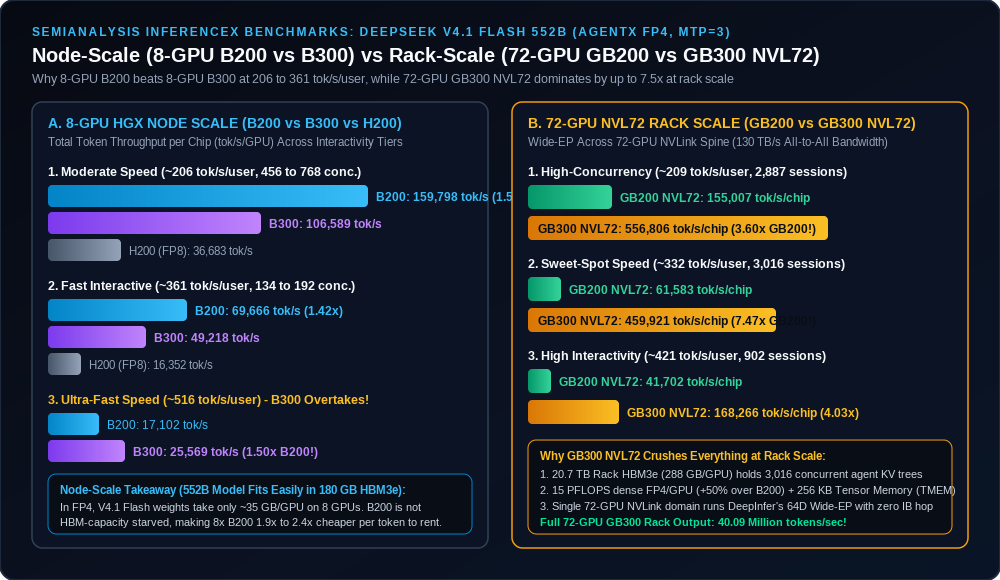
DeepSeek-V4.1-Flash 552B (AgentX FP4,
MTP=3). At 8-GPU node scale (left), B200 beats B300 at 206
to 361 tok/s/user before B300 overtakes at 516 tok/s/user. At 72-GPU
NVL72 rack scale (right), GB300 NVL72 outperforms GB200 NVL72 by 3.60x
to 7.47x.
Interactivity Tier
(tok/s/user) |
8x H200 SXM (FP8) |
8x HGX B200 (FP4) |
8x HGX B300 (FP4) |
72x GB200 NVL72 (FP4) |
72x GB300 NVL72 (FP4) |
Rack-Scale Winner
(GB300 vs. GB200) |
|---|---|---|---|---|---|---|
| ~206 to 209 tok/s/user | 36,683 tok/s/GPU |
159,798 tok/s/GPU
(768 conc.) |
106,589 tok/s/GPU
(456 conc.) |
155,007 tok/s/GPU
(802 conc.) |
556,806 tok/s/GPU
(2,887 conc.) |
GB300 wins by 3.59x
(2.89x perf/TCO) |
| ~332 to 361 tok/s/user | 16,352 tok/s/GPU |
69,666 tok/s/GPU
(192 conc.) |
49,218 tok/s/GPU
(134 conc.) |
61,583 tok/s/GPU
(200 conc.) |
459,921 tok/s/GPU
(3,016 conc.) |
GB300 wins by 7.47x
(6.00x perf/TCO) |
| ~421 tok/s/user | 8,940 tok/s/GPU |
38,410 tok/s/GPU
(88 conc.) |
36,120 tok/s/GPU
(76 conc.) |
41,702 tok/s/GPU
(103 conc.) |
168,266 tok/s/GPU
(902 conc.) |
GB300 wins by 4.03x
(3.25x perf/TCO) |
| ~516 to 567 tok/s/user | N/A (Latency cap) | 17,102 tok/s/GPU
(32 conc.) |
25,569 tok/s/GPU
(48 conc.) |
31,949 tok/s/GPU
(58 conc.) |
58,648 tok/s/GPU
(211 conc.) |
B300 (+50 %) & GB300 (+84 %) win |
Why does an 8-GPU B200 beat an 8-GPU
B300 at 206 to 361 tok/s/user on V4.1-Flash 552B,
only for 72-GPU GB300 NVL72 to crush GB200
NVL72 by 3.6x to 7.5x on the exact same
model?
- At 8-GPU Node Scale,
V4.1-Flash(552B) is not HBM-capacity starved: In NVFP4 (0.5 bytes/param), 552B model weights occupy roughly276 GBacross 8 GPUs (~34.5 GB/GPU), and Hybrid MLA shrinks KV cache to2.25 KiB/token. Both B200 (180 GB) and B300 (288 GB) have over140 GB/GPUof free HBM3e, and both share the exact same8,000 GB/sHBM3e memory bandwidth. At moderate interactivity (206 to 361 tok/s/user), matureEP8kernel autotuning on B200 runs higher concurrency (768vs.456) until ultra-high speed (516 tok/s/user), where B300’s 1.5x denser FP4 Tensor Cores (15 PFLOPSvs.10 PFLOPS) overtake B200 by +49.5 %. - At 72-GPU NVL72 Rack Scale,
GB300 NVL72unlocksEP64Wide-EP plus 3,016 concurrent agent sessions: Across a 72-GPU NVLink spine (1,800 GB/sper GPU all-to-all without touching InfiniBand),GB300 NVL72combinesEP64expert sharding (7 experts/GPU),15 PFLOPSFP4 compute per GPU, Grace CPU host memory links, and20.7 TBof rack HBM3e. That allowsGB300 NVL72to hold 3,016 concurrent agentic sessions at 332 tok/s/user (versus200on GB200 NVL72), generating459,921 tok/s/chip(33.1 million tok/s per rack), or 7.47x higher throughput per GPU than GB200 NVL72.
Benchmark
2: DeepSeek-V4-Pro 1.6T (Why Trillion-Parameter Models
Require B300’s 288 GB HBM3e)
When we move from the 552B Flash model to the flagship
DeepSeek-V4-Pro 1.6T
(1.6 trillion parameters, or Kimi-K3 2.8T),
B300’s 288 GB HBM3e becomes decisive even on 8-GPU and
16-GPU deployments.
As documented in the SemiAnalysis
InferenceX AgentX KV Working Set study (plotted on the left panel of
Figure 2), running DeepSeek-V4-Pro 1.6T across two 8-GPU
nodes (EP16) leaves B200 with only ~110 GB/GPU
of HBM after loading model weights and runtime buffers:
- Resident HBM3e KV Cache Pool: B200 (180 GB) holds only 22 million tokens of KV cache across 16 GPUs, whereas B300 (288 GB) holds 43 million tokens (+95 %).
- HBM Prefix Cache Hit Rate & DRAM Offload Spill:
Under multi-turn coding agent trajectories (
AgentX), B200’s 22-million-token pool constantly evicts active session prefixes, dropping its HBM hit rate to 73.0 % and forcing 20.0 % of KV lookups to spill over PCIe into slow host DRAM. On B300, the 43-million-token pool sustains a 91.0 % HBM hit rate and slashes PCIe DRAM spills by 14.7x to just 1.36 %. - Throughput and Cost per Token on
V4-Pro 1.6T: At50 tok/s/user, 8-GPU B300 delivers47,300 tok/s/GPU(+38.6 % over B200’s34,129 tok/s/GPU), lowering owning TCO per million tokens by 6.3 % ($0.0133vs.$0.0142/MTok). At 72-GPU rack scale (GB300 NVL72vs.GB200 NVL72), disaggregated serving onV4-Pro 1.6Tdelivers +43 % to +51 % higher throughput per GPU and 13 % to 18 % lower cost per token across the entire interactivity curve.
5.
Live Cloud GPU Rental Economics via gpu-memory.com: Renting
vs. Owning for 64x64
SemiAnalysis InferenceX models hardware costs from the perspective of
an owning hyperscaler amortizing bare-metal server
CapEx and datacenter power over 3 to 4 years ($1.73/hr for
B200, $2.26/hr for B300). Most AI startups, enterprise
platform teams, and independent inference providers do not own
10,000-GPU datacenters; they rent GPUs on the spot or on-demand cloud
market.
To ground DeepInfer’s $38.00/GPU-hour revenue in live
market reality, we pulled real-time pricing from gpu-memory.com, our live
cloud GPU price tracker monitoring 523 active offers across 31
cloud providers and 24 GPU models (via direct Rust provider API
collectors):
Live GPU rental table across 31 providers (gpu-memory.com)
| GPU Model & Memory | HBM Bandwidth | Owning TCO (InferenceX) |
gpu-memory.com Lowest Spot /
On-Demand |
gpu-memory.com Market
Median |
gpu-memory.com Market
Max |
Best Cost per PFLOP-hr
(gpu-memory.com) |
Active Offers / Providers |
|---|---|---|---|---|---|---|---|
NVIDIA B300
(288 GB HBM3e) |
8,000 GB/s |
$2.26 / hr
($2.31 GB300) |
$4.48 / hr (CoreWeave
8x Spot) / $6.60 / hr (Massed
8x On-Demand) |
$9.99 / hr (Together AI
1x) |
$15.00 / hr (OCI
8x / Vast) |
$2.96 / PFLOP-hr
($1.33 on CW Spot!) |
13 offers /
11 providers |
NVIDIA B200
(180 GB HBM3e) |
8,000 GB/s |
$1.73 / hr
($1.86 GB200) |
$4.11 / hr (Beam
1x) / $4.26 / hr (CoreWeave
8x Spot) / $5.43 / hr (Massed
8x) |
$7.99 / hr (Runpod / GPU.ai / fal) | $14.00 / hr (OCI
8x) |
$3.55 / PFLOP-hr | 16 offers /
14 providers |
NVIDIA H200 SXM
(141 GB HBM3e) |
4,800 GB/s |
$1.40 / hr | $2.09 / hr (Beam
1x) / $2.62 / hr (CoreWeave
8x Spot) / $3.49 / hr (Civo
8x) |
$4.94 / hr | $10.60 / hr (Azure
8x) |
$4.99 / PFLOP-hr | 20 offers /
17 providers |
NVIDIA H100 SXM
(80 GB HBM3) |
3,350 GB/s |
~$1.20 / hr |
$1.70 / hr (Lium Spot) / $2.45 / hr (Min On-Demand) | $3.99 / hr | $12.29 / hr (Azure
8x) |
$4.03 / PFLOP-hr | 23 offers /
17 providers |
AMD MI300X
(192 GB HBM3) |
5,325 GB/s |
~$1.35 / hr |
$2.39 / hr (Runpod
1x On-Demand) |
$2.69 / hr | $2.99 / hr (Hot Aisle
1x On-Demand) |
$2.06 / PFLOP-hr | 4 offers /
3 providers |
RTX PRO 6000 Blackwell
(96 GB) |
1,597 GB/s |
$0.68 / hr | $1.09 / hr (Min On-Demand) | $2.19 / hr | $3.03 / hr | $4.35 / PFLOP-hr | 19 offers /
12 providers |
Three
operational insights from tying gpu-memory.com to DeepInfer
and InferenceX
Combining live rental rates from gpu-memory.com with DeepInfer’s
$38.00/GPU-hour yield and InferenceX’s throughput curves
reveals three practical rules for infrastructure buyers:
- Why B300 has a lower
$/PFLOP-hr($2.96) than B200 ($3.55) ongpu-memory.com: Even though B300’s median hourly rental rate ($9.99/hr) is 25 % higher than B200’s median ($7.99/hr), B300 packs 50 % more dense FP4 compute (15 PFLOPSvs.10 PFLOPS) and 60 % more HBM3e (288 GBvs.180 GB). On CoreWeave’s8x NVIDIA HGX B300spot instances ($4.48/GPU-hr, or$35.84/hrfor the 8-GPU server), compute cost drops to $1.33 per PFLOP-hour, making it the single lowest cost-per-PFLOP Blackwell offer on the public cloud. - For 8-GPU node-scale
DeepSeek-V4.1-Flash 552B, renting B200 is 1.88x to 2.41x cheaper per token than renting B300: Notice on gpu-memory.com that public cloud providers currently list1xand8xHGX nodes rather than 72-GPU NVL72 racks. If you are renting 8-GPU nodes to serveDeepSeek-V4.1-Flash 552B(as in DeepInfer’s64Pprefill pool orEP8batch decode),8x B200delivers 1.50x higher throughput per GPU than8x B300at 206 tok/s/user (159,798vs.106,589 tok/s/GPU) while costing 20 % to 38 % less per hour ($5.43/hrvs.$6.60/hron Massed Compute8xdedicated, or$7.99/hrvs.$9.99/hrmarket median). That makes rented 8-GPU B200 nodes 1.88x to 2.41x more cost-effective per token than 8-GPU B300 nodes for 552B-scale models. - The 128-GPU (
64P + 64D) Cluster P&L across Owner, Smart Renter, and Retail Median tiers: Let’s compare the hourly and monthly economics of running a 128-GPU (64P + 64D) DeepInfer pod (including$0.40/GPU-hrfor the 14.4 TB/GPU 3FS NVMe SSD pool):
Operator Tier (128-GPU
64P + 64D Pod) |
Per-GPU Hourly Cost (GPU +
$0.40 3FS SSD) |
128-GPU Cluster Cost per Hour
(per Month) |
Cluster Revenue at $38.00/hr
Benchmark ($30.40/hr Live 80 %) |
Gross Compute Margin
(Benchmark / Live 80 %) |
|---|---|---|---|---|
1. Owning Hyperscaler
(InferenceX B200 / B300 TCO) |
$2.13 / hr (B200) to
$2.66 / hr (B300) |
$273 to $340 / hr
($199k to $248k / mo) |
$4,864 / hr
($3,891 / hr live) |
93.0 % to 94.4 %
(91.3 % to 93.0 % live) |
2. Smart Cloud Renter
(gpu-memory.com Spot / Best 8x) |
$4.66 / hr (CW B200 Spot) to
$7.00 / hr (Massed B300 8x) |
$596 to $896 / hr
($435k to $654k / mo) |
$4,864 / hr
($3,891 / hr live) |
81.6 % to 87.7 %
(77.0 % to 84.7 % live) |
3. Cloud Market Median
(gpu-memory.com Median) |
$8.39 / hr (B200 Med) to
$10.39 / hr (B300 Med) |
$1,074 to $1,330 / hr
($784k to $971k / mo) |
$4,864 / hr
($3,891 / hr live) |
72.7 % to 77.9 %
(65.8 % to 72.4 % live) |
4. Legacy Hyperscaler List
(gpu-memory.com Max OCI) |
$14.40 / hr (B200 Max) to
$15.40 / hr (B300 Max) |
$1,843 to $1,971 / hr
($1.35M to $1.44M / mo) |
$4,864 / hr
($3,891 / hr live) |
59.5 % to 62.1 %
(49.3 % to 52.6 % live) |
6. Decision Guide: Which Blackwell System Should You Deploy or Rent?
Whether you are procuring bare-metal racks, renting 8x
HGX nodes through gpu-memory.com,
or architecting an internal inference pool for autonomous coding agents
(see our headless
terminal agent routing guide), match your hardware topology to your
model’s memory footprint and interactivity SLA:
- Renting 8-GPU Nodes for
DeepSeek-V4.1-Flash 552BPrefill (64P) or Batch Decode (~100 tok/s/user): Rent 8x NVIDIA HGX B200 (180 GB) nodes on gpu-memory.com ($4.26/hrCoreWeave spot or$5.43/hrMassed Compute dedicated on-demand). AtEP8with 256 requests/rank, an 8-GPU B200 node achieves 94.7 % ofEP64batch decode throughput (24,900 tok/s/GPU) and beats 8-GPU B300 by 1.50x at 206 tok/s/user, delivering the lowest cost per million tokens on the rental market. - Deploying Fast Interactive Agent Decode
(
240 to 360+ tok/s/user) at Cluster Scale: Adopt DeepInfer’s64P + 64D(128-GPU) disaggregated architecture or deploy on a 72-GPU NVIDIA GB300 NVL72 rack. Sharding 384 experts across 64 Decode GPUs (EP64) reduces HBM weight reads to 7 experts per GPU, unlocking 8.0x higher interactive decode throughput (15,700 tok/s/GPU) on DeepInfer and up to556,806 tok/s/chip(7.5x GB200 NVL72 at 332 tok/s/user) on GB300 NVL72. - Serving Trillion-Parameter Flagships
(
DeepSeek-V4-Pro 1.6TorKimi-K3 2.8T): Always choose NVIDIA B300 (288 GB) or GB300 NVL72 over B200 (180 GB). The extra 108 GB of HBM3e per GPU nearly doubles the resident KV cache working set (43Mvs.22Mtokens onEP16), raises HBM prefix cache hit rates from 73 % to 91 %, and eliminates the 20 % PCIe host DRAM spill that bottlenecks B200 on multi-turn agentic workloads. - Never Deploy MoE Inference Without a Persistent NVMe KV
Tier: DeepInfer’s $38.00 / GPU-hour economics
depend on its 91.4 % prefix cache hit rate. Adding
14.4 TB per GPU of NVMe flash costs only
~$0.40 per GPU-hourin amortized SSD TCO while eliminating over 90 % of redundant prefill FLOPs across multi-day coding sessions.
The Staged Hardware Upgrade Path: Acquiring 8-GPU B200 Nodes Today and Repurposing Them as the Prefill Pool for a B300 / GB300 Decode Rack Later
For teams acquiring hardware in phases, comparing 8-GPU HGX
B200 (180 GB/GPU) against 8-GPU HGX B300
(288 GB/GPU) for maximum aggregate throughput
(EP8) highlights a clean, zero-waste CapEx upgrade
path:
| Phase & Model Target | 8-GPU HGX B200 (1,440 GB Node
HBM3e) |
8-GPU HGX B300 (2,304 GB Node
HBM3e) |
Architectural Verdict |
|---|---|---|---|
Phase 1A: Standalone 8-GPU
EP8 Max Aggregate tok/s on
V4.1-Flash 552B |
159,798 total tok/s/GPU
(~24,900 output tok/s/GPU at 256 reqs/rank;
weights take only 34.5 GB/GPU) |
106,589 total tok/s/GPU
(Extra 108 GB/GPU HBM sits idle; same
8,000 GB/s HBM3e bandwidth) |
B200 wins: 1.50x higher throughput at 206 tok/s/user and 1.9x to 2.4x lower cost per token. |
Phase 1B: Standalone 8-GPU
EP8 Max Aggregate tok/s on
V4-Pro 1.6T |
43,743 total tok/s/GPU
(800 GB FP4 weights leave only ~55 GB/GPU for
KV cache; 20 % DRAM spill) |
51,936 total tok/s/GPU
(+19 % to +39 % higher throughput;
~163 GB/GPU free for KV cache) |
B300 wins on trillion-parameter models due to 3x larger resident HBM KV pool. |
Phase 2: Repurposing 8-GPU B200s
as the Prefill Pool (64P) for a
GB300 NVL72 Decode Rack (64D) |
100 % Bit-Compatible
Prefill Worker: Dequeues bounded
32,768-token chunks FIFO and streams KV blocks over 400
Gbps RDMA |
Dedicated Wide-EP
Decode Rack: Holds 3,016 to 16,384 concurrent
active sessions in 20.7 TB rack HBM3e |
Ideal Hybrid Cluster:
B200 nodes handle compute-bound prefill; GB300 NVL72 handles
memory-bound EP64 decode. |
Why does acquiring 8-GPU B200 nodes today and later
sliding them into the Prefill pool (64P)
in front of a B300 / GB300 NVL72 Decode rack
(64D) work so cleanly?
- Bit-for-Bit Identical
SM100KV Cache Formats: Both B200 and B300/GB300 share theSM100Blackwell architecture and produce bit-identicale4m3/ue8m0 MXFP4block KV caches andMXFP8sliding-window states. A KV cache block computed on an 8-GPU B200 prefill server transfers directly into a GB300 NVL72 decode rack over400 GbpsGPUDirect RDMA (GDR) with zero re-quantization or precision drift. - Prefill Never Needs 288 GB/GPU of HBM Capacity:
Decode must hold thousands of concurrent user KV caches in HBM at the
same time (
2,048to16,384active streams), which is whyGB300 NVL72(288 GB/GPU) shines on decode. Prefill, by contrast, processes requests FIFO in bounded32,768-tokentime-budgeted chunks, flushes the resulting KV blocks to the decode rack and 3FS NVMe storage, and immediately frees its HBM. Your existing 8-GPU B200 nodes never become obsolete: they transition from standaloneEP8engines in Phase 1 into dedicated64Pprefill engines feeding yourGB300 NVL72decode supernode in Phase 2.