On September 24, 2026, unreleased configuration strings surfaced in OpenAI client code. The discovery points to an unannounced subscription tier named ChatGPT Pro Max priced at $500 / month.
The finding arrived just five days ahead of OpenAI DevDay on September 29, 2026. It lands two weeks after OpenAI paused new sign-ups for its $200 / month Pro tier.

The core value proposition listed in the leak is concise: “Fastest Work and Codex.”
This prompts an immediate question for builders: will OpenAI continue to offer the best value for subscription dollars, and what could a 50 x capacity tier actually deliver?
Evaluating this leak requires analyzing hardware architecture, wafer-scale economics, and shifting subscription margins.

1. Fact-Checking the Leak: What Was Actually Discovered
The leak was identified by reverse-engineer Tibor Blaho (@btibor91 on X) and reported by TestingCatalog.
Blaho captured video demonstrations of unreleased checkout flows in the ChatGPT web client. The client artifacts reveal several verifiable facts:
- Explicit Plan Identifier: The internal subscription
configuration registers
promaxandchatgptpromaxproduct tokens. - Pricing Structure: The base plan price is set to $500 / month. In European locales with Value Added Tax (VAT), the checkout modal rendered at $600 / month.
- Dedicated Copywriting: The plan description specifically highlights “Fastest Work and Codex,” diverging from the reasoning and model-access copy of existing Pro tiers.
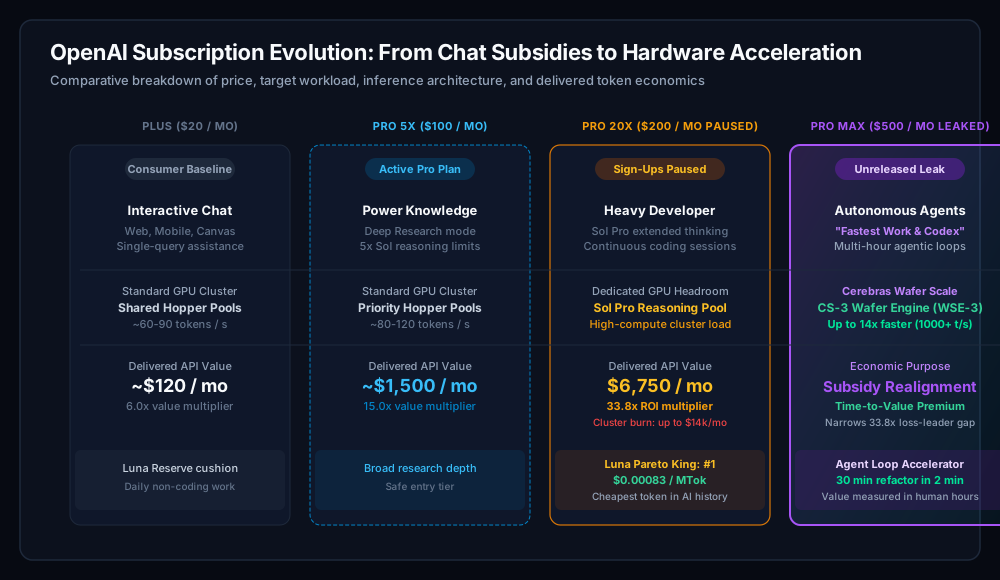
- Current Deployment State: Pro Max is currently unreleased staging code. OpenAI’s public pricing catalog continues to list only Free, Go, Plus ($20 / mo), Pro ($100 / mo active), Business, and Enterprise.
The discovery follows server capacity strains. On September 10, 2026, OpenAI halted new purchases of its grandfathered $200 / month Pro tier due to GPU cluster contention.
Our OpenAI Subscription Plans Guide documented that freeze. High-compute reasoning models like Sol Pro triggered unprecedented cluster load, forcing OpenAI to restrict access.
The Race for “Work”: Competing with Grok Bot and Muse
The leaked copywriting specifically joins “Fastest Work and Codex.” While Codex addresses autonomous terminal coding, “Work” represents OpenAI’s persistent workspace, canvas, and project execution interface.
OpenAI faces intensifying ecosystem competition for builder mindshare. xAI’s Grok Bot (on SuperGrok Heavy) provides persistent terminal execution, while Anthropic’s Muse (and Claude Code workspaces) delivers deep contextual project collaboration.
To prevent developers from migrating to Grok Bot or Muse, OpenAI must transform Work from a slow canvas into an instantaneous copilot. Pairing Work with wafer-scale inference allows users to generate, test, and render complex application artifacts without disruptive generation pauses.
2. The Hardware Link: Cerebras CS-3 Wafer-Scale Inference
Why does the leaked plan promise “Fastest Work and Codex” rather than higher message counts? The answer lies in specialized inference silicon.
In August 2026, OpenAI previewed GPT-5.6 Sol Ultrafast powered by Cerebras wafer-scale infrastructure, as reported by TestingCatalog on X. Cerebras technology delivers up to a 14 x inference speedup, generating over 1,000 tokens / s.
Standard GPU clusters (like NVIDIA H100 and B200 systems) excel at high-batch throughput. They process hundreds of concurrent user prompts efficiently in parallel.
However, single-stream sequential generation on standard GPUs is bottlenecked by memory bandwidth. Generating 500 reasoning tokens requires fetching model weights from high-bandwidth memory hundreds of times sequentially.
+-------------------------------------------------------------------------------+
| INFERENCE SILICON ARCHITECTURE COMPARISON                                     |
+----------------------+---------------------------+----------------------------+
| METRIC               | NVIDIA H100 / B200 SXM    | CEREBRAS CS-3 (WSE-3)      |
+----------------------+---------------------------+----------------------------+
| Die Architecture     | Modular Multi-Chip GPU    | Single Wafer-Scale Engine  |
| Silicon Area         | ~814 mm² per GPU          | 46,225 mm² (Full Wafer)    |
| AI Compute Cores     | ~16,896 CUDA / Tensor     | 900,000 AI Cores           |
| On-Chip SRAM Cache   | ~50 MB per GPU            | 44 GB On-Wafer SRAM        |
| Memory Bandwidth     | ~3.35 TB / s HBM3         | 21 PB / s Unified SRAM     |
| Generation Speed     | 60--120 tokens / s        | 1,000--1,800 tokens / s    |
| Execution Latency    | Baseline (1.0 x)          | Up to 14 x Faster          |
+----------------------+---------------------------+----------------------------+
The Cerebras CS-3 Wafer Scale Engine-3 (WSE-3) eliminates this off-chip memory bottleneck. It integrates 44 GB of SRAM directly on a single contiguous 46,225 mm² silicon wafer with 21 PB / s of bandwidth.
Entire model layers reside directly on-chip. Tokens generate without waiting for off-wafer memory transfers.
Why Speed Matters for Codex and Work (But Not for Chat)
For conversational chat, 1,000 tokens / s is largely wasted. Humans read at roughly 5 to 8 words per second. Reading speed cannot absorb thousand-token bursts in real time.
For autonomous agentic coding, inference velocity changes everything:
- Autonomous Refactoring Loops: An agent using Codex does not just output text. It writes code, invokes terminal tools, runs test suites, parses stack traces, and repairs syntax errors.
- Compressing the Feedback Loop: A comprehensive multi-file refactor on standard GPU clusters can take 25 to 45 minutes of sequential reasoning.
- The 14 x Acceleration: Under Cerebras benchmark measurements, that 35-minute agent run collapses to roughly 2.5 minutes.
- Developer Value: For an engineer billing $150 / hr, saving 15 hours per month in waiting time delivers $2,250 in billable value. That easily offsets a $500 monthly fee.
Speed is the primary commodity for autonomous agent workflows.
The Codex Spark Precedent: Dedicated Hardware Buckets
This is not the first time OpenAI has paired Cerebras silicon with specialized developer quotas.
Earlier in 2026, OpenAI tested Codex Spark, an ultrafast model powered by Cerebras wafer-scale engines. Codex Spark notably featured its own dedicated usage bucket, completely isolated from the standard weekly rolling quota.
While OpenAI recently removed Codex Spark from public client menus, the technical foundation remains active. The experiment proved that OpenAI can partition dedicated wafer-scale capacity from general GPU cluster pools.
3. The Economic Context: Luna at $0.00083 / MTok and the Capacity Frontier
To evaluate a $500 plan, consider the delivered economics of existing subscriptions.
Our analysis of LLM Subscription Token Value and ROI examined empirical benchmarks published by researcher Kun Chen (@kunchenguid on X).
Chen’s saturation tests revealed that the grandfathered $200 / month ChatGPT Pro tier delivers $6,750 / month in API-equivalent token value. That represents a 33.8 x ROI multiplier over list price.
Hardware cost modeling by SemiAnalysis went further. Power users running continuous Sol Pro reasoning sessions consume up to $14,000 / month in underlying cluster compute.
+-------------------------------------------------------------------------------+
| DELIVERED VALUE VS. SUBSCRIPTION PRICE (EMPIRICAL AUDIT)                      |
+--------------------+-----------------+--------------------+-------------------+
| SUBSCRIPTION PLAN  | MONTHLY PRICE   | DELIVERED API VALUE| VALUE MULTIPLIER  |
+--------------------+-----------------+--------------------+-------------------+
| SuperGrok Heavy    | $300 / mo       | $12,000 / mo       | 40.0x ROI         |
| Claude Max         | $200 / mo       | $7,200 / mo        | 36.0x ROI         |
| ChatGPT Pro (20X)  | $200 / mo       | $6,750 / mo        | 33.8x ROI         |
| Cursor Ultra       | $200 / mo       | $3,400 / mo        | 17.0x ROI         |
+--------------------+-----------------+--------------------+-------------------+
The Pareto Frontier: Luna as the Best Token Value in AI History
In research conducted by FeiZ (@Fei2411 on X) across 81 model configurations in real-api-pricing, GPT-5.6 Luna on ChatGPT Pro 20X achieved Rank #1 overall.
FeiZ measured the effective unit cost by dividing subscription fees by empirical saturated token throughput over four weeks:
$$\text{Effective Unit Price (\$/MTok)} = \frac{\text{Monthly Subscription Price}}{\text{Saturated Monthly Delivered Tokens}}$$
Under saturated workloads, Luna on ChatGPT Pro delivers compute at $0.00083 per Million Tokens ($0.00083 / MTok).
For comparison, Claude Sonnet 5 on Claude Max yields $0.00504 / MTok (Rank #6). Standalone metered APIs are far costlier: metered DeepSeek V4 Flash costs $0.01392 / MTok, while standalone GPT-5.6 Sol API costs $0.54723 / MTok.
Luna on a flat-rate $200 Pro plan is the cheapest high-capability token in computing history.
This staggering volume explains why OpenAI paused $200 sign-ups. Developers routing terminal agents into grandfathered $200 accounts extracted tens of billions of tokens monthly, burning datacenter margins.
Fifty-Fold Capacity Modeling: How Much Luna Does $500 Buy?
If OpenAI prices Pro Max at $500 / month, how does capacity scale?
Examining the multiplier progression reveals the stakes: - ChatGPT Plus ($20 / mo) represents the baseline 1 x compute allocation. - ChatGPT Pro 5X ($100 / mo) delivers a 5 x compute headroom multiplier. - ChatGPT Pro 20X ($200 / mo) delivers a 20 x compute headroom multiplier.
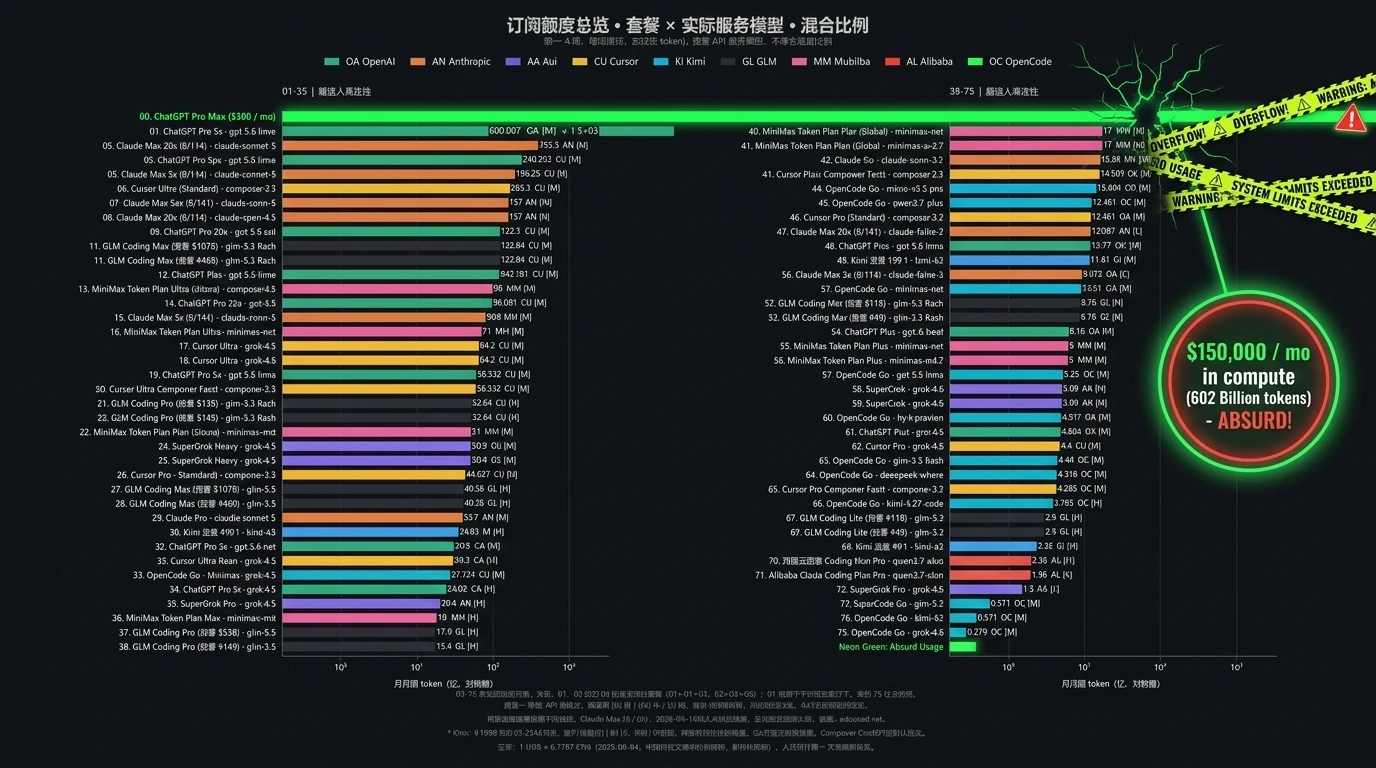
Under fully saturated workloads on Pro 20X, FeiZ’s Pareto analysis proved Luna yields roughly 241 Billion tokens / month at $0.00083 / MTok.
If the $500 tier scales proportionally as a 50 x multiplier (2.5 times the 20X tier), what happens? - Monthly Delivered Volume: Saturated Luna capacity would reach an unprecedented 602 Billion tokens / month. - Daily Throughput: That represents over 20 Billion tokens every day for an individual subscriber. - Delivered API Value: At standard developer API pricing ($0.15–$0.25 / MTok), 600 Billion tokens equals $90,000 to $150,000 / month in equivalent compute.
Will OpenAI actually allow 600 Billion tokens on a $500 plan?
If they do, OpenAI preserves its crown for the best value per subscription dollar. The effective unit cost would stay around $0.00083 / MTok.
Alternatively, heavy cluster demand suggests OpenAI may be exploring whether a higher tier can better match power-user needs.
4. Speculation: What Value Will a $500 / Month Plan Deliver?
With Luna delivering $0.00083 / MTok on $200 plans and cluster demand surging, why is OpenAI preparing a $500 tier? Developer speculation centers on four distinct structural hypotheses:
Hypothesis A: Proportional 50-Fold Value Scaling (Maintaining Value Per Dollar)
The most developer-friendly possibility is linear headroom scaling.
Under this model, Pro Max follows the established multiple progression. Plus represents baseline, Pro 5X ($100 / mo) delivers a 5 x multiplier, and Pro 20X ($200 / mo) delivers a 20 x multiplier.
Extending that slope to $500 / month yields a 50 x headroom multiplier (2.5 times the 20X tier).
What would 50 x capacity deliver under saturation according to FeiZ’s Pareto token modeling? - Delivered Monthly Volume: Saturated Luna usage would reach roughly 602 Billion tokens / month. - Daily Throughput: That equates to over 20 Billion tokens generated daily for a single subscriber. - Equivalent API Value: At standard developer API pricing ($0.15–$0.25 / MTok), 600 Billion tokens equals $90,000 to $150,000 / month in raw compute value. - Unit Economics: Effective token costs remain at $0.00083 / MTok, preserving OpenAI’s crown for maximum value per subscription dollar.
However, physical datacenter capacity presents a severe obstacle. OpenAI halted new subscriptions for the $200 20X plan on September 10 precisely because heavy reasoning models overloaded GPU clusters. Delivering 50 x headroom to thousands of autonomous agent runners could risk destabilizing shared clusters.
Hypothesis B: The Subsidization Reset (Zero Additional Headroom or Price Replacement)
The opposite possibility is that OpenAI is actively reducing its subsidization deficit.
As revealed in Chen’s empirical saturation audit, power users consume $6,750 to $14,000 / month in underlying GPU compute. On a $200 subscription, this represents a substantial operational deficit.
In this scenario, the $500 tier offers 0 x additional compute headroom over the previous 20X tier.
Instead, $500 / month becomes the new replacement price for the exact same 20 x compute allocation that previously cost $200.
Raising the price from $200 to $500 reduces OpenAI’s monthly subsidization loss per power user by roughly 60 percent, as modeled in SemiAnalysis datacenter reports. It also cools cluster contention by filtering out casual experimenters. Developers running commercial agent pipelines would pay the premium, while non-commercial users would step down to Pro 5X ($100 / mo).
Hypothesis C: Pure Wafer Velocity (The Same 20X Allocation at 14-Fold Speed)
A third hypothesis decouples price from token count and ties it directly to inference velocity.
In this model, Pro Max subscribers receive the exact same 20 x quota as the paused $200 tier. However, the entire allocation routes through Cerebras CS-3 wafer-scale engines at 1,000 to 1,800 tokens / s, confirmed by Cerebras benchmark measurements.
Subscribers pay the $300 premium strictly for developer velocity rather than larger token allocations: - Collapsing Agent Loops: Autonomous multi-file refactoring runs that take 35 minutes on standard GPU clusters finish in 2.5 minutes on wafer-scale silicon. - Zero-Latency Iteration: Code edits, linter checks, and test passes execute synchronously without context switching. - Billable Hour Economics: For a software engineer billing $150 / hr, eliminating 15 hours of idle waiting time per month recovers $2,250 in billable value.
For professional software teams, instantaneous execution velocity easily justifies the $500 monthly fee, even with zero additional token allocation.
Hypothesis D: The Dual-Bucket Spark Return (A 40-Fold Headroom Split Across Silicon)
The fourth hypothesis builds directly on the Codex Spark precedent documented in our OpenAI subscription quotas guide.
When OpenAI tested Codex Spark on Cerebras silicon earlier in 2026, it featured a dedicated usage bucket completely separate from standard weekly rolling quotas. While OpenAI recently removed Spark from client menus, Pro Max could mark its return as an exclusive flagship feature.
Under a dual-bucket structure, OpenAI could provide an aggregate 40 x headroom allocation divided evenly across two distinct silicon pools: 1. 20 x Standard GPU Reasoning Pool: Running on NVIDIA H100 and B200 clusters for complex multi-step reasoning, architectural trade studies, and deep pre-planning. 2. 20 x Ultrafast Cerebras Spark Pool: Running exclusively on wafer-scale engines at 1,000+ tokens / s for rapid terminal tool executions, test loops, and real-time code completions.
This architecture isolates wafer-scale clusters from unbounded reasoning tasks while giving developers specialized fast lanes for execution.
Next-Gen “Work”: The Strategic Weapon Against Grok Bot and Muse
These hardware and pricing models directly power OpenAI’s evolving software interface.
The leaked Pro Max copywriting specifically highlights “Fastest Work and Codex.” While Codex addresses terminal execution, “Work” represents OpenAI’s persistent workspace, canvas, and project environment.
OpenAI faces aggressive competition for developer workflows: - xAI’s Grok Bot: SuperGrok Heavy provides persistent, multi-step autonomous agent execution inside user terminals. - Anthropic’s Muse: Claude Code workspaces and Muse provide deep project-wide contextual collaboration and automated codebase maintenance.
To prevent developers from migrating to Grok Bot or Muse, OpenAI must elevate Work beyond a passive canvas. Powered by Cerebras wafer-scale engines, Work can generate full applications, execute tests, and render interactive UI components in sub-second intervals. Combining ultra-fast silicon with persistent project memory positions Pro Max as a full-fledged agent operating system.
5. Strategic Guide: How to Get Maximum Value Across AI Plans
Whether OpenAI launches Pro Max at DevDay or adjusts existing tiers, engineers must navigate quota mechanics deliberately.
Here is the operational playbook for maximizing token value today:
1. Leverage the Dual-Bucket Sandwich Architecture
Never burn expensive terminal agent reasoning tokens on ambiguous requirements.
As detailed in our Headless Terminal Agent Harnesses Guide, apply the three-step sandwich:
- Step 1 (Architecture & Pre-Planning): Use flat-rate web GPT Pro (or Claude Opus) to draft specifications, database schemas, and task decompositions. This draws from the flat-rate web subscription with zero marginal cost.
- Step 2 (Deterministic Execution): Feed the validated plan to lightweight coding agents running fast, cheap models (like Luna or Jev reflex classifiers) in terminal harnesses.
- Step 3 (Post-Validation): Bring the finished pull request back to high-compute web models for adversarial verification.
2. Compare Against Competing Ecosystem Quotas
Before committing $500 monthly, audit the broader subscription landscape:
- Anthropic Claude Ecosystem: Our Claude Pro & Team Analysis covers Claude Code limits and the strict 5-hour rolling lockout window.
- Google AI & Jules: Our Google AI Studio and Jules Guide examines free 1 M token context windows and dedicated cloud development environments.
- Cross-Plan ROI Rankings: Review our Empirical Subscription ROI Audit for detailed cost-per-token curves across Cursor, Grok, and Claude.
The era of cheap, undifferentiated AI subscriptions is evolving into hardware-differentiated performance tiers. Monitoring where compute dollars yield real engineering velocity is essential.