As part of our developer subscription series covering OpenAI’s $100 / $200 / $500 Pro 50x tiers, Google AI Ultra and Jules, Anthropic Claude Max and Claude Code, and xAI SuperGrok, one rapidly evolving developer platform deserves a dedicated architectural audit: Meta Muse Code.
Built by Meta Superintelligence Labs around the Muse
Spark (1.2
launched August 5, 2026 and 1.3
launched September 2, 2026) and Muse Wonder (1.0 and
Muse Wonder Full launched October 12, 2026) model
families, Muse Code
entered the market with aggressive entry pricing: starting at just
$5 / month for Everyday Usage and scaling to
$15 / month (5x), $50 / month (20x),
and $200 / month (80x). For nearly two months after
paid plans launched on August 31, 2026, multi-agent builders extracted
the subscription credential generated during muse login and
plugged it directly into third-party terminal harnesses like oh my pi
(omp), opencode-muse,
and jcode.
On October 29, 2026, that era of open credential portability
on first-party Muse Code plans ended. Meta activated
server-side tool-schema attestation across /v1/responses,
/v1/chat/completions, and /v1/messages that
rejects third-party tool-calling requests using Muse Code subscription
credentials with
HTTP 403 client_attestation_denied. Here
is the complete developer field guide to Meta Muse Code tiers, the
hidden weekly cap, model gating, Contributor data-sharing defaults, OS
sandboxing, and how to configure your multi-model agent stack under the
new harness lock-in.

1. Meta Muse Code Subscription Tiers at a Glance ($5 to $200 / Month)
Unlike OpenAI and Anthropic, which begin their individual paid coding
tiers at $20 / month, Meta introduced a micro-tier at $5 /
month, expanded its intermediate tiers from their initial
August 31 launch multipliers (3x and 10x) up
to 5x ($15 / mo) and
20x ($50 / mo) in September, and added a
$200 / month (80x) tier alongside the Muse
Wonder launch on October 12, 2026 per
Meta’s official Muse Code subscription documentation:
| Plan Feature | Everyday Usage | High Usage | Power Usage (Sweet Spot) | Maximum Usage |
|---|---|---|---|---|
| Monthly Price | $5.00 / mo | $15.00 / mo | $50.00 / mo | $200.00 / mo |
| Usage Multiplier | 1x Baseline | 5x Everyday ($3.00 per 1x; up from 3x at launch) | 20x Everyday ($2.50 per 1x; up from 10x at launch) | 80x Everyday ($2.50 per 1x; added Oct 12, 2026) |
| 5-Hour Prompt Allowance | 10 to 50 prompts / 5 h | ~50 to 250 prompts / 5 h (5x) | ~200 to 1,000 prompts / 5 h (20x) | ~800 to 4,000 prompts / 5 h (80x) |
| Overarching Weekly Cap | Undocumented weekly reset ceiling | Undocumented weekly reset ceiling | Undocumented weekly reset ceiling | Undocumented weekly reset ceiling |
| Included Models | Muse Spark 1.3, Standard Muse Wonder 1.0, Muse Image | Muse Spark 1.3, Standard Muse Wonder 1.0, Muse Image | Adds Muse Wonder Full + max Contributor reasoning | Full Muse Wonder Full + Spark 1.3 + Wonder 1.0 |
| Context Window | 1,048,576 tokens | 1,048,576 tokens | 1,048,576 tokens + higher file uploads | 1,048,576 tokens + multi-agent swarms |
| Multimodal & Features | Image/video uploads, voice mode, web search | Expanded multimodal inputs, voice, web search | Early feature access, parallel Git worktrees | Maximum concurrency across parallel worktrees |
| Default Data Policy | Contributor Mode ON by default (since v1.4.6) | Contributor Mode ON by default (since v1.4.6) | Contributor Mode ON by default (since v1.4.6) | Contributor Mode ON by default (since v1.4.6) |
| Harness Portability | Locked to native muse CLI
(client_attestation_denied) |
Locked to native muse CLI
(client_attestation_denied) |
Locked to native muse CLI
(client_attestation_denied) |
Locked to native muse CLI
(client_attestation_denied) |
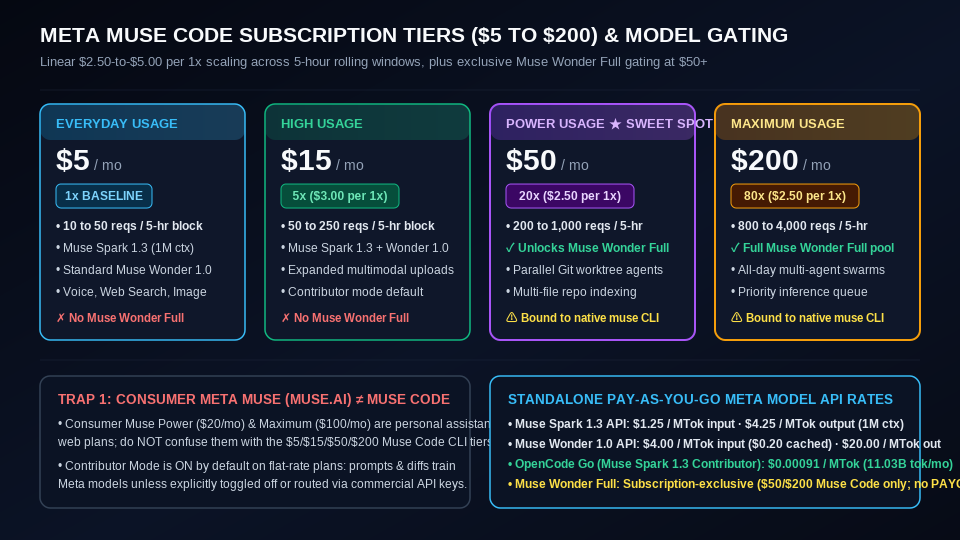
First, the Fact Check: Six Common Muse Code Misconceptions
Before provisioning seats or wiring credentials into an agentic workflow, engineering teams should verify six structural realities of the Meta Muse ecosystem:
-
✗ Your Muse Code subscription
credential still works for tool-calling inside
oh my pi(omp), OpenCode, or third-party harnesses. While early adopters extracted the OAuth API key provisioned duringmuse loginand plugged it intoomporopencode-muse, Meta’s Terms of Service (§3.2) explicitly prohibit using the subscription credential outside the coding harness. On October 29, 2026, Meta began enforcing this server-side: any request carrying tool declarations that do not match Muse Code’s builtinmusetool namespace is rejected withHTTP 403 client_attestation_denied. -
✗ Consumer “Meta Muse” ($20 / mo
Power and $100 / mo Maximum) is the same subscription as Muse
Code. Just as xAI separates X Premium+ from SuperGrok, Meta
operates two separate subscription ladders: consumer personal-assistant
plans for Meta AI
(documented
on meta.com at $20 / mo Power for 500 million Muse
tokens/week and $100 / mo Maximum for 3 billion Muse
tokens/week) and developer terminal plans for Muse
Code
(on
dev.meta.ai at $5 Everyday, $15 High Usage, $50 Power Usage, and
$200 Maximum Usage). Buying the $20 or $100 consumer plan does not fund
the
museCLI. - ✗ Muse Code only enforces a 5-hour window with no weekly ceiling. Although Meta’s public help page only mentions the 5-hour prompt window (“10 to 50 prompts every 5 hours” on Everyday), Muse Code enforces a dual-gate architecture identical to Anthropic’s: a 5-hour session window paired with an undocumented weekly usage ceiling that locks the account until a fixed weekly reset timestamp (for example, observed in CLI lockout traces).
-
✓ Muse Wonder Full is locked
exclusively behind the $50 Power and $200 Maximum Usage subscriptions,
with no standalone pay-as-you-go API. Standard
muse-wonder-1.0is available on the metered Meta Model API ($4.00 / MTok input, $0.20 / MTok cached input, $20.00 / MTok output), but the larger frontier checkpoint, Muse Wonder Full (which leads DeepSWE and SWE-Marathon and scores 59.1 on the Artificial Analysis Intelligence Index), has no pay-as-you-go token price and cannot be unlocked by setting reasoning effort tomaxon standard Wonder 1.0. - ✓ Contributor Mode is enabled by default on flat-rate plans and requires v1.4.8+ to prevent background training leaks. Since Muse Code v1.4.6, flat-rate subscribers default to Contributor Mode, granting higher plan usage in exchange for allowing Meta to train future models on your prompts, code, files, model responses, and connector content. Versions before v1.4.8 also contained a bug where background requests continued transmitting under Contributor Mode even after a user disabled it.
- ✓ Upgrading from High Usage ($15) to Power Usage ($50) lowers your unit cost per 1x of quota. Everyday Usage ($5 for 1x) costs $5.00 per 1x unit, High Usage ($15 for 5x) drops to $3.00 per 1x unit, and both Power Usage ($50 for 20x) and Maximum Usage ($200 for 80x) settle at a linear $2.50 per 1x unit while unlocking Muse Wonder Full.
2. The Model Lineup & Meta Model API Rate Card: Spark 1.3 vs. Wonder 1.0 vs. Wonder Full
To evaluate whether your team should use a flat-rate Muse Code
subscription, OpenCode Go, or direct pay-as-you-go billing on the Meta Model API
(dev.meta.ai/docs/pricing-rate-limits), compare the
exact token prices, cache discounts, and team rate limits across Meta’s model catalog:
+---------------------------------------------------------------------------------------------------+
| META MODEL API PAY-AS-YOU-GO PRICING & SUBSCRIPTION GATING |
+-----------------------------+--------------------+------------------------+-----------------------+
| MODEL IDENTIFIER | CONTEXT / MAX OUT | API PRICE (IN/CACHE/O) | RATE LIMIT / GATE |
+-----------------------------+--------------------+------------------------+-----------------------+
| Muse Spark 1.3 (Standard) | 1,048,576 / 943k | $1.25 / $0.15 / $4.25 | 3,000 RPM / 4.0M TPM |
| (`muse-spark-1.3`) | Text/Img/Vid/Aud | per 1M tokens (88% off)| Included on $5+ plans |
+-----------------------------+--------------------+------------------------+-----------------------+
| Muse Spark 1.3 Contributor | 1,048,576 / 943k | $0.10 / $0.002 / $0.20 | 150 RPM / 3.0M TPM |
| (`muse-spark-1.3-contrib.`) | Training opt-in | ($0.00091 OpenCode Go) | Max effort sub-only |
+-----------------------------+--------------------+------------------------+-----------------------+
| Muse Wonder 1.0 (Preview) | 1,000,000 tokens | $4.00 / $0.20 / $20.00 | 3,000 RPM / 4.0M TPM |
| (`muse-wonder-1.0`) | Text/Img/Vid/Aud | per 1M tokens (95% off)| Included on $5+ plans |
+-----------------------------+--------------------+------------------------+-----------------------+
| Muse Wonder Full | 1,000,000 tokens | NO PAYG API OFFERED | Exclusive to $50 Power|
| (Frontier Flagship) | DeepSWE #1 (59.1) | (Subscription-only) | & $200 Maximum plans |
+-----------------------------+--------------------+------------------------+-----------------------+
Note: Web search grounding costs $2.50 / 1,000 queries; Muse Image costs $0.01 / image (150 RPM);
Muse Voice Transcribe costs $0.18 / hour; SAM 3.1 costs $2.50 / 1k images or $0.20 / 1k video frames.1.
Muse Spark 1.3 (muse-spark-1.3 and
muse-spark-1.3-contributor)
Released on September
2, 2026 as the default coding engine replacing Spark 1.2,
Muse Spark 1.3 is a closed-weight multimodal model
accepting text, images, video, audio, and PDFs across a
1,048,576-token context window (with up to
943,718 max output tokens): - Tool-Call
Efficiency: In Meta’s internal evaluations, Spark 1.3 requires
roughly 20 % fewer tool calls and 25 % fewer
total tokens than Spark 1.2 while scoring 61
(xhigh) to 62 (max) on the Artificial
Analysis Intelligence Index. - The Massive Contributor Price Gap
(12.5x to 75x Cheaper): On the pay-as-you-go Meta Model API,
standard muse-spark-1.3 costs $1.25 / MTok
input, $0.15 / MTok cached input, and
$4.25 / MTok output (at 3,000 RPM / 4,000,000 TPM). By
contrast, muse-spark-1.3-contributor drops the
pay-as-you-go rate to $0.10 / MTok input (12.5x
cheaper), $0.002 / MTok cached input (75x
cheaper, a 98 % cache discount), and $0.20 / MTok
output (21x cheaper), throttled to 150 RPM and 3,000,000 TPM.
However, as documented in oh-my-pi
issue #11788, max reasoning effort on the
contributor model is gated to Muse Code subscriptions. -
OpenCode Go Economics: In the FeiZ
real-api-pricing dataset,
muse-spark-1.3-contributor on OpenCode Go delivers
11.0294 billion tokens per 4-week month at an effective
unit cost of $0.00091 per Million Tokens.
2. Muse
Wonder 1.0 (muse-wonder-1.0) vs. Muse Wonder Full
Released on October
12, 2026, Muse Wonder is Meta’s frontier agentic
architecture built for complex multi-file repository engineering, active
memory, and cross-domain reasoning (unavailable in South Korea): -
Standard muse-wonder-1.0 (API Preview):
Priced at $4.00 / MTok input, $0.20 / MTok
cached input (a 95 % prompt cache discount),
and $20.00 / MTok output at 3,000 RPM / 4,000,000 TPM.
- Muse Wonder Full
(Subscription-Exclusive): As VentureBeat
highlighted at launch, Meta withholds its top-performing checkpoint
(Muse Wonder Full, which leads DeepSWE and
SWE-Marathon) from the pay-as-you-go API entirely. Developers can only
run Muse Wonder Full inside the native muse CLI on the
$50 / mo Power Usage (20x) or $200 / mo Maximum
Usage (80x) plans.
3.
Inside the October 29 Harness Lock-In:
HTTP 403 client_attestation_denied
When developers install Muse Code
(curl -fsSL https://dev.meta.ai/install.sh | bash) and run
muse login via device-code authentication, the CLI
provisions an automatic subscription API key. From August through late
October 2026, community plugins like opencode-muse,
opencode-muse-auth,
oh-my-pi
(omp PR #10677), and jcode
(#1885) extracted that credential so developers could run their $5,
$15, or $50 flat-rate subscription inside third-party harnesses.
On October 29, 2026 (starting around 03:36 UTC), Meta turned on server-side harness attestation enforcement to back Section 3.2 of the Meta Model API Terms of Service (“may not be used to access the Services outside the coding harness or to circumvent your subscription’s usage limits or billing”).
How Meta’s Server-Side Tool-Namespace Attestation Works
As documented in incident reports on developing-today/opencode
(#818) and reverse-engineered in mcowger/plexus
(PR #1028), Meta’s gateway does not simply check
your User-Agent or x-client-id header:
- The Exact Error Payload: When a third-party harness
sends a tool-enabled request to
/v1/responses,/v1/chat/completions, or/v1/messagesusing a key billed to a Muse Code subscription, Meta returns:- HTTP Status:
403 Forbidden - Error Code:
client_attestation_denied - Message:
"This API key is billed to a Muse Code subscription, and this request does not carry Muse Code's builtin tool declarations."
- HTTP Status:
- Builtin
museTool-Schema Inspection: The gate triggers specifically on requests that declaretools. The server inspects the request’s tool definitions to verify that tools in themusenamespace match the exact builtin tool schemas compiled into the officialmuseCLI binary (for example, v1.4.14 builtin schemas), rejecting fabricated tool names or non-Muse harness toolsets even when only 1 % of a High Usage plan’s quota has been consumed. - Two Separate Errors Developers Frequently Confuse with This
Gate:
- OpenCode Zen
403 FreeTierError(oh-my-pi#12306): Occurs when routingmuse-spark-1.3-contributor-freethroughompagainst OpenCode’s/zen/v1/responsesgateway without OpenCode’s client headers. That is OpenCode enforcing its own free-tier client lock, not Meta. - Account Rotation
400 encrypted_contentError (oh-my-pi#15913): Occurs in multi-account round-robin pools when encrypted reasoning state (encrypted_content) minted by one Meta subscription credential is replayed on the next turn under a different rotated account ("encrypted_content was not issued to this caller").
- OpenCode Zen
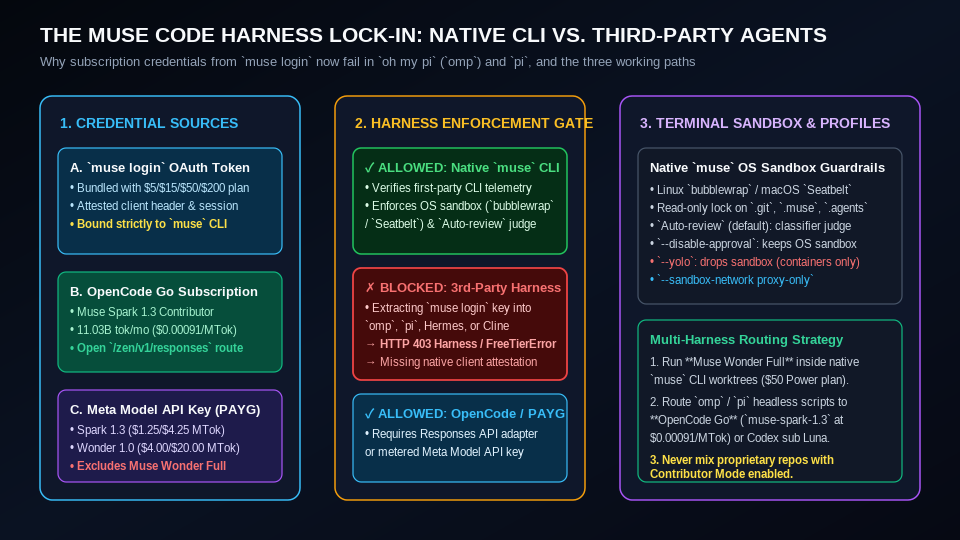
HTTP 403 client_attestation_denied): why extracting
muse login tokens into omp or OpenCode plugins
fails on tool calls, and the sanctioned execution paths.
Why
You Should Use muse serve / @muse-code/sdk
Instead of Schema-Injection Shims
While some third-party proxy patches attempted to bypass
client_attestation_denied by injecting a dummy 240-byte
builtin tool declaration from muse v1.4.14, doing so
directly violates Meta Model API ToS
§3.2 and risks permanent account suspension
([user_blocked]).
Instead, Meta provides three sanctioned programmatic
interfaces that drive the native muse binary
lawfully while keeping your subscription compliant: -
muse exec: Runs non-interactive, headless
batch tasks directly through the official binary. -
muse serve (Muse Session Protocol):
Launches the local muse daemon and exposes a structured
session socket that orchestrators (such as Paseo PR #5719)
can drive without extracting the underlying OAuth token. -
@muse-code/sdk (meta-models/muse-code-sdk):
Meta’s official TypeScript and Python SDK for spawning and controlling
muse sessions programmatically.
4.
Inside the Native muse CLI Harness: Fail-Closed Sandboxing,
Approval Judges, and Contributor Opt-Out
Because consuming a Muse Code subscription now requires running the
official muse CLI (interactively, via
muse exec, or via muse serve), every engineer
should understand its permissions and
sandboxing architecture
(dev.meta.ai/docs/muse-code/permissions) and recent v1.4.6 to v1.4.14
security hardening:
1.
Fail-Closed Kernel Sandboxing (bubblewrap,
Seatbelt, and Windows Sandbox)
- Fail-Closed Guarantee: Muse Code uses
Seatbelt on macOS (with glob regex enforcement added in
v1.4.11), a bundled
bubblewrap(bwrap) helper on Linux, and Windows Sandbox on Windows. Crucially, Muse Code refuses to execute any shell command if it cannot verify that the OS sandbox is active (validated at startup since v1.4.6). - Credential & Control-Plane Isolation: Inside
the sandbox, writes are confined to the workspace and temp directory,
while
.git,.muse, and.agentsare protected read-only, and (as of v1.4.10) sandboxed child processes are blocked from reading or mutatingmusesign-in credentials. - Linux
bwrap0.9.0 Troubleshooting (muse-code-sdk#28): On Linux hosts where/usr/bin/bwrapis an older v0.9.0 binary lacking--ro-bind-symlink,musemay accidentally invoke the systembwrapinstead of its bundled helper and fail withexit code 125. Ensure yourbwrapbinary supports--ro-bind-symlinkor pointmuseto its bundled sandbox helper. - Network Proxy Gate
(
--sandbox-network): Defaults toproxy-only, which intercepts the first outbound connection to any new(host, port, protocol)tuple and pauses for human approval. Can also be set torestrictedorunrestricted.
2.
Approval Modes (--approval-mode) vs. Permission Profiles
(permissions.default_profile)
Muse Code separates low-level approval flags from named permission
profiles: - --approval-mode Flags: -
on-request (default): Known safe commands run automatically
inside the sandbox; destructive commands (like rm -rf)
pause for review. - untrusted: Every shell stage without an
explicit allow rule pauses for approval. - never (or
--disable-approval): Never pauses for approval prompts,
relying strictly on the kernel OS sandbox to contain execution. -
Permission Profiles
(permissions.default_profile): -
Auto-review: Uses an automated safety
classifier judge to approve or reject tool calls (disable the judge with
--approval-judge off). Since v1.4.9, if the
Auto-review judge takes more than 15 evaluation
steps, it automatically escalates the prompt to the human
operator. - Ask me: Requires manual human
confirmation on every eligible action. -
Read-only: Permits repository exploration
and code analysis while blocking all file writes and side-effecting
shell commands. - Unrestricted /
--yolo: Disables both approval
prompts and the OS sandbox (and since v1.4.9 implies
--disable-request-user-input in the TUI and
muse exec). Use --yolo exclusively inside
disposable containers.
3. Disabling Contributor Mode for Proprietary Codebases
Because Contributor
Mode is ON by default for all Muse Code subscribers
(allowing Meta to train models on your prompts, files, and connector
outputs), you must explicitly opt out before running muse
on private or client repositories: 1. Upgrade to
muse v1.4.8 or newer: Fixes the pre-1.4.8 bug
where background tasks still leaked data under Contributor Mode after
opt-out. 2. Interactive Persistent Toggle: Run
/settings inside the muse TUI, select
Contributor mode under Model, and
toggle it off. 3. CI / Headless Enforcement
(muse exec / muse serve): Because the
CLI flag --contributor-mode off is per-run and
never persisted to disk, always pass both the flag and
environment variable in automated scripts:
bash MUSE_CONTRIBUTOR_MODE=0 muse exec --contributor-mode off --disable-approval "Run the test suite and fix failing assertions"
5. Summary Playbook: How to Route Meta Muse Models in Late 2026
- For Native Terminal Work &
Muse Wonder Full($50 / mo Power Usage): Subscribe to the $50 / month Power Usage (20x) plan only if you intend to use the officialmuseCLI,muse exec, ormuse serve(@muse-code/sdk). It gives you Meta’s lowest per-unit subscription price ($2.50 per 1x) and unlocks Muse Wonder Full, which cannot be purchased on the API at any price. - For Third-Party Harnesses (
oh my pi/omp,pi, OpenCode): Do not extractmuse loginsubscription tokens into third-party harnesses;client_attestation_denied(HTTP 403) will block your tool calls. Instead, either connect your orchestrator tomuse servevia the Muse Session Protocol, routemuse-spark-1.3-contributorthrough OpenCode Go ($0.00091 / MTok), or generate a standalone pay-as-you-go Meta Model API key ($0.10 / MTok input, $0.002 / MTok cached input, $0.20 / MTok output onmuse-spark-1.3-contributor, or $1.25 / $0.15 / $4.25 on standardmuse-spark-1.3with zero training retention).