In September 2026, five days before OpenAI DevDay, we published The $500 / Month ChatGPT Pro Max Leak: Fastest Codex, Cerebras Hardware, and Subscription Value Speculation. In that piece, we modeled four structural scenarios for what a $500 monthly tier would actually deliver: proportional 50x capacity scaling (Hypothesis A), a subsidy reset that charged $500 for the old $200 allowance (Hypothesis B), pure low-latency velocity (Hypothesis C), or a dual-bucket split between interactive speed and background execution (Hypothesis D).
Over the past four weeks, OpenAI managed to execute almost every single one of those scenarios in sequence.
First came the post-DevDay baseline reduction: OpenAI officially launched the $500 / month tier as ChatGPT Pro 500, set its Work and Codex allowance at 25x the ChatGPT Plus baseline, and announced plans to cut existing Pro 200 ($200 / month) accounts in half from 20x down to 10x. Then, on October 29, 2026, OpenAI Codex and ChatGPT lead Thibault “Tibo” Sottiaux (@thsottiaux on X) reversed the cut and doubled the entire Pro ladder back up, landing the $500 tier squarely at 50x usage.

Here is the complete audit of what changed on October 29, how the 0.5x cut and 2.0x doubling arithmetic works across every tier, why Ultrafast mode’s 8x quota burn can still drain a 50x plan faster than a $100 seat if misconfigured, and how to stack persistent cloud Dots with OpenAI’s 100 % matched monthly API credits ($100, $200, and $500 per month).
1. The Three-Act Quota Whiplash: From 20x to the 50 % Cut and the Day 25 Doubling
To understand why Sottiaux’s October 29 announcement triggered both celebration and sharp debate across the OpenAI Developer Community, you have to trace the exact slope of included Work and Codex usage per subscription dollar relative to ChatGPT Plus ($20 / month = 1x baseline).
Act I: The Pre-DevDay Baseline (September 2026)
Prior to DevDay, OpenAI’s self-serve Pro lineup had an inconsistent dollar-to-quota slope: - ChatGPT Plus ($20 / month): 1x baseline allowance ($20.00 per 1x unit). - ChatGPT Pro 5X ($100 / month): 5x Plus allowance ($20.00 per 1x unit). - ChatGPT Pro 20X ($200 / month): 20x Plus allowance ($10.00 per 1x unit), which was temporarily paused for new sign-ups on September 10, 2026 after terminal agent runners saturated cluster capacity.
In our September 24 Pro Max analysis, we noted that if OpenAI extended the $200 tier’s slope ($10.00 per 1x unit) linearly to a $500 plan, the new tier would have to deliver 50x usage (Hypothesis A). Conversely, if OpenAI wanted to eliminate the $200 tier’s heavy compute subsidy (Hypothesis B), it would cut the per-dollar slope in half.
Act II: The Post-DevDay 50 % Baseline Cut (Early October 2026)
When OpenAI formally rolled out the three-tier Pro structure (About ChatGPT Pro tiers), it initially chose the subsidy reset path. Instead of scaling all tiers at 0.10x per dollar ($10 per 1x unit), OpenAI standardized the lineup at 0.05x per dollar ($20 per 1x unit, matching Plus): - Pro 100 ($100 / month): 5x Plus usage ($20.00 per 1x). - Pro 200 ($200 / month): Reopened to new subscribers at 10x Plus usage ($20.00 per 1x), with a scheduled reduction that would cut existing grandfathered 20x subscribers in half down to 10x. - Pro 500 ($500 / month): Launched at 25x Plus usage ($20.00 per 1x), bundled with exclusive access to Ultrafast mode in ChatGPT Work and Codex.
For developers who had been paying $200 / month for 20x usage, this meant paying $500 / month just to reach 25x usage, only a 25 % capacity increase for a 150 % price jump.
Act III: The October 29 “Day 25” Doubling Back to 50x
Following weeks of sustained developer pushback during OpenAI’s “28 Days of Shipping” quality-of-life sprint, Thibault Sottiaux published the Day 25 announcement on X on October 29, 2026 at 16:56 UTC:
“Day 25/ We are doubling all usage limits for all Pro 100/200/500 tiers and Business Premium, effective today. We heard your kind feedback and won’t be reducing usage limits for Pro 200, so your Work and Codex usage will stay the same. We’re also going to continue offering extended limits for dots for now, and usage of your dot will still continue to be separate from your default usage.”
By multiplying the 0.05x-per-dollar post-DevDay baseline by 2 across the board, OpenAI restored the 0.10x-per-dollar ($10.00 per 1x) slope across every single Pro tier:
+---------------------------------------------------------------------------------------------------+
| OPENAI PRO & BUSINESS PREMIUM QUOTA PROGRESSION (SEPT 2026 -> POST-DEVDAY CUT -> OCT 29 DOUBLING) |
+---------------------+---------------+------------------+------------------+-----------------------+
| SUBSCRIPTION TIER   | MONTHLY PRICE | PHASE 1 (SEPT)   | PHASE 2 (0.5x)   | PHASE 3 (OCT 29 2x)   |
+---------------------+---------------+------------------+------------------+-----------------------+
| ChatGPT Plus        | $20 / mo      | 1x ($20.00 / 1x) | 1x ($20.00 / 1x) | 1x ($20.00 / 1x)      |
| ChatGPT Pro 100     | $100 / mo     | 5x ($20.00 / 1x) | 5x ($20.00 / 1x) | 10x ($10.00 / 1x)     |
| ChatGPT Pro 200     | $200 / mo     | 20x ($10.00 / 1x)| 10x (Cut Planned)| 20x ($10.00 / 1x)*    |
| ChatGPT Pro 500     | $500 / mo     | 50x (Speculated) | 25x ($20.00 / 1x)| 50x ($10.00 / 1x)     |
| Business Premium    | Seat Tier     | --               | 5x Std Seat      | 10x Std Seat          |
+---------------------+---------------+------------------+------------------+-----------------------+
*Note: For Pro 200 accounts opened at 10x, Day 25 doubled limits to 20x. For grandfathered Pro 200
accounts already at 20x, canceling the planned 50 % cut kept their net allowance unchanged at 20x.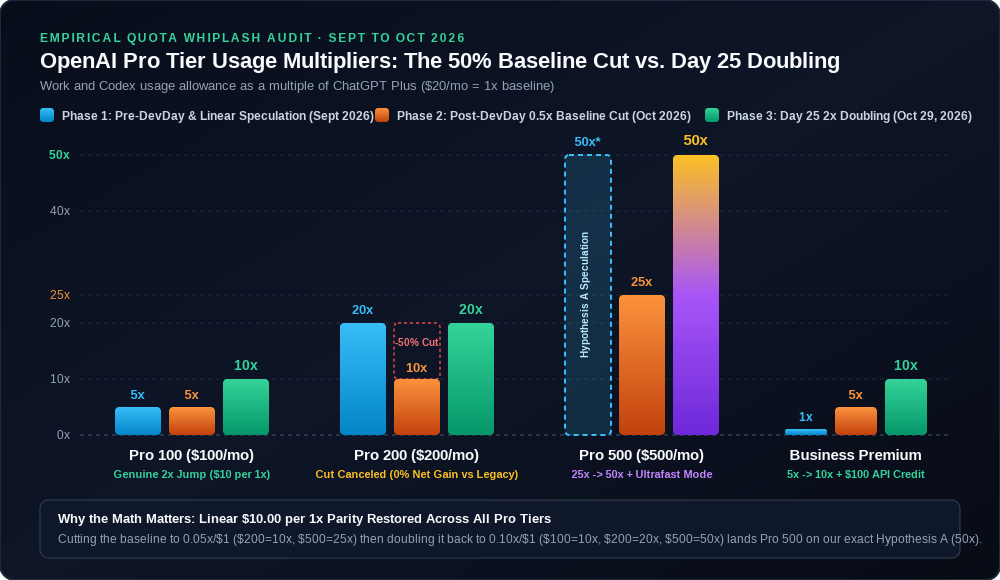
Why Grandfathered Pro 200 Users Called Out the Framing
Look closely at the second paragraph of Sottiaux’s post: “We heard your kind feedback and won’t be reducing usage limits for Pro 200, so your Work and Codex usage will stay the same.”
In the OpenAI
Developer Community thread (#1403525), veteran Pro 200 subscribers
immediately pointed out the nuance: 1. For Pro 100 ($100 / mo),
Pro 500 ($500 / mo), and Business Premium: Day 25 delivered a
true 2.0x capacity increase over their launch
allowances (5x -> 10x on Pro 100,
25x -> 50x on Pro 500, and 5x -> 10x on
Business Premium). 2. For post-pause Pro 200 accounts at
10x: Day 25 doubled their 10x post-DevDay allowance up to
20x, eliminating the two-tier split between new and
legacy $200 subscribers. 3. For grandfathered Pro 200 accounts
already at 20x: Their allowance did not jump
to 40x. Instead, OpenAI halved their target from 20x to 10x on paper and
“doubled it back” to 20x by canceling the scheduled cut.
While grandfathered Pro 200 users gained zero net tokens over their September baseline, the structural outcome across the lineup is now mathematically clean: Pro 100 (10x), Pro 200 (20x), and Pro 500 (50x) all price Work and Codex capacity at an identical $10.00 per 1x Plus equivalent.
2. Scorecard: Grading Our September $500 Plan Speculation Against Shipped Reality
In Section 4 of our September 24 article, we laid out four competing hypotheses (A through D) for the $500 tier. Now that Pro 500 is live and updated through Day 25, we can grade each prediction against primary documentation from learn.chatgpt.com:
| September 2026 Hypothesis | What We Predicted | What OpenAI Actually Shipped (Oct 2026) | Verdict |
|---|---|---|---|
| Hypothesis A: Proportional 50x Scaling | Extending the $200 Pro (20x) slope to $500 yields a 50x compute multiplier (~353 B to 375 B saturated Luna tokens/mo). | Launched at 25x, then doubled on Oct 29 (Day 25) to 50x Plus usage across Work and Codex. | CONFIRMED (via 25x -> 50x two-step) |
| Hypothesis B: The Subsidy Reset | OpenAI cuts the per-dollar subsidy so users must pay more for the same 20x-class headroom. | OpenAI attempted a 50 % cut on Pro 200
(20x -> 10x) alongside a 25x Pro 500
launch, before reversing under user pushback. |
ATTEMPTED & REVERSED |
| Hypothesis C: Pure Velocity Tier | The $500 premium gates hardware-accelerated low-latency generation for Codex agent loops. | Ultrafast mode (up to 8x faster on GPT-6 Astra and GPT-6.1 Sol) is gated exclusively to Pro 500 among self-serve plans. | CONFIRMED (with an 8x quota burn catch) |
| Hypothesis D: Dual-Bucket Split | Separating background agent orchestration from interactive coding pools. | Dots (persistent cloud agents on GPT-6 Astra) run on a separate usage meter with extended limits, plus Auto-review runs at 0x plan burn. | CONFIRMED (via Dots + Free Auto-Review) |
3. Token Economics at 50x: What Does $500 / Month Buy in Standard Mode?
Now that Pro 500 sits at a 50x multiplier over
ChatGPT Plus (2.5 times the 20x Pro 200 allowance), we can compute the
exact four-week saturated token volumes and effective unit costs
(USD / MTok) using the FeiZ
real-api-pricing adopted dataset (measured under the
standard 97 % cached input / 2.5 % uncached input / 0.5 % output coding
mix) and OpenAI’s official Codex credit
rate card.
Official Codex Standard Credit Rates and API Pricing
In learn.chatgpt.com/docs/pricing,
OpenAI publishes the relative weight of each model in credits
per 1 million tokens alongside the OpenAI API
Standard pricing table:
+---------------------------------------------------------------------------------------------------+
| OPENAI MODEL RATE CARD: CODEX CREDITS VS. STANDARD API VS. ULTRAFAST API (PER 1 MILLION TOKENS)   |
+-------------------+---------------------------+-------------------------+-------------------------+
| MODEL             | CODEX CREDITS (IN/CACHE/O)| STANDARD API (IN/C/OUT) | ULTRAFAST API (IN/C/OUT)|
+-------------------+---------------------------+-------------------------+-------------------------+
| GPT-6 Astra       | 250 / 25 / 1,250 credits  | $10.00 / $1.00 / $50.00 | $60.00 / $6.00 / $300.00|
| GPT-6.1 Sol       | 50 / 2.5 / 250 credits    | $2.00 / $0.10 / $10.00  | $12.00 / $0.60 / $60.00 |
| GPT-6 Sol         | 50 / 5.0 / 250 credits    | $2.00 / $0.20 / $10.00  | --                      |
| GPT-6.1 Terra     | 25 / 1.25 / 125 credits   | $1.00 / $0.05 / $5.00   | --                      |
| GPT-5.6 Sol       | 100 / 10 / 500 credits    | $4.00 / $0.40 / $20.00  | --                      |
| GPT-5.6 Luna      | 5.0 / 0.5 / 30 credits    | $0.20 / $0.02 / $1.20   | --                      |
| GPT-6 Luna        | 2.5 / 0.25 / 12.5 credits | $0.10 / $0.01 / $0.50   | --                      |
+-------------------+---------------------------+-------------------------+-------------------------+
Note: Every 1 Codex credit equals exactly $0.04 of Standard API list price across all models.
GPT-6.1 Sol has zero long-context (>272k token) surcharge when drawn from a subscription in Codex/Work.
Notice the invariant in that table: 1 Codex credit equals
exactly $0.04 of Standard API compute
(250 credits = $10.00 on GPT-6 Astra input;
50 credits = $2.00 on GPT-6.1 Sol input;
2.5 credits = $0.10 on GPT-6 Luna input). In addition,
GPT-6.1 Sol cuts cached input costs in half compared to GPT-6 Sol
(2.5 credits vs. 5.0 credits per 1 million
cached tokens, a 95 % cache discount instead of 90 %) and waives the 2x
long-context surcharge (>272k tokens) inside
subscription-backed Codex and ChatGPT Work sessions.
Scaling Measured Monthly Token Volumes to 10x, 20x, and 50x
Because Pro 100 (10x), Pro 200 (20x), and Pro 500 (50x) all share the same $10.00 per 1x unit ratio in Standard mode, scaling FeiZ’s empirical Plus (1x) and Pro 20x measurements to the new 50x Pro 500 ceiling yields:
- GPT-6 Luna (Lightweight High-Speed Execution):
- Plus (1x, $20 / mo):
9.203 billiontokens / month ($0.00217 / MTok). - Pro 100 (10x, $100 / mo):
~92.03 billiontokens / month ($0.00109 / MTok). - Pro 200 (20x, $200 / mo):
~184.06 billiontokens / month ($0.00109 / MTok; or141.163 billiontokens / month on GPT-5.6 Luna at$0.00142 / MTok). - Pro 500 (50x, $500 / mo):
~352.9 billionto460.15 billiontokens / month in Standard mode ($0.00109to$0.00142 / MTok), matching the 375 billion token figure we modeled under Hypothesis A in September.
- Plus (1x, $20 / mo):
- GPT-6.1 Sol & GPT-6 Sol (Primary Coding &
Tool-Calling Workhorse):
- Plus (1x, $20 / mo):
0.87 billionto1.10 billiontokens / month ($0.01818to$0.02299 / MTok). - Pro 100 (10x, $100 / mo):
8.7 billionto11.0 billiontokens / month ($0.00909to$0.01149 / MTok). - Pro 200 (20x, $200 / mo):
17.4 billionto22.0 billiontokens / month ($0.00909to$0.01149 / MTok;12.902 billionmeasured on older GPT-5.6 Sol). - Pro 500 (50x, $500 / mo):
43.5 billionto55.0 billiontokens / month in Standard mode ($0.00909to$0.01149 / MTok), plus roughly 50 % faster default generation announced on Day 1 of Sottiaux’s sprint.
- Plus (1x, $20 / mo):
- GPT-6 Astra (Flagship Deep Reasoning &
Architecture):
- Plus (1x, $20 / mo):
0.159 billion(159 million) tokens / month ($0.12579 / MTok). - Pro 200 (20x, $200 / mo):
3.812 billiontokens / month ($0.05247 / MTok). - Pro 500 (50x, $500 / mo):
~9.53 billiontokens / month in Standard mode ($0.05247 / MTok). At Standard API rates ($1.295 / MTokunder the 97 % cached / 2.5 % input / 0.5 % output mix), 9.53 billion Astra tokens represent $12,340 / month in API-equivalent compute (a 24.7x ROI multiplier on a $500 subscription).
- Plus (1x, $20 / mo):
4. The Ultrafast 8x Burn Trap: How a 50x Plan Shrinks to 6.25x Volume
If Pro 100 (10x), Pro 200 (20x), and Pro 500 (50x) all cost the exact same $10.00 per 1x unit in Standard mode, why pay $500 instead of buying two Pro 200 seats + one Pro 100 seat?
The primary feature exclusive to Pro 500 among
self-serve plans is Ultrafast mode for GPT-6
Astra and GPT-6.1 Sol (rolled out to GPT-6.1
Sol on October
28, 2026). According to OpenAI’s Speed
documentation
(learn.chatgpt.com/docs/agent-configuration/speed),
Ultrafast generates tokens up to 8x faster than
Standard mode in Codex and ChatGPT Work, especially when paired with
persistent WebSockets that eliminate per-turn HTTP handshake overhead
across rapid tool calls.
However, OpenAI’s speed documentation also discloses a key quota multiplier that every Pro 500 subscriber must calculate before toggling Ultrafast on permanently:
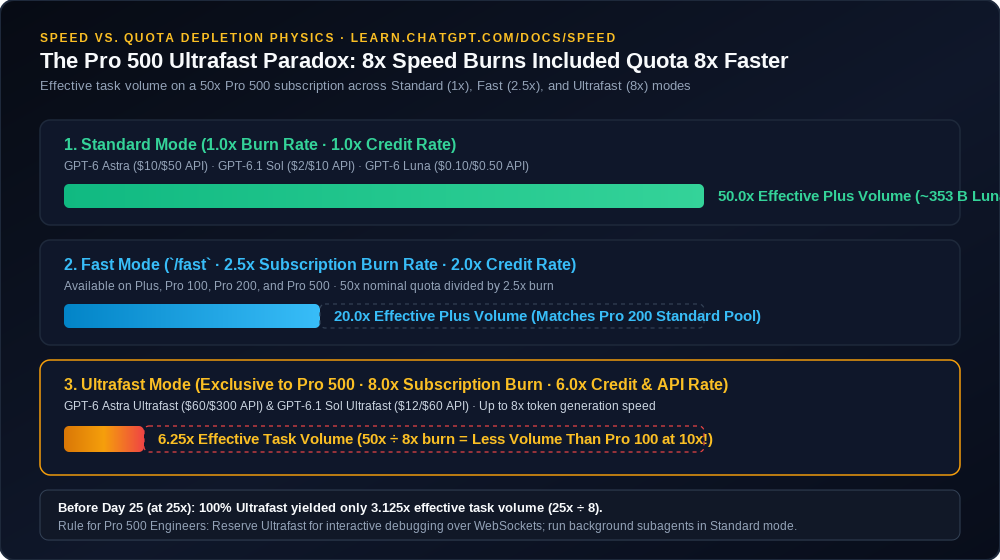
Effective Task Volume Multiplier = Nominal Plan Multiplier (50x) ÷ Speed Mode Subscription Burn Rate (1x, 2.5x, or 8x)
Here is the official speed-mode burn table from learn.chatgpt.com/docs/pricing:
| Speed Mode | Supported Models | Speedup vs. Standard | Included Subscription Quota Burn Rate | Purchased Credits & Enterprise Pay-As-You-Go Burn | Effective Task Volume on Pro 500 (50x Pool) |
|---|---|---|---|---|---|
| Standard Mode | All Models (Astra,
Sol, Terra, Luna) |
1.0x (+50 % Day 1 boost) | 1.0x | 1.0x | 50.0x Plus Volume |
Fast Mode
(/fast) |
GPT-6 Astra,
6.1 Sol, 6.1 Terra, 6 Sol,
6 Luna |
~1.5x to 2.5x | 2.5x | 2.0x | 20.0x Plus Volume
(50x / 2.5) |
| Ultrafast Mode | GPT-6 Astra Ultrafast,
GPT-6.1 Sol Ultrafast |
Up to 8.0x | 8.0x | 6.0x
($60/$300 Astra, $12/$60 Sol) |
6.25x Plus Volume
(50x / 8.0) |
Look at what that 8x subscription burn rate means in practice: -
Why the 25x Launch Limit Was Unusable with Ultrafast:
When Pro 500 launched at 25x before Day 25, running
Ultrafast mode at an 8x burn rate gave a $500 subscriber only
25x / 8 = 3.125x effective Plus volume.
You could pay $500 / month and exhaust your entire weekly quota after
doing less total coding work than a $100 Pro 100 subscriber
(5x). That arithmetic explains why Pro 500 adopters hit
rate limits so quickly in October and why OpenAI had to double the
ceiling to 50x. - Even at 50x, 100 % Ultrafast Yields Only 6.25x
Volume: With the Day 25 doubling to 50x,
continuous Ultrafast execution yields
50x / 8 = 6.25x effective task volume
(roughly 1.19 billion Astra tokens or
5.4 billion GPT-6.1 Sol tokens per month). That is still
less total token volume than a $100 Pro 100 seat running in
Standard mode (10x). - Subscription Burn
(8x) vs. Credit / API Burn (6x): Notice that Ultrafast
penalizes included subscription usage (8x) more heavily
than purchased credits or API usage (6x, where GPT-6.1
Sol Ultrafast costs $12 / MTok input and
$60 / MTok output vs. $2 / $10 Standard). -
The Hybrid Routing Rule for Pro 500: Never set
service_tier = "ultrafast" globally for background subagent
swarms, test-runner loops, or repo-wide indexing. Reserve Ultrafast
strictly for interactive live debugging, incident response, and
synchronous human-in-the-loop coding where 8x token streaming
speed keeps an engineer in flow, and keep background tasks on
GPT-6.1 Sol Standard (1x burn) or GPT-6 Luna
Standard.
5. Three Pools for One Price: Work + Codex, Persistent Cloud “Dots”, and 100 % Matched API Credits
The most underappreciated part of OpenAI’s October 2026 subscription architecture is that a paid Pro 100, Pro 200, or Pro 500 seat no longer buys a single quota bucket. Instead, it unlocks three distinct compute and billing pools (plus zero-burn Auto-review):
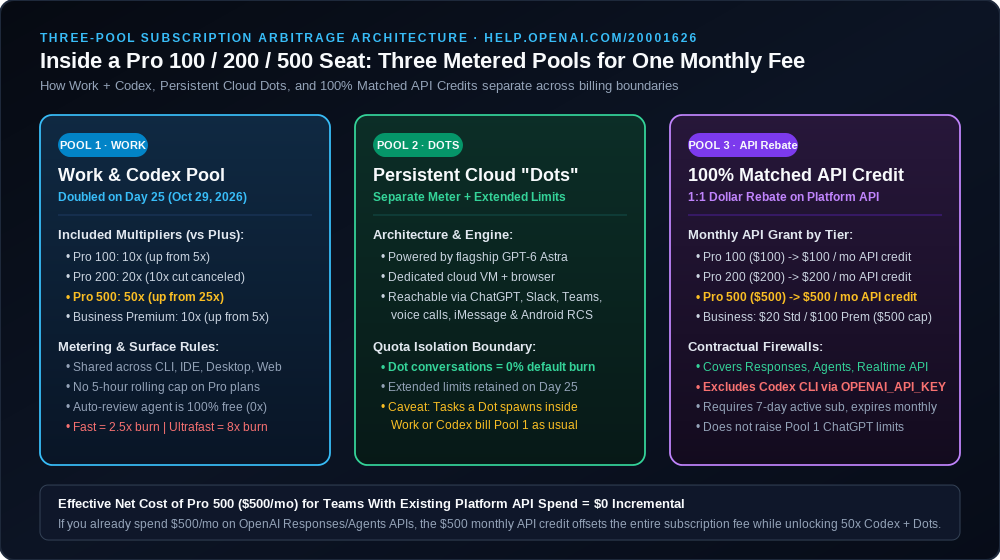
Pool 1: Shared ChatGPT Work & Codex Pool (10x / 20x / 50x + Free Auto-Review)
- No 5-Hour Rolling Cap on Pro Plans: As documented
in
learn.chatgpt.com/docs/pricing, while ChatGPT Plus ($20) and Standard Business seats enforce rolling 5-hour local message windows (45 to 300messages on GPT-6 Astra,150 to 1,000on GPT-6.1 Sol, and350 to 3,000on GPT-6 Luna), Pro 100, Pro 200, and Pro 500 plans currently have no 5-hour rolling limit, drawing directly from their broader weekly/monthly pool. - Sign in with ChatGPT Across External Harnesses: Unlike competitors that block third-party CLI harnesses, OpenAI officially supports Sign in with ChatGPT across Codex CLI, VS Code, desktop apps, and partner agents including OpenCode, Pi, Amp, and Devin.
- Free Auto-Review Agent (Day 2 Upgrade): Announced
on Day 2 of the shipping sprint and documented in
learn.chatgpt.com/docs/sandboxing/auto-review, enablingSettings -> Permissions -> Auto-reviewspawns a secondary safety-and-alignment reviewer agent that inspects every command and file action of your primary Codex agent and counts 0 % against your plan usage.
Pool
2: Persistent Cloud “Dots” (@yourname-dot on GPT-6
Astra)
In his October 29 post, Sottiaux specifically noted: “We’re also going to continue offering extended limits for dots for now, and usage of your dot will still continue to be separate from your default usage.”
According to OpenAI’s Meet Dots documentation
(learn.chatgpt.com/docs/dots): - What a Dot
Is: A Dot is an always-on, persistent cloud agent powered by
GPT-6 Astra with its own cloud computer, browser,
persistent memory, and handle (such as @tibo-alfred). It
works between conversations even when your local workstation is powered
off, and can be messaged or called via ChatGPT desktop/mobile, Slack,
Microsoft Teams, voice calls, and (as of Day 24, October 28)
iMessage on iOS and RCS on Android. -
Eligibility: Available on Pro 100, Pro 200, Pro
500 (for users 18+ outside the EEA, UK, and Switzerland),
Business Premium (worldwide), and
Enterprise (worldwide, admin-enabled). - The
Quota Isolation Rule (And Its Catch): Direct conversations,
proactive research, memory synthesis, and scheduling with your Dot
do not count toward your ChatGPT or Codex usage limits.
In addition, the first-month “extended limits” window for deeper Dot
work has been extended indefinitely per Sottiaux’s Day 25 update.
However, any sub-tasks that your Dot explicitly
launches or manages inside ChatGPT Work or Codex draw from your
Pool 1 Work/Codex allowance as usual.
Pool 3: The 100 % Matched Monthly API Credits Benefit ($100, $200, or $500 / Month)
Perhaps the single biggest economic shift in OpenAI’s current Pro structure is documented in OpenAI Help Center Article #20001626 (“API credits benefit for eligible ChatGPT subscriptions”).
Every eligible paid Pro 100, Pro 200, Pro 500, and Business subscriber (whose subscription has been active for at least 7 days) can claim a recurring monthly OpenAI API credit grant that matches 100 % of their Pro subscription fee:
| Subscription Plan | Monthly Subscription Fee | Included Work & Codex Pool | Monthly Free OpenAI API Credit Grant | Net Subscription Cost If You Already Spend That Amount on the OpenAI API |
|---|---|---|---|---|
| ChatGPT Plus | $20 / mo | 1x (5-hr + weekly cap) | $0 / mo (Excluded) | $20 / mo |
| ChatGPT Pro 100 | $100 / mo | 10x (No 5-hr cap) + Dot | $100 / mo API Credits | $0 / mo incremental |
| ChatGPT Pro 200 | $200 / mo | 20x (No 5-hr cap) + Dot | $200 / mo API Credits | $0 / mo incremental |
| ChatGPT Pro 500 | $500 / mo | 50x + Ultrafast + Dot | $500 / mo API Credits | $0 / mo incremental |
| Business Standard | $20–$25 / seat / mo | 1x per seat | $20 / seat / mo (Pooled, $500 workspace cap) | $0–$5 / seat / mo incremental |
| Business Premium | Premium seat tier | 10x per seat + Dot | $100 / seat / mo (Pooled, $500 workspace cap) | Offset up to $500 / mo workspace cap |
Before you build an arbitrage pipeline around those free API credits,
verify the four contractual firewalls enforced by OpenAI: 1.
Codex via API Key Is Excluded: You
cannot use these free monthly API credits to run the
Codex CLI or IDE extension authenticated via
OPENAI_API_KEY. They apply strictly to the OpenAI API
Platform (Responses API, Agents SDK, Realtime API, Images API, and
built-in tools like web search and file search) for building your own
applications and internal pipelines. 2. No Rollover:
Credits expire at the end of each monthly billing cycle (or annual cycle
for annual Business workspaces). 3. Same-Email Ownership
Link: To claim the credit, your ChatGPT account and your OpenAI
API Platform account must share the same email address, you must be an
Owner of both the subscription and the target API organization, and you
must explicitly link them in Billing Settings after 7 days of paid
tenure. 4. Separate from ChatGPT Quotas: The API
credits do not raise your signed-in ChatGPT web or Codex subscription
limits; they fund your linked platform.openai.com
organization directly without requiring a separate credit card on the
API account.
6. Operational Playbook: How to Configure Pro 100, Pro 200, and Pro 500 Today
With the October 29 doubling in effect, here is how engineering teams
and solo builders should allocate seats and configure
config.toml to extract every dollar of compute value:
- Choose Your Tier by Volume, Not Per-Dollar
Discount: Because Pro 100 (
10xfor $100), Pro 200 (20xfor $200), and Pro 500 (50xfor $500) now share the exact same $10.00 per 1x Standard-mode unit price and the exact same 100 % API credit match, upgrading from Pro 100 to Pro 200 or Pro 500 is purely a question of weekly token volume and whether you need interactive Ultrafast mode on Pro 500. - Claim and Burn Your 100 % Matched API Credits Every Billing
Cycle: Link your Pro 100/200/500 account to your
platform.openai.comorganization immediately after day 7. Route your application backends, automated CI evaluation suites (Promptfoo/ OpenAI Evals), document ingestion pipelines, and custom Responses API agents through that organization so the $100 / $200 / $500 monthly credit zeroes out your production API bill before expiration. - Keep Codex Defaulted to
gpt-6.1-solat Standard Speed (1x Burn): In Codex and ChatGPT Work, GPT-6.1 Sol costs 5x fewer credits than GPT-6 Astra (50 creditsvs.250 creditsinput;2.5 creditsvs.25 creditscached input, a 10x advantage on cached context reads) and carries zero long-context surcharge above 272k tokens. Usegpt-6.1-solat Standard speed for 90 % of multi-file implementation and test-repair loops, toggle/fast(2.5xburn) only when waiting interactively, and toggle Ultrafast (8xburn) on Pro 500 only during live incident debugging or synchronous pair-programming over WebSockets. - Offload Asynchronous Research and Coordination to Your Cloud
Dot: Because conversations, web research, and monitoring inside
your Dot (
@yourname-dot) run on GPT-6 Astra without consuming your default Work and Codex quota pool, assign continuous issue triage, PR spec drafting, Slack/Teams thread tracking, and literature synthesis to your Dot, and reserve your 10x / 20x / 50x Codex pool for actual repository execution. - Enable Free Auto-Review Instead of Burning Primary Agent
Turns on Permission Prompts: Turn on
Settings -> Permissions -> Auto-reviewin Codex. Because the secondary reviewer agent does not count against your plan usage, it eliminates manual approval bottlenecks on long-running refactors at zero token cost. - Prune Inactive MCP Servers and Nest
AGENTS.mdFiles: As OpenAI explicitly warns in its Codex usage optimization guide, every connected MCP server injects tool schemas into every turn’s prompt context. Disable unused MCP servers and nest directory-scopedAGENTS.mdfiles so your 10x, 20x, or 50x allowance goes toward reasoning and code generation rather than re-evaluating static tool definitions.